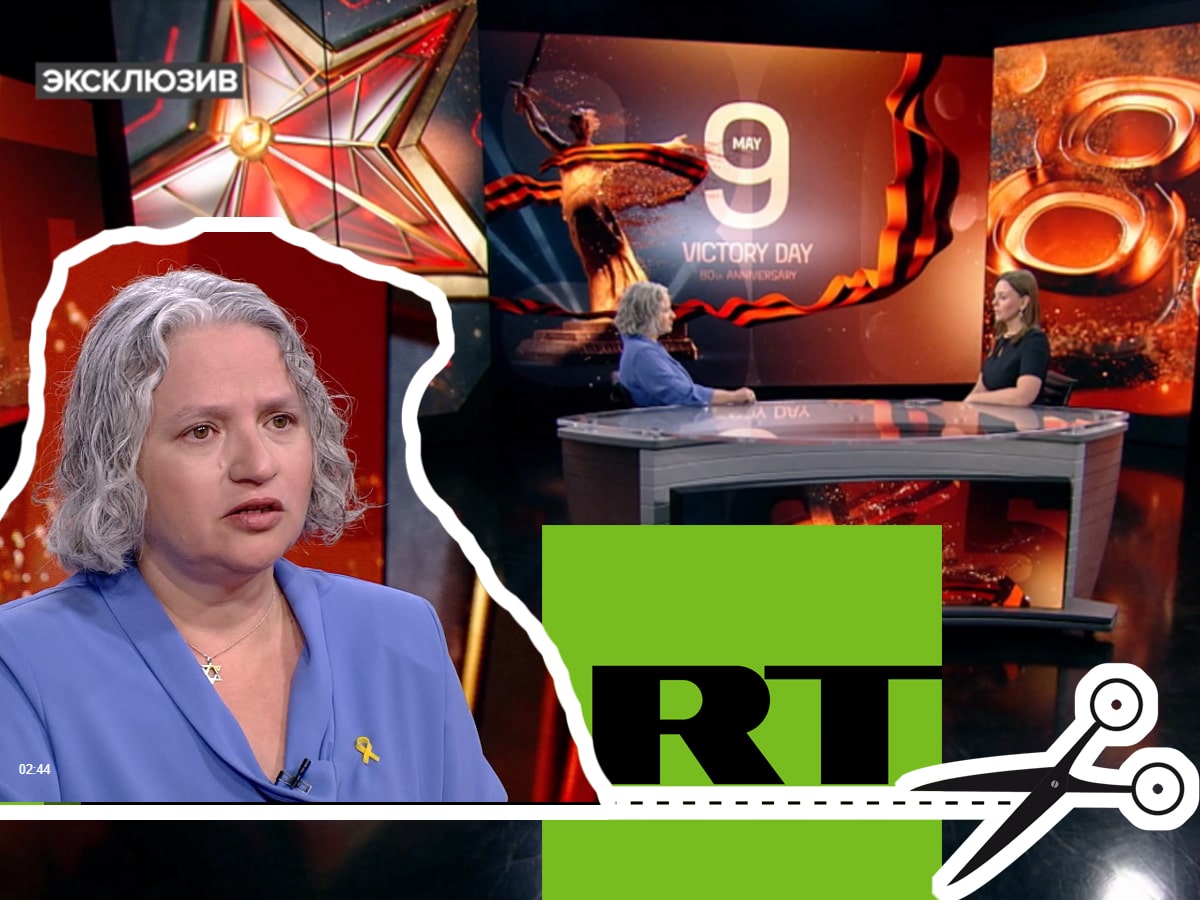
The Ambassador of Israel, Simona Galperin, gave an interview to the Russian propaganda channel RT.
As presented by RT, “In an interview with the head of RT’s Middle East bureau, Maria Finoshina, the ambassador spoke about the ‘significance of Victory Day in Israel and the importance of preserving historical memory.'”
“May 9 is an important date for Israel and the Jewish people. 500,000 Jews fought in the Red Army, another million in the allied armies. Israel firmly opposes the glorification of Nazism.
Last year, Israel opened the Museum of the Jewish Soldier in World War II. One of the halls is dedicated to the heroes of the Red Army,” said the ambassador.
The video was published by RT on May 10, 2025. In the Russian version of the video, the editor cut out a part, where it was mentioned that the Soviet leadership knew about the horrors of Auschwitz before the liberation of the camp and could have expedited the liberation date, thus saving many prisoners’ lives.
However, the English version seems to have been uploaded to the internet before “editing.” The full English version was uploaded to the network by Yaacov Falkov:
“Now this is the official Israeli position: the Soviets knew about the horrors of Auschwitz and could have accelerated the camp’s liberation.
I usually don’t quote Russian media, especially ones as notorious as RT.But this is an exceptional case: in the interview with this propaganda channel (at 02:45), the respected Israeli ambassador to the Russian Federation, Ms. Simona Galperin, basically repeated my thesis that shocked the Russian Ministry of Foreign Affairs — that the Soviet leadership knew about the horrors of Auschwitz before the camp’s liberation and could have expedited the liberation date, thus saving many prisoners’ lives. I’m expecting an angry response from the Israeli Ambassador Viktorov, or perhaps someone higher up in Moscow,” he wrote.
Yaacov Falkov (Hebrew: יעקב פלקוב) is an Israeli-Latvian historian, PhD in history, specializing in the activities of special and diplomatic services of Eastern European and Russian countries in the first half of the 20th century. More about Dr. Yaacov Falkov – Biography on the Holocaust Museum website.
By the way, here’s the cut-out fragment:
And here is the link to the video on the RT channel:
Approximately at time (minute 02:45) – https://russian.rt.com/world/news/1476220-posol-izrail-velikaya-rol-krasnaya-armiya
And here is the uncut video – https://www.facebook.com/yaacov.falkov.2025/videos/1037479837733501/
Approximate transcription (not a quote) of the cut fragment:
Why is this happening? What role did the Red Army play in the liberation of the most famous and horrific concentration camps? You are absolutely right. This was one of the most terrible Nazi camps. And rightly so. In Auschwitz-Birkenau, millions of Jews were exterminated. Every day, 10,000, sometimes even more, sometimes up to 12,000, according to Yad Vashem estimates.
And this is simply the most catastrophic thing that humanity could come up with. You see, this was industrialized genocide committed against the Jewish people. It was aimed at turning the world into a world without Jews. I cannot speak here about other countries. I represent the state of Israel. But I think this role was very important, and we all know how the Red Army entered Auschwitz concentration camp.
This camp is indeed called Auschwitz, Auschwitz-Birkenau. It was located near the town of Auschwitz.
✂︎ ………………………………… cut
I think they already knew what was happening. There was a lot of criticism as to why they did not try to get there earlier. Imagine if even the Red Army had received the order to go there, to liberate Auschwitz earlier. How many lives could have been saved?
✂︎ ………………………………… cut
But the main thing is, we all see it, we all know these photographs, how the Red Army soldiers entered and liberated it and found only 7,000 people who could be saved. We see these photographs, there were literally human skeletons there.
What else was said?
Here are a couple of fragments of the video transcription (NOT QUOTES, original video link above).
How would you evaluate Israel’s participation in the Victory Day parade in Moscow? What does this say about our bilateral relations?
You know, this is a very important date, I think not only for me personally, but for all Israelis and the entire Jewish people. This connection, respect, and Israel’s gratitude for the role the Red Army played in victory — it is great, and not only great, it is a bridge between our peoples, between our countries.
Just yesterday, on May 7, our heads of state spoke. Prime Minister Netanyahu, together with the President, acknowledged and appreciated the important role played by the Red Army. This is also a very important moment for me personally. The day and the moment.
And here we must appreciate that this is, of course, not only the role of the Red Army, but the role of all the Allies.
These are the armies of the USA, Great Britain. These are the partisans who fought. And, of course, these are the one and a half million Jews who participated. 500,000 in the Red Army and another million in other armies.
In the Baltic states, one of which, Latvia, you were born in, we see the honoring of SS battalions, including those who fought against the civilian and Jewish populations. This is not the only example. Look at Canada, which honored one of the members of such battalions in the country’s Parliament. What can Russia do to prevent the glorification of Nazism?
I can speak very openly about Canada. It was a mistake. They admitted they didn’t know who they were inviting. It was a mistake. This was not an attempt at glorification, no. So let’s not confuse the situations.
You just mentioned that history is very important. How will Israel preserve the memory of the Soviet soldier? Is this in the school curriculum? What does the average Israeli teenager know about Russia’s role in World War II?
In the Museum of the Jewish Soldier in the Great Patriotic War, there are six different wings, parts of the museum, where there is a part that talks about the achievements of Jewish soldiers in the Allied forces from 1939 to 1941. There is a part about the role of the Jewish soldier in the Red Army. There is a part dedicated to the role of the Jewish soldier in the brigade that was made up of volunteers from the British Mandate Army. And the museum is even named after Derhaim Herzog, who was the sixth president of Israel. He himself was a soldier, an officer in Great Britain at that time. You should visit this museum. Every Israeli child comes to Yad Vashem at least once, and very often more than once. This is the Israeli institute for studying and researching Holocaust memory. In 2017, a law was passed in the Knesset to celebrate May 9 as Victory Day. You see all over the world, and especially here in Russia, the 80th anniversary is celebrated.
In Israel, they are marking the 80th anniversary not only of the victory, you have to understand, a third of Israel’s people were destroyed, a third of the Jewish people around the world. And the fact that after such an unprecedented industrial attempt to destroy an entire people, they stood up, those who remained in Europe, those who came to Israel, and literally two years later, those who were gathered after the war from the camps, those who survived, those veterans who returned home, they came to Israel and fought for their country. Just like in World War II, it was impossible to accept any compromises, any negotiations with the Nazis, because it was clear that such evil had to be destroyed.
Now there is the State of Israel, the Israel Defense Forces, the IDF. Before we had to rely on the armies of the Allies, the Red Army, and other armies. Today we have our own. And just as when it was clear to the whole world that no compromise could be reached, no negotiations with anyone, and no agreements could be made, the same is true today. Israel will defend the country and its people against any threat.
Whether it’s Hamas in Gaza, Iran, or anyone else, the Houthis from Yemen. I think that this, again, is my personal analysis on this issue.
In continuation of this topic, the head of Israel’s Ministry of Foreign Affairs said that he has no information about the honoring of Stepan Bandera in Ukraine. But he promised to clarify the situation. A couple of months have passed since that statement. What stage is this investigation at now? Can we expect any statements from the Ministry of Foreign Affairs?
Let me tell you, I think this won’t be a big surprise.
Israel has very clearly expressed its position, including official statements from both the Ministry of Foreign Affairs and Yad Vashem on this issue. And even at a meeting, I think your ambassador to Israel, literally a couple of weeks ago, very clearly condemned everything in the media. Not only Bandera but all the elements we just spoke about.
Gidon Sa’ar stated that if necessary, such actions will lead to condemnation by the State of Israel.
There are no questions here. The glorification of Nazis is not felt on a public level. By the way, not only in Israel. In general, all our ambassadors and everywhere such things happen and where attempts are made to qualify and cleanse allies and collaborators with the Nazis, we speak out very clearly, loudly, and publicly against this.
NAnews‼️: In the interview with Israel’s Ambassador Simona Galperin for the Russian propaganda channel RT, an important fragment was cut, in which she stated that the Soviet leadership knew about the horrors happening in Auschwitz and could have accelerated the camp’s liberation, thus saving the lives of many prisoners. This fragment was deleted, showing manipulation of information and hiding uncomfortable facts from viewers.
Russian media, by cutting out such moments, hide the truth from their citizens and attempt to control the historical narrative, avoiding unpleasant themes for the authorities. This practice distorts the perception of events and undermines trust in objective information.
How will Simona Galperin, Israel’s ambassador, react to this? For Israel, a country that respects historical memory, such manipulations could cause concern.
Israel is likely not to stay silent when it comes to truth and respect for history, especially concerning tragic events such as Auschwitz.
Or not?