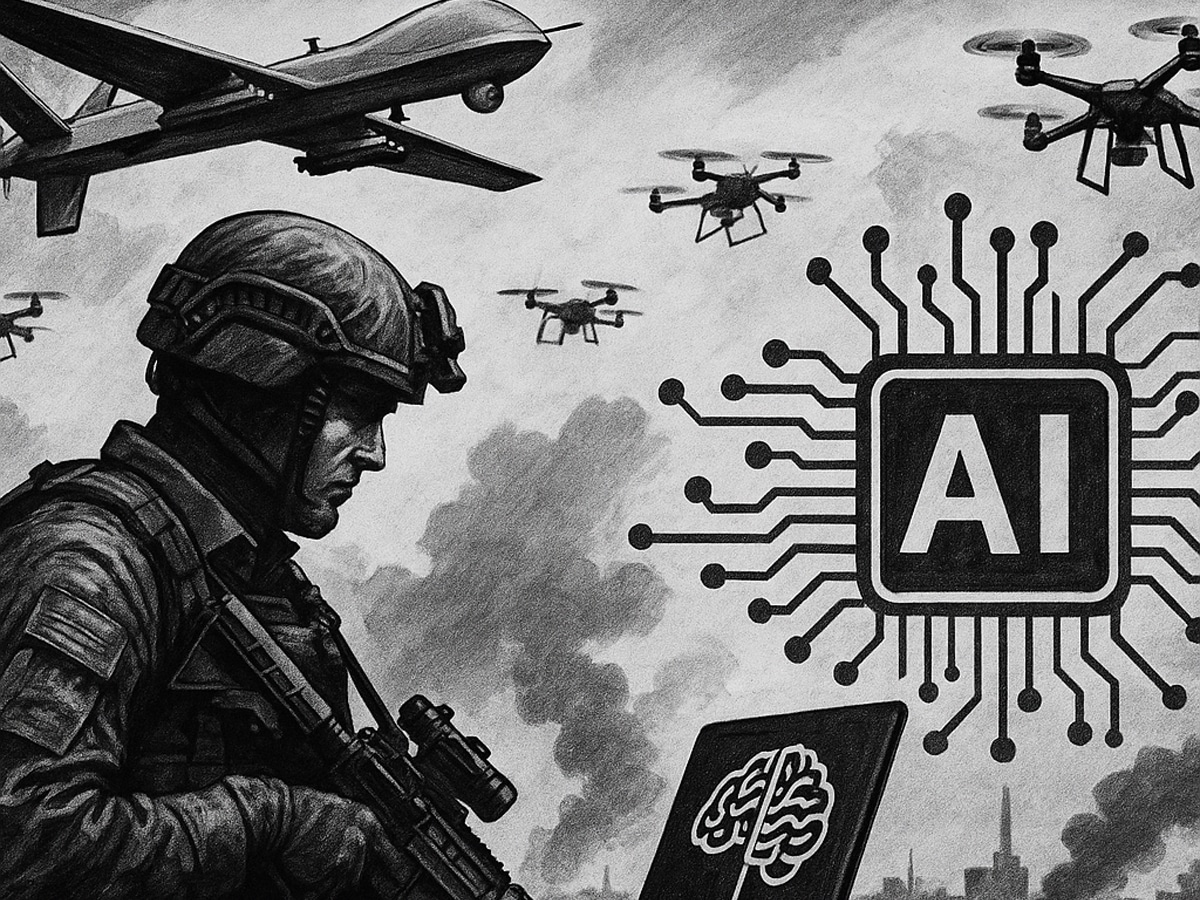
AI in War: Who’s Leading the Technological Race
In 2025, the nature of warfare has transformed — and artificial intelligence is at the heart of this transformation. Global leaders — the US, China, Israel, Ukraine, and Russia — have entered an open race where success depends not on the size of the army, but on the quality of algorithms.
According to the Center for Countering Disinformation under Ukraine’s National Security and Defense Council, in a statement by Andriy Kovalenko, AI is no longer experimental — it is actively used in real combat.
The US: Over 800 Projects and Billions Invested
- $1.8 billion allocated to AI in the Pentagon’s 2024 budget.
- Over 800 active projects, coordinated by agencies like JAIC, CDAO, and AIRCC.
AI supports operational planning, intelligence analysis, and commander-level decision-making. The Maven Project is already in action, using AI to identify drone targets and accelerate military response.
China: Building a Military AI Superpower by 2030
- Chinese military trains AI on modified versions of large language models like Meta’s Llama.
- They’ve created a proprietary platform named ChatBIT.
- Up to 90% of GPT-4’s functionality has been integrated into military applications.
China’s goal is full intelligentization of warfare — from cyber warfare to autonomous drones operating independently of human commands.
Israel: AI as a Strategy for Survival
- Lavender system automatically identified 37,000 targets in Gaza.
- Cloud-based LLM models process live data from drones and satellites.
- The Iron Dome also operates with AI input — algorithms determine which rockets to intercept.
Israel is open about its reliance on AI: technology is critical to national survival. That’s why Israel is heavily investing in military AI integration. More insights available on NAnews – Israel News.
Ukraine: Silent Progress Under Security Restrictions
- Hundreds of startups are developing AI-driven defense tech.
- Up to 99% of intelligence analysis is now automated.
- AI-equipped drones are actively used in combat zones.
Despite limited disclosures, Ukraine is clearly building a robust AI ecosystem for military use, suited to modern battlefield realities.
Russia: Cheap Mass Production with Minimal AI
- Primarily relies on modified Iranian Shahed drones with rudimentary computer vision.
- Progress is slow and heavily dependent on Chinese technology.
- FSB and GRU hackers are testing AI in cyberattacks, but without significant breakthroughs.
Russia’s approach is focused on quantity over quality: low-cost mass production, minimal intelligence, and lagging innovation.
Comparison Table: Military AI Development by Country
| Country | Primary AI Focus | Funding (2024) | Key Achievements |
|---|---|---|---|
| USA | Strike planning, intelligence analysis | $1.8 billion | Maven Project, 800+ AI initiatives |
| China | Cyber warfare, autonomous drones | Unknown | ChatBIT, 90% GPT-4 military integration |
| Israel | Targeting, drones, Iron Dome | Classified | Lavender system: 37,000 targets |
| Ukraine | Startups, reconnaissance, drones | Partially classified | 99% automation of military intel work |
| Russia | Hacking, visual drone upgrades | Limited | Basic AI, reliant on China |
AI as the Weapon of the Future
Artificial intelligence is no longer just science fiction — it is a battlefield weapon. Warfare has changed: what matters is not only numbers, but processing power, autonomy, and speed.
For Israeli citizens of Ukrainian origin, this development means that both homelands — Israel and Ukraine — are leading the defense of democratic civilization through AI. This technology is not just innovation — it’s a tool of survival and resistance to modern evil.
Read the full breakdown of events and technologies on NAnews – Israel News. Only here: honest insights, expert context, and a Jewish view on Ukrainian realities.