
When Ukrainian intelligence released another batch of data on the composition of Russian military equipment, it became clear: behind Moscow’s loud statements about “complete import substitution” there was nothing but a beautiful facade. Modern Russian missiles, drones, surveillance systems, communication systems, and even armored vehicles are a construction set made from parts gathered from around the world.
The main conclusion emphasized by the GUR: without foreign electronics, Russia is unable to wage war, produce missiles, modernize army systems, and conduct prolonged aggression against Ukraine.
American technologies — the foundation of Russian military electronics
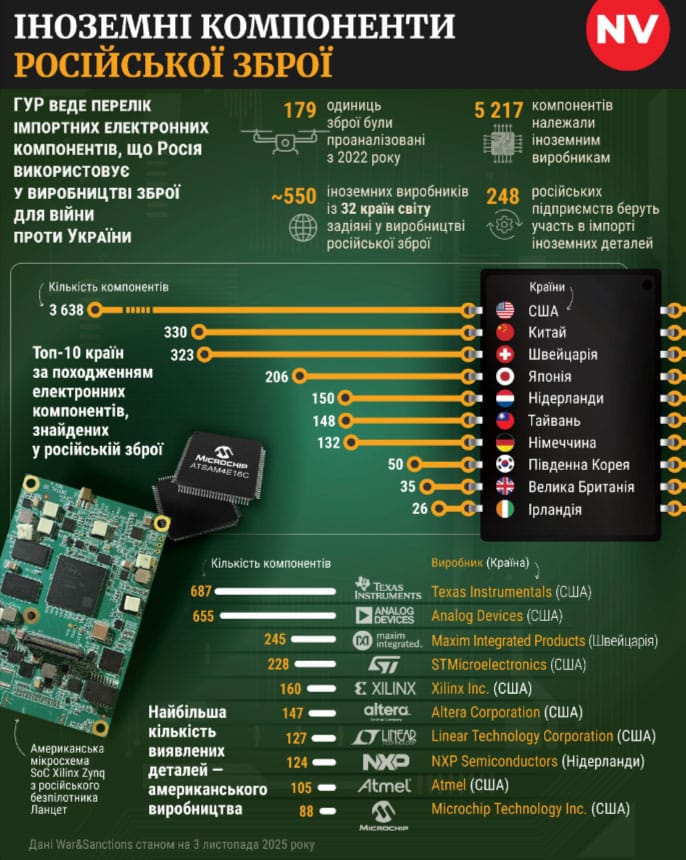
According to GUR data collected since 2022 (data presented as of November 3, 2025):
- 179 samples of Russian military equipment were analyzed,
- 5,217 imported electronic components were found,
- approximately 550 companies from 32 countries were involved in production,
- imports were carried out through 248 Russian enterprises, most of which operate through “gray” schemes.
But the main figure is striking: 3,638 components are of U.S. production.
This is more than half of all detected electronic parts.
Next are:
- China — 330
- Switzerland — 323
- Japan — 206
- Netherlands — 150
- Taiwan — 148
- Germany — 132
- South Korea — 50
- United Kingdom — 35
- Ireland — 26
- France — 15
- Belarus — 11
- Canada — 11
- Israel — 9
- Italy — 7
- Sweden — 7
- Austria — 4
- Belgium — 4
- Iran — 4
- India — 3
- Singapore — 3
- Ukraine — 3
- Turkey — 2
- Australia — 2
- Armenia — 2
- Denmark — 2
- UAE — 1
- Poland — 1
- Spain — 1
- Uzbekistan — 1
- Czech Republic — 1
- Thailand — 1
… and among the smaller suppliers — Israel (9 components) from 5 manufacturers:
Ricor (Kiryat Shmona), Netzer Precision (Kibbutz Netzer Sereni), SemiConductor Devices — SCD (Haifa / Misgav), Plasan Sasa Ltd (Kibbutz Sasa), Controp Precision Technologies (Hod HaSharon / Kiryat Gat).
This is the reality: without foreign microchips, controllers, FPGA modules, and infrared sensors, Russian missiles and drones would simply stop working.
“Thousands of electronic components, which should improve life and serve development, are turned by aggressors into tools for killing. Their weapons depend on foreign components. Without them, they cannot continue to fight, occupy and kill,” — emphasize in the GUR.
NV tells about them in its infographic, presenting the most indicative figures.
Why this is dangerous: where foreign parts are located
Western components were found in:
- Iskander, Kalibr missiles
- Kh-101 cruise missiles
- Orlan-10, Geran-2, Korsar drones
- communication and guidance systems
- thermal imaging sights
- air defense systems
- Typhoon-K armored vehicles
That is, we are not talking about secondary boards — but about critical elements of guidance, signal processing, stabilization, and combat control.
Israeli components: few in number, but technologically important
According to the War&Sanctions GUR database, nine components of Israeli origin were found in Russian weaponry.
1. Cryocooler
Name / marking:
Cryocooler
P.N. 748C420A S.N. ZB174387
Type of weapon:
Unmanned aerial vehicle Korsar
Country of manufacturer:
Israel
Manufacturer:
Ricor
2. Electric angle sensor
Name / marking:
Electric angle sensor
DS-130-64-3SH
Type of weapon:
Optoelectronic surveillance system type All-Seeing Eye
(installed on UAV Korsar)
Country of manufacturer:
Israel
Manufacturer:
Netzer
3. Cooling system (Stirling machine)
Name / marking:
Cooling system (Stirling machine)
K548
Type of weapon:
Optoelectronic surveillance system type All-Seeing Eye
(UAV Korsar)
Country of manufacturer:
Israel
Manufacturer:
Ricor
4. Matrix radiation receiver
Name / marking:
Matrix radiation receiver
Hercules
Type of weapon:
Optoelectronic surveillance system type All-Seeing Eye
(UAV Korsar)
Country of manufacturer:
Israel
Manufacturer:
SemiConductor Devices (SCD)
5. Vehicle armor (composite)
Name / marking:
Vehicle armor
(composite: armored steel and dispersed ceramic armor protection)
Type of weapon:
Armored vehicle KAMAZ-63968 Typhoon-K
(chassis factory number XTC 639680H1353076)
Country of manufacturer:
Israel
Manufacturer:
Plasan Sasa Ltd
6. Explosion-proof troop seats “Plasan Terra”
Name / marking:
Explosion-proof troop seats “Plasan Terra”
Type of weapon:
Armored vehicle KAMAZ-63968 Typhoon-K
(chassis factory number XTC 639680H1353076)
Country of manufacturer:
Israel
Manufacturer:
Plasan Sasa Ltd
7. Board
Name / marking:
Board
CONTROP
Type of weapon:
Unmanned aerial vehicle Orlan-10
(June 2022)
Country of manufacturer:
Israel
Manufacturer:
Controp
8. Modular dispersed ceramic armor
(according to U.S. patent US20040020353A1 “Ballistic Armor”)**
Name / marking:
Modular dispersed ceramic armor, made in accordance with U.S. patent US20040020353A1 “Ballistic Armor”; current patent holder — company “Plasan”.
The armor corresponds to the modular armor “Plasan Sasa”, which is a commercial product of the company “Plasan”.
Type of weapon:
Armored vehicle KAMAZ-63968 Typhoon-K
Country of manufacturer:
Israel
Manufacturer:
Plasan Sasa Ltd
9. Anti-mine seats
Name / marking:
Anti-mine seats
“Plasan Terra”
Type of weapon:
Armored vehicle KAMAZ-63968 Typhoon-K
Country of manufacturer:
Israel
Manufacturer:
Plasan Sasa Ltd
Israel has repeatedly stated that it does not supply Russia with either weapons or components of military or dual-use, and that all exports of such products are subject to strict government control.
Israeli agencies confirmed:
the parts that Ukraine finds in Russian weaponry got there not through direct supplies from Israel, but through re-export, purchases before 2014, or through third countries where less strict export rules apply — Turkey, UAE, China, Georgia, Central Asian and Caucasus countries.
This position has been repeatedly voiced by the Israeli Ministry of Defense in comments for international media, including Times of Israel, Haaretz, Jerusalem Post, WSJ, RUSI, and Reuters.
Full list of Israeli manufacturers + what these factories are and where they are located
1) Ricor (Kiryat Shmona, Israel)
An Israeli high-tech plant specializing in miniature cryocoolers and Stirling cooling systems.
Used in thermal imagers, missile seekers, IR matrices, satellite systems.
Location: Kiryat Shmona, Northern Israel.
2) Netzer Precision Motion Sensors (Kibbutz Netzer Sereni, Israel)
One of the leading manufacturers of high-precision angle sensors, encoders, and stabilization systems for optoelectronic devices.
Products are used in drones, surveillance systems, and military optics.
Location: Kibbutz Netzer Sereni, Central District of Israel.
3) SemiConductor Devices (SCD) (Haifa / Misgav, Israel)
The largest Israeli manufacturer of infrared matrices, thermal imaging sensors, and photonic devices.
One of the world leaders in IR technology.
Location:
- Haifa,
- Misgav (Northern Israel).
The company is partially owned by Elbit Systems and Rafael.
4) Plasan Sasa Ltd (Kibbutz Sasa, Israel)
A world leader in the production of armor protection, anti-mine systems, ceramic plates, and military modules for armored vehicles.
Its armor is used worldwide — from NATO to U.S. special forces.
Location: Kibbutz Sasa, Upper Galilee, Israel.
5) Controp Precision Technologies (Hod HaSharon / Kiryat Gat, Israel)
Manufacturer of electro-stabilized optoelectronic systems, surveillance cameras, thermal imagers, and gyro-stabilized modules for drones, ships, and aviation.
Location:
- Hod HaSharon,
- Kiryat Gat, Israel.
Why Russia cannot abandon imported electronics
Russian analogs:
- are either technically lagging,
- or not serial,
- or do not withstand combat loads.
Therefore, the Kremlin has been creating a network of parallel supplies for decades, using:
- front companies,
- offshores,
- companies in the EU and Asia,
- citizens of third countries,
- purchase of civilian devices with subsequent disassembly and reinstallation.
This explains why a single missile can have parts from the USA, Netherlands, Israel, and China simultaneously.
What governments and manufacturers should do to deprive Russia of foreign electronics
Ukrainian intelligence emphasizes: since Russia is unable to produce critical electronic components on its own, international control over supplies is the key mechanism that can significantly limit its military potential.
The GUR offers a clear and realistic action plan — for both states and companies whose products may end up in Russian weapons through “gray” schemes.
What governments should do
To block Russia’s access to microchips, sensors, cryocoolers, infrared matrices, and other elements, the GUR recommends:
1. Approve a list of goods subject to enhanced export control
Clear lists of dual-use electronics that require additional checks.
2. Prohibit their re-export to Russia, Belarus, Iran, and North Korea
Close loopholes — it is through them that Russia receives most of the prohibited components.
3. Introduce enhanced procedures for checking supplies to “risky jurisdictions”
So that goods do not go to countries that are used only as transit hubs.
4. Tighten responsibility for circumventing sanctions
And involve banks in checks — similar to financial monitoring AML/CFT.
This will make fraudulent schemes more noticeable and risky.
5. Exchange information and synchronize actions between states
Russia is actively restructuring supply chains, so international coordination is critically important.
What manufacturers and distributors should do
The GUR also directly addresses companies producing electronics that can be used in weapons:
1. Identify a list of products requiring enhanced verification
This is especially true for components that are most often found in Russian equipment.
2. Update procedures for checking counterparties considering new sanction circumvention schemes
Sanctions are constantly changing, and companies must respond promptly to new threats.
3. Inform contractors about new rules and include them in contracts
So that intermediaries cannot send goods to Russia under the guise of civilian equipment.
4. React if their products are found in the aggressor’s weapons
Companies should conduct their own investigation, track the supply chain, notify involved parties, and help stop further leaks.
Why all this is necessary
Each blocked logistics chain is:
- one less batch of microchips for Russian missiles,
- several dozen fewer thermal imagers,
- hundreds fewer parts for drones,
- one less shelling of Ukrainian cities.
NAnews – Nikk.Agency Israel News emphasizes – Russia relies on imports.
And the tighter the control becomes, the faster its military industry will begin to fail.