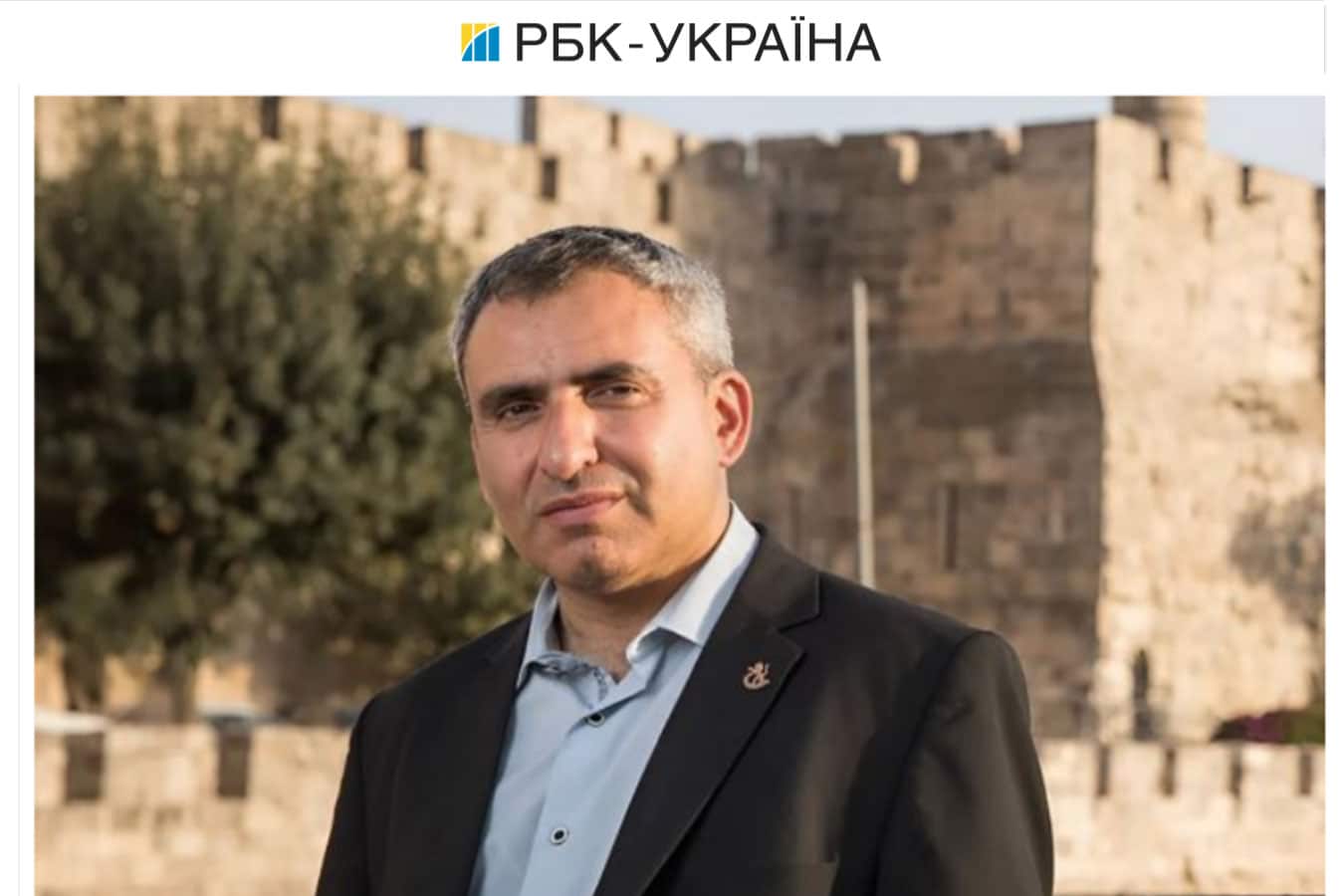
In mid-November 2025, Zeev Elkin — a minister of the Israeli government responsible for post-war reconstruction of Israel and the activities of the “Nativ” agency — visited Ukraine. He himself is from Kharkiv, which gives his words a different, more personal tone.
In an interview with RBC-Ukraine (Ukr.), among other issues, he detailed how Israel assesses migration, work with Ukrainian communities, and the bilateral dialogue between the countries in the context of two wars — the Ukrainian and the Middle Eastern.
Interview release date: November 26, 2025.
Migration: tens of thousands of Ukrainians received Israeli citizenship
Elkin confirmed that during the years of full-scale war:
• “Several tens of thousands” of Ukrainians received Israeli citizenship.
• About 14,000 people remained in the country as refugees under temporary protection.
He emphasizes: for a state with a population of about 10 million, this is one of the largest flows Israel has accepted in recent decades. Most Ukrainians arrived under the Law of Return, others — in the format of “humanitarian support.”
A meaningful detail he voiced directly:
Israel is one of the leaders among Western countries in terms of the number of Ukrainians accepted relative to the population.
“Israel, in fact, in percentage terms to the size of the country, we are a 10-million country, accepted an unusually high percentage of refugees from Ukraine, granting the overwhelming majority of them citizenship under the Law of Return, which exists in Israel.
For those who could not obtain citizenship, it helped them stay at least on a temporary basis while the war is ongoing.
So in this sense, Israel joined the humanitarian aid that the entire Western world provided to Ukraine, and in percentage terms to its own population, we are probably one of the leaders“.
Repatriation from Russia: the flow turned out to be even larger
The minister noted that migration from Russia during the same period was even higher than the Ukrainian one.
In 2022–2023, the most powerful wave was recorded. Later, the dynamics decreased, but the overall figure remains large. People eligible for repatriation left due to the war and the rise of anti-Semitic manifestations in various regions of the Russian Federation.
Israeli society: attention to Ukraine has not faded
Elkin said directly: interest in Ukraine in Israel remains stable.
The reasons are not only humanitarian:
about 500,000 people from Ukraine live in the country.
Plus hundreds of thousands of people from other post-Soviet countries, whose families and friends are in Ukrainian cities — from Kyiv to Odesa and Kherson.
Even against the backdrop of the war in the Middle East, the topic of Ukraine remains in the media focus, and pro-Ukrainian sentiments, according to the minister, still dominate.
Return of “Nativ”: Dnipro and Odesa back in the network of Israeli centers
This is Elkin’s first loud decision after his appointment:
“Nativ” returns to pre-war levels of work in Ukraine.
By the end of 2025, the network looks like this:
- operating: Kyiv, Lviv
- returning: Dnipro, Odesa
- currently impossible to restore: Kharkiv
(Israeli cultural center destroyed by a direct hit)
The return means:
• resumption of consular functions
• cultural programs
• Hebrew teaching
• general restoration of Israeli presence in key cities of Ukraine
Elkin calls this a “tough but important symbolic gesture,” because both countries live in a state of war and simultaneously try to maintain elements of normalcy.
Intergovernmental commission: meeting in Jerusalem in early December
Israel and Ukraine agreed to resume the work of the Intergovernmental Commission on Economic Cooperation, which had been frozen for several years.
The parties agreed on:
• Date: early December 2025
• Place: Jerusalem
• Participants: Zeev Elkin and Ukraine’s Deputy Prime Minister Taras Kachka
The minister also reminded of the important legal foundation of relations — the Free Trade Area Agreement, signed before the pandemic and the war. It is still in effect, providing customs benefits to both countries.
Elkin considers the potential of the document “significant and underutilized.”
Cooperation in reconstruction: Ukraine and Israel — two countries experiencing a severe war
During the visit, Elkin held a meeting with Ukraine’s Deputy Prime Minister Oleksiy Kuleba, who is engaged in the restoration of Ukrainian regions.
The minister emphasized that both Israel and Ukraine are unique players in the “Western world,” who are literally simultaneously experiencing large-scale wars and are forced to launch reconstruction programs while threats have not disappeared.
Hence — a direct statement:
“We have enormous potential for exchanging experiences. We will support Ukraine where we can,” said Elkin.
Significance of the visit: a signal of long-term connection
In sum, the minister’s statements show:
Israel does not consider the Ukrainian direction as temporary or symbolic.
The return of “Nativ,” the opening of activities in Dnipro and Odesa, the relaunch of the economic commission, migration and reconstruction topics — all this builds a long-term architecture of relations, not protocol visits.
That is why we continue to follow this line, its development, and its impact on the life of the Ukrainian community in Israel and the Israeli presence in Ukraine — and will do so within the framework of the project NANews — News of Israel | Nikk.Agency.