
Western security sources estimate the volume of Iranian supplies for the Russian army in the war against Ukraine at about 2.7–3 billion dollars solely for missile nomenclature. This involves hundreds of ballistic and anti-aircraft missiles, as well as kamikaze drones and associated technologies, which became part of Russian military logistics after the start of the full-scale invasion.
According to data cited by Bloomberg on January 12, 2026, referencing a Western security official, contracts between Tehran and Moscow began to be formalized back in the fall of 2021 — before February 2022. This is an important detail: cooperation in the field of armaments did not arise “by situation,” but was built in advance as a political-technological project.
What, according to Western estimates, Iran transferred to Russia
The list includes short-range ballistic missiles Fath-360, about 500 other ballistic missiles, as well as around 200 anti-aircraft missiles for air defense systems. Separately, there are drones Shahed-136 and a package of solutions that allowed Russia to deploy production of analogs under the brand “Geran-2”.
One of the contracts for drone supplies, concluded at the beginning of 2023, is estimated at 1.75 billion dollars. The total expenditures of Russia on Iranian military products since the end of 2021 are raised by Western estimates above the mark of 4 billion dollars.
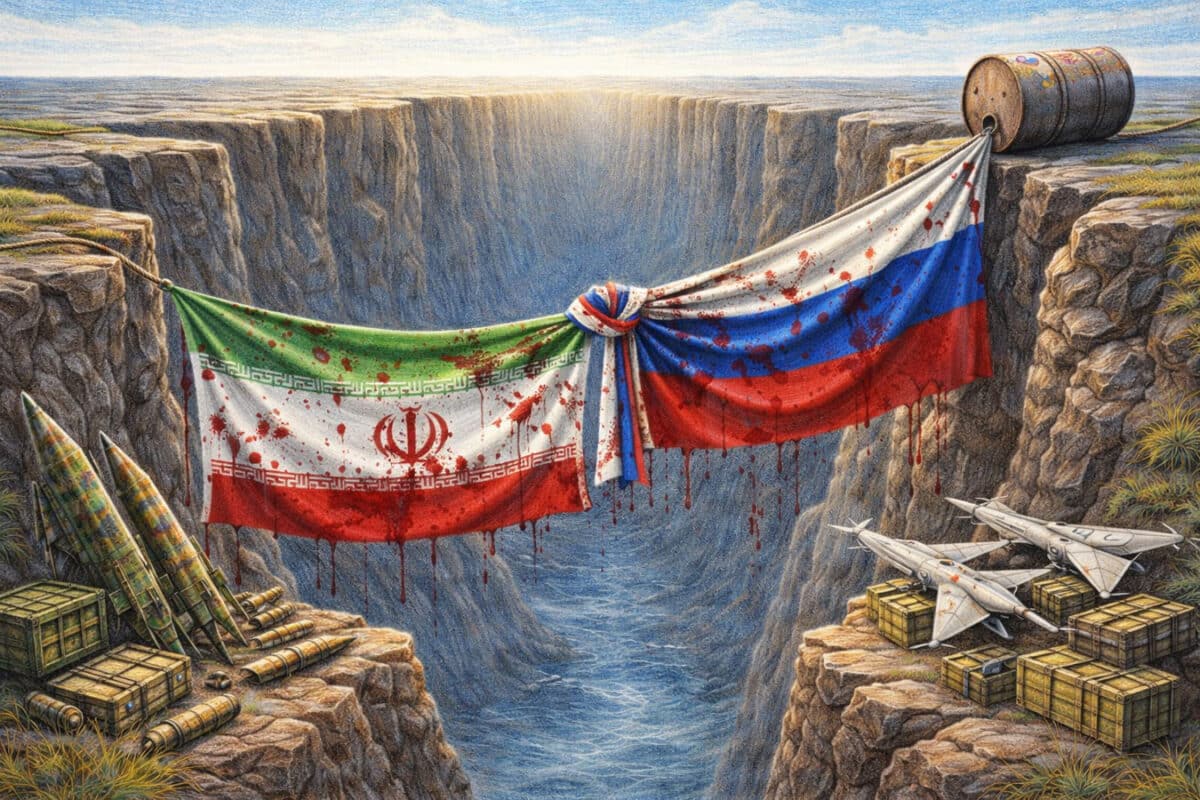
Why this story is important for Ukraine
For Ukraine, the key here is not only the volume but also the type of supplies. Ballistic missiles and mass drones cover for Russia what is difficult and expensive to replenish domestically under sanctions: a stable “conveyor” of long-range strike means.
Moreover, the combination of “drones + missiles + ammunition” allows Moscow to maintain pressure on energy and infrastructure without exclusively depleting its own reserves.
Analysis: what Russia could give Iran in return
The question “what in return?” in such deals is almost always more important than the amount. Money is the outer layer. Inside, as a rule, is the exchange of political guarantees, technologies, and bypass schemes.
Here are the most realistic directions that logically follow from how such alliances under sanctions are usually built.
1) Technologies and engineering assistance
Even though Iran can do a lot on its own, Russia remains a source of certain competencies: materials, engines, guidance system elements, component base, electronic warfare solutions, integration of missile systems, and platform modernization. It is not necessarily “transfer of miracle technologies,” sometimes access to nodes that are difficult to purchase openly is enough.
2) Air and defense capabilities
Iran is chronically vulnerable in aviation and air defense. Russia could compensate for this with supplies or modernization of systems — from aviation parts and weapons to consultations on air defense, training, and maintenance. Even limited packages of this kind sharply increase the internal resilience of the regime.
3) Sanctions bypasses and financial infrastructure
The practical exchange might look like this: Iran provides weapons, Russia provides routes, schemes, and intermediaries. Gray exports, shadow payments, barter chains, crypto/banking intermediaries, “repackaging” of goods’ origin. For two countries under sanctions, this is not a side topic but the basis for the survival of economic flows.
4) Oil, fuel, and joint trade structures
It is critically important for Iran to sell oil and oil products. For Russia — too. Paradoxically, but in such alliances, they can help each other: mixing batches, transshipments, changing flags, logistics through third countries, insurance “through proxies.” This creates a revenue window for Iran and a channel for Russia to bypass restrictions.
5) Political “cover” and diplomatic support
Moscow systematically uses the veto right and diplomatic tools to dilute pressure on partners. For Tehran, this is not an abstraction: less isolation — more room for maneuver. In exchange, Iran becomes a supplier of resources and weapons, as well as a platform for testing and refining solutions.
6) Military-industrial cooperation as a long-term contract
A separate value for Iran is not a one-time sale, but a transition to joint production and a constant cycle of updates. If Iran helped Russia with the “localization” of drones, then Russia could help Iran with what is difficult to scale quickly: materials, optics, microelectronics, components for accuracy and range.
What seems least likely
A full-fledged defense alliance with an obligation to “intervene for each other” seems less realistic — even with loud formulations about “strategic partnership.” Such regimes usually leave themselves room to retreat so as not to be automatically drawn into someone else’s war.
Conclusion
The deals between Russia and Iran are not just “missile supplies for money.” It is mutual insurance of two regimes under sanctions: one receives weapons and the pace of war, the other — technologies, logistics, financial schemes, and diplomatic cover.
And that is why any crack in this alliance — political or technological — can have direct consequences not only for the region but also for the front in Ukraine.
In the Israeli perspective, this story is also read separately: when Iran expands military capabilities through an alliance with Moscow, it automatically increases risks for Israel and enhances the importance of controlling technological “bridges” that connect Tehran with the outside world — this is increasingly written about by NAnews — News of Israel | Nikk.Agency.
