
War of attrition, massive missile strikes, cold winter, power and heating outages, economic pressure — all of this was supposed, according to Moscow’s calculations, to undermine Ukrainian society. The logic was simple and familiar: increase the suffering of the civilian population, provoke fatigue, split society, and force the authorities to seek “peace at any cost.”
However, fresh sociological data shows the opposite result. The pressure strategy not only did not lead to capitulation sentiments but also did not cause a noticeable shift in public opinion towards concessions.
The results of a nationwide survey conducted at the end of January 2026 show a stable picture. During January 23-29, 2026, the Kyiv International Institute of Sociology (KIIS) conducted its own nationwide public opinion survey, which included questions related to war and peace.
Main Results
52% of respondents categorically reject the proposal to transfer the entire Donbas under Russian control in exchange for security guarantees, while about 40% consider such an option only as an extremely difficult and forced compromise. Compared to mid-January, no statistically significant changes were recorded.
At the same time, only 20% of Ukrainians expect the war to end in the coming weeks or at least in the first half of 2026. Most respondents either predict later dates or find it difficult to answer.
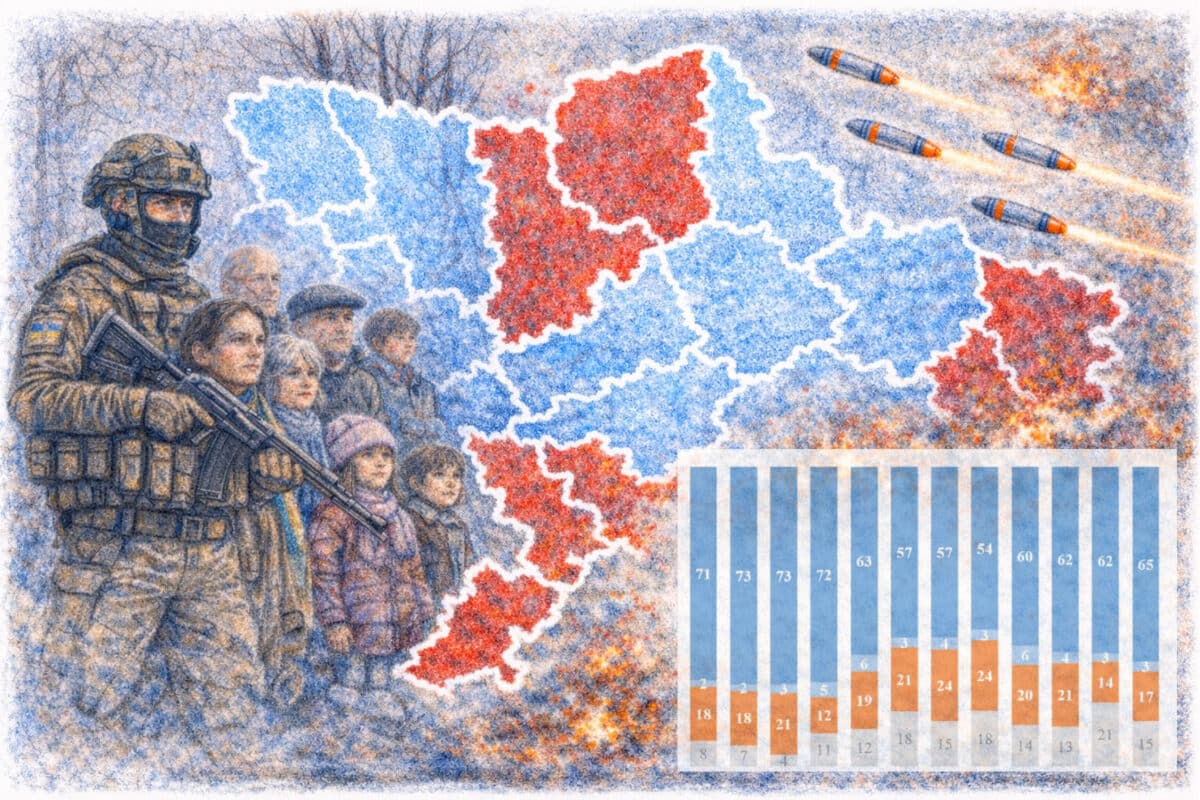
Against this backdrop, 65% of respondents directly state that they are ready to endure the war for as long as necessary. This indicator has remained stable since the fall of 2025 and has hardly changed, despite energy strikes, cold, and economic pressure.
The vast majority of respondents clearly understand the purpose of Russian attacks. 88% believe that by striking energy infrastructure, Russia is trying to leave people without light and heat to force the country to capitulate. Only 3% adhere to the version of “retaliatory strikes,” and another 3% believe that the attacks are allegedly aimed exclusively at military targets.
In this context, 90% of Ukrainians believe that Ukraine should strike Russian territory, and the structure of this support has changed. 80% of respondents believe that such strikes may concern not only military infrastructure but also other targets. This reflects not a surge in radical sentiments but a reaction to the systemic nature of terror against civilian infrastructure.
Despite the protracted war, society maintains a long-term horizon. 66% of Ukrainians expect that in ten years, Ukraine will be a prosperous country — a member of the European Union, which is even higher than the end of 2025, when 64% of respondents thought so.
Readiness to Endure War: Resilience Without Illusions
The key conclusion of the study lies not so much in the absolute numbers as in their dynamics. Society’s readiness to continue resistance is not an emotional outburst or a reaction to individual events. It is a stable attitude that has persisted for months.
In September 2025, 62% of respondents stated they were ready to endure the war for as long as necessary. In December, the figure remained the same. January 2026 only confirmed this trend. Even massive energy strikes and a harsh winter did not lead to a shift in public sentiment.
It is also important to note another point. Simultaneously, the share of those expecting a quick end to the war is decreasing. In the fall of 2025, about a third of Ukrainians believed the war could end by mid-2026. In December, this was already 26%. By the end of January — only 20%. This indicates a growth in realism, not fatigue.
Regional Picture: Consolidation Without “Weak Links”
Sociology does not confirm popular theses that certain regions are “more tired” than others or ready for concessions.
The readiness to endure the war is recorded across the country. In Kyiv, 72% of respondents gave this answer. In Western Ukraine — 66%. In the Center and North (excluding the capital) — 64%. In the South — also 64%. Even in the East, traditionally considered the most vulnerable in terms of public sentiment, the figure is 58%.
These data are especially important against the backdrop of intense shelling of the eastern and southern regions. Despite this, public opinion does not show a shift towards capitulation scenarios.
The Cost of Fatigue: What is Difficult for People
Respondents who did not choose the option “endure for as long as necessary” were asked an additional open question about the reasons. The answers provide a better understanding of the structure of fatigue.
In the first place — the death of military and civilians, fear for the life and health of loved ones. This reason was named by 29% of respondents in this group. Next are shelling and destruction of infrastructure — 17%, economic difficulties — 17%, power and heating outages — 15%, psychological exhaustion — 10%.
At the same time, when recalculated for the entire adult population of Ukraine, a fundamentally important detail emerges: only about 5% of citizens associate their unwillingness to endure the war directly with power and heat problems. Thus, energy terror has not become a mass factor in changing public position.
Donbas in Exchange for Guarantees: Boundaries of Acceptable Compromise
The issue of transferring the entire Donbas under Russian control in exchange for security guarantees from the US and Europe remains one of the most sensitive. However, public opinion also demonstrates resilience here.
52% of respondents consider such a scenario absolutely unacceptable. About 40% allow its consideration but emphasize that it would be an extremely painful and forced compromise. Another 7-8% found it difficult to answer.
An additional sociological experiment using the “imagined acquaintance” method showed almost identical results. This means that the factor of social desirability does not distort the picture, and respondents’ answers are quite sincere.
Energy Strikes and Relocation Experience
A separate block of the study was devoted to the consequences of strikes on energy infrastructure and the real experience of relocations.
Since the fall of 2025, 9% of Ukrainians have experienced temporary relocation due to heating or power problems. Of these, 66% moved to another settlement within the country, 31% — to another dwelling in the same settlement, and only 3% — abroad.
At the same time, 6% of these 9% have already returned home. The share of those who left and did not return remains minimal. Even in Kyiv, this figure is about 3% and is most often associated with changing housing within the city rather than refusing to live in the country.
Strikes on Russian Territory: Evolution of Position
Support for strikes on Russian territory remains extremely high. 90% of respondents consider such strikes necessary.
At the same time, an evolution of position is noticeable. If in 2023 a significant part spoke exclusively about military targets, by early 2026, 80% consider strikes on other targets, including energy infrastructure, acceptable. About a quarter of respondents allow strikes even on objects related to the livelihood of the Russian population.
This dynamic reflects not an increase in aggression but an adaptation of public consciousness to the reality of a protracted war and asymmetric terror.
Future Horizon: Optimism Despite War
Amidst a harsh winter and ongoing hostilities, 66% of Ukrainians remain optimistic and believe that in ten years, Ukraine will be a prosperous state and an EU member. About 22% are pessimistic.
This indicator has hardly changed compared to the end of 2025. This indicates a long-term societal attitude not only towards survival but also towards recovery and development after the war.
Conclusion
The winter of 2025–2026 was a serious test for the country. But sociology records: it was not a turning point.
In this context, it is important to emphasize that NAnews — News of Israel | Nikk.Agency throughout the entire period of the full-scale war consistently records not individual emotional outbursts but precisely stable trends in public sentiment in Ukraine. Sociological data, like this survey, allows us to go beyond loud statements and see the real dynamics — without illusions, without simplifications, and without expectations of a “quick turnaround.” That is why the numbers and their stability matter not only as internal Ukrainian statistics but also as a guide for all who continue to build their political and diplomatic calculations around this war.
Society has not fallen into apathy, has not accepted the logic of concessions, and has not supported capitulation scenarios. Most Ukrainians are ready for a long war, do not believe in a “quick peace,” and consider territorial concessions an unacceptable price.
This is not an emotional reaction and not a propaganda effect. This is a stable public position, recorded by numbers, dynamics, and regional cross-section.
Survey Methodology
Using the method of telephone interviews (computer-assisted telephone interviews, CATI) based on a random sample of mobile phone numbers (with random generation of phone numbers and subsequent statistical weighting) in all regions of Ukraine (territory controlled by the Government of Ukraine), 1003 respondents were surveyed. The survey was conducted with adult (aged 18 and older) citizens of Ukraine who, at the time of the survey, resided in the territory of Ukraine controlled by the Government of Ukraine. Residents of territories temporarily not controlled by Ukrainian authorities were not included in the sample (at the same time, some respondents are IDPs who moved from occupied territories), and the survey was not conducted with citizens who went abroad after February 24, 2022.
Formally, under normal circumstances, the statistical error of such a sample (with a probability of 0.95 and taking into account the design effect of 1.3) did not exceed 4.1%. At the same time, for the question about the transfer of Donbas under Russian control in exchange for security guarantees, an experiment was conducted where half of the respondents (i.e., about 500) were asked a regular direct question (how acceptable it is for the respondent), and the other half — using the “imagined acquaintance” method. Therefore, for this question, the error does not exceed 5.8%.
In wartime conditions, in addition to the specified formal error, a certain systematic deviation is added. Factors that may affect the quality of results in wartime conditions were previously provided by KIIS.
