
On March 16, 2026, a story erupted in Lebanon that at first glance looks like a local episode of a war of nerves, but in fact concerns three key issues for the Israeli audience: security on the northern front, Ukraine’s role in the regional crisis, and Hezbollah’s attempts to expand the conflict far beyond southern Lebanon. The trigger was a statement by Ali Ammar, a deputy from the Loyalty to the Resistance bloc, who accused the Ukrainian embassy in Beirut of harboring a suspected Mossad agent and demanded immediate action from the Lebanese state.
The essence of the accusation is as follows: according to Ammar, the Ukrainian diplomatic mission is allegedly hiding a person wanted by Lebanese justice on charges of planning and carrying out “terrorist acts,” and is also trying to organize his departure from the country. This version was published by media close to Hezbollah, and then retold by the Lebanese publication L’Orient Today, separately noting that Ammar’s demand was addressed to the Lebanese Ministry of Foreign Affairs, security forces, and judicial authorities.
According to a Hezbollah representative, the Ukrainian embassy not only provides shelter to the agent but is also actively working to ensure his removal from the country.
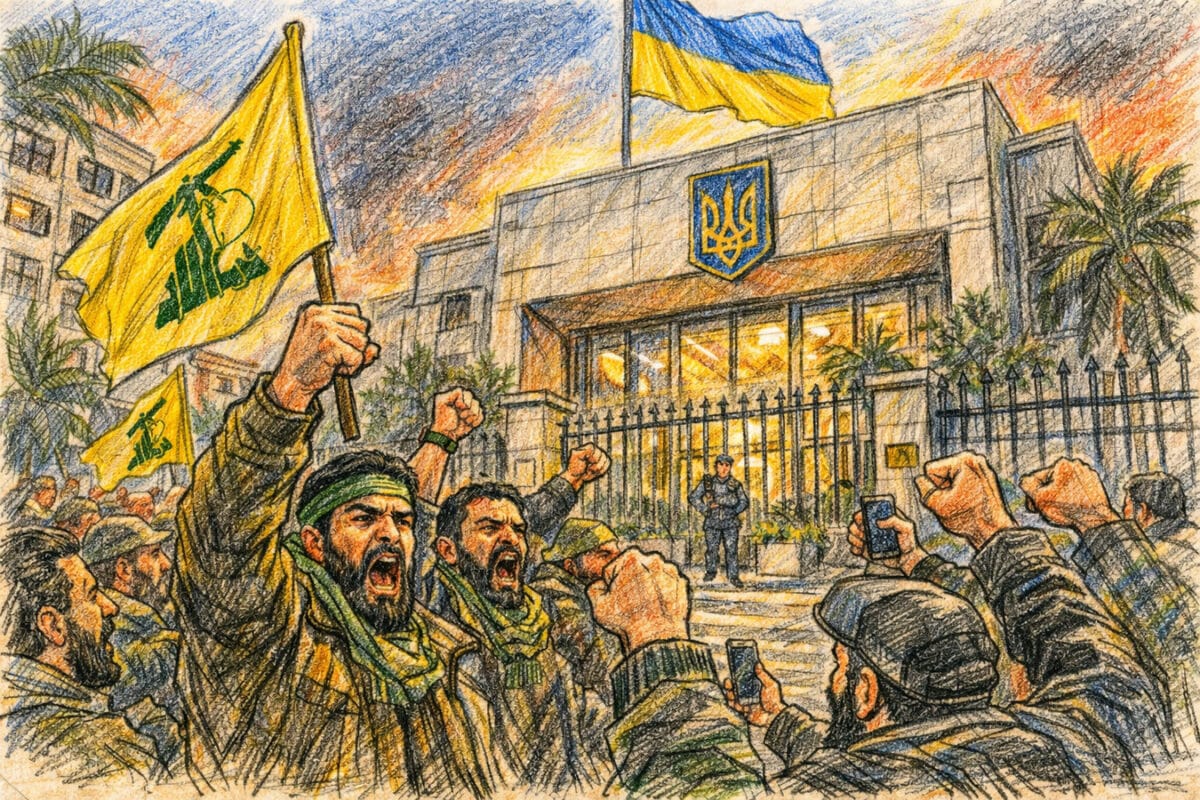
Allegedly, this “agent” led a “spy network during the war in 2024.”
Khaled al-Aida, of Syrian origin with Ukrainian citizenship, is accused of “planning terrorist attacks.”
Aida is allegedly involved in the “murder of former Hezbollah Secretary General Hassan Nasrallah.”
He was eventually caught with an improvised explosive device hidden on a motorcycle intended for subsequent use in southern Beirut.
He managed to escape after an Israeli bombing of the building where he was held in the southern suburbs of Beirut. As a result, he found refuge in the Ukrainian embassy.
But here, the form of the accusation is as important as the accusation itself. When a structure closely linked to the pro-Iranian military network in Lebanon demands that the state effectively pressure a foreign embassy and achieve the extradition of a person located there, it is no longer just a propaganda attack. It is an attempt to turn a diplomatic platform into part of a military conflict.
What exactly Hezbollah demands and why it looks like a challenge to diplomatic law
According to published formulations, Ali Ammar demands that the Lebanese authorities “immediately and firmly” intervene, prevent the suspect’s departure, and force the Ukrainian embassy to hand him over to Lebanese justice. In retelling, this sounds almost like a domestic political dispute. But in the language of international law, the meaning is quite different: it is about pressure on a diplomatic mission, whose premises are protected by a special status.
The Vienna Convention on Diplomatic Relations explicitly states that the premises of the mission are inviolable: representatives of the receiving state cannot enter them without the consent of the head of the mission, and the premises themselves are not subject to search, requisition, arrest, or enforcement actions. That is why the demand to “force the embassy to hand over the person” in reality means encroaching on territory where the law has long limited the appetites of security forces and political groups.
And this is perhaps the main nerve of the whole story. Hezbollah is not just throwing another accusation against Ukraine. It is pushing the Lebanese state to take a step that in any capital of the world would be considered a diplomatic scandal of the highest level.
Why the throw-in was made right now
Context here decides almost everything. Reuters writes that the war on the Lebanese front sharply escalated after March 2, when Hezbollah entered the regional conflict on the side of Iran, and Israel in response expanded strikes on Lebanon. At the same time, the Lebanese authorities in recent days have demonstrated increasingly unusual toughness for Beirut: the government banned Hezbollah’s military activities, and President Joseph Aoun sought direct negotiations with Israel, although without noticeable success.
Against this backdrop, the attack on the Ukrainian embassy looks not accidental. Ukraine in recent weeks has already become the object of aggressive rhetoric from Iranian and pro-Iranian figures following reports of assistance to Israel and other Middle Eastern countries against Iranian threats. L’Orient Today separately noted that on the same day Ammar accused the Ukrainian diplomatic mission, Iranian MP Ebrahim Azizi stated that Ukraine had become a “legitimate target” for Tehran due to “assistance to Israel.”
So we are not dealing with an isolated Lebanese story, but part of a broader campaign: to link Ukraine, Israel, and Mossad in one “accusatory plot” and thereby justify further political or forceful pressure.
Why this story is important for the Israeli audience
Israelis should not only look at the loudness of the accusations but also at the mechanism itself. If Hezbollah begins to publicly demand pressure on the Ukrainian embassy in Beirut under the pretext of searching for a “Mossad agent,” it means that for the organization, the usual front on the border is no longer enough. It seeks to blur the boundaries between war, diplomacy, Lebanon’s internal politics, and international relations.
It is precisely in this place that NAnews — Israel News | Nikk.Agency sees the fundamental meaning of what is happening: for Hezbollah and the Iranian axis, Ukraine is increasingly becoming not an external observer, but a convenient target for pressure in the same logic in which only Israel, the USA, or individual Arab governments were previously targets. This is an important shift. It shows that any country that Tehran or Beirut records in the camp of assistance to Israel can quickly be drawn into a campaign of threats, accusations, and informational attacks.
At the same time, Ammar did not present public evidence of his accusations in the published statements. The available materials from L’Orient Today and Al-Manar record precisely his assertions and political demands, but do not show supporting materials, independent verification, or procedural details that would allow the accusation to be considered proven. This does not negate the seriousness of the plot but changes the way it is presented: it is an accusation, not an established fact.
What this means for Lebanon
For Lebanon itself, the situation is doubly unpleasant. On the one hand, Beirut is trying to show the outside world that the state is still capable of speaking the language of institutions, negotiations, and international legitimacy. On the other hand, Hezbollah once again demonstrates that it is ready to impose its own agenda, even if it leads the country to a new diplomatic crisis. Reuters directly points out: the Lebanese authorities want to limit Hezbollah’s military role but cannot act against it without the risk of internal explosion.
Therefore, the story with the Ukrainian embassy is not only a blow against Kyiv. It is also a test for the Lebanese state. If it swallows such rhetoric and allows it to turn into practical steps, it will mean further blurring of the boundary between official Lebanon and the logic of an armed organization acting in the interests of the Iranian axis.
Where this scandal might lead next
With high probability, we will see a continuation precisely in the informational-political plane: new throw-ins, new accusations, attempts to turn the diplomatic plot into a symbol of the “Ukrainian-Israeli conspiracy” against Lebanon. For Hezbollah, this is a convenient scheme. It allows simultaneously hitting Israel, demonizing Ukraine, and pressuring its own government, portraying it as too weak if it does not take drastic steps.
But for Israel, there is also a more practical conclusion here. Any assistance that Ukraine provides to countries in the region in countering the Iranian threat is already perceived in the pro-Iranian camp not as a diplomatic gesture, but as entering the zone of direct hostile action. And this means that pressure on Ukrainian structures outside Ukraine — whether embassies, representatives, or communities — may well become a new part of this big war.
That is why the scandal around the Ukrainian embassy in Beirut should not be read as a secondary Middle Eastern exotic. It is yet another symptom of how Israel’s war with the Iranian axis is expanding geography, erasing old diplomatic barriers, and making even formally neutral platforms an arena of new confrontation.