
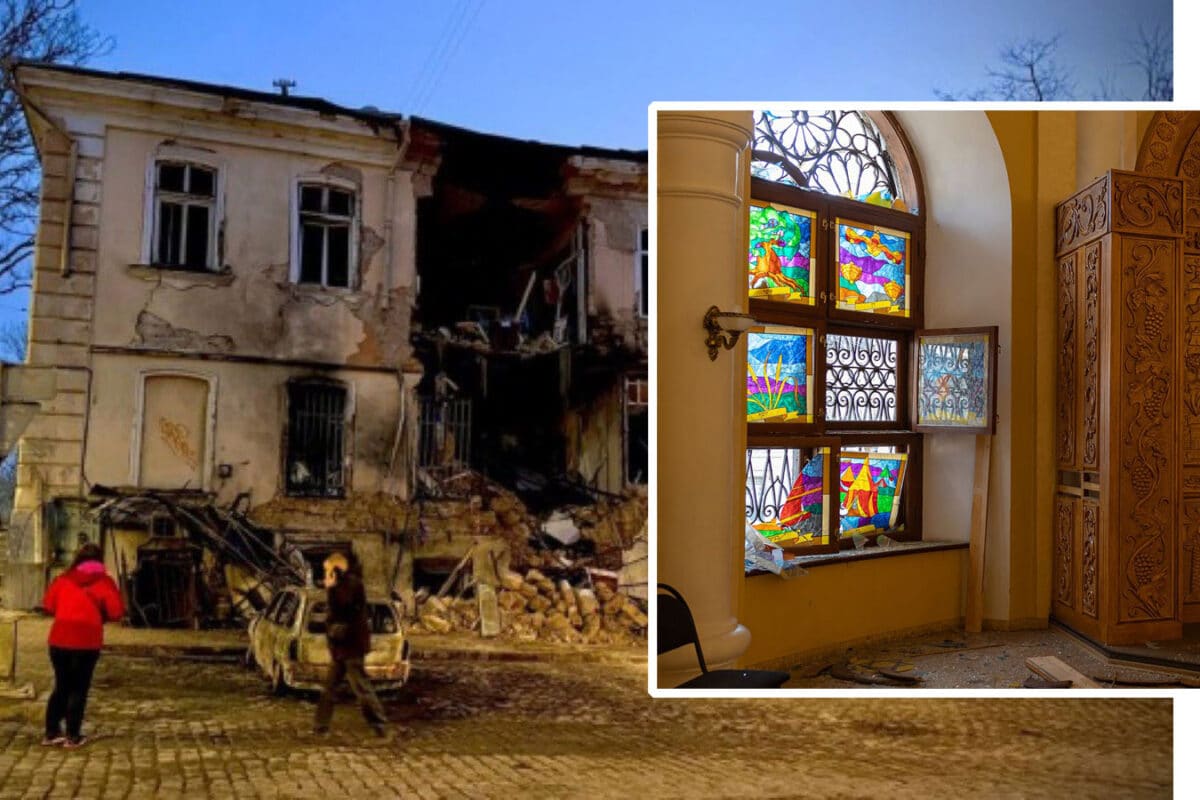
The night attack by Russian terrorists on Odessa on March 19, 2026, was not just another report from Ukraine for the Israeli audience. A Russian drone struck near the city’s main synagogue, and this detail immediately changed the perception of the entire story: it was no longer just about residential areas, fires, and the wounded, but about a direct hit on one of the most recognizable Jewish symbols in southern Ukraine.
The Israeli Foreign Ministry reacted quickly and unusually directly, even by the standards of recent months. The ministry stated that a kamikaze drone struck near the synagogue in Odessa, causing significant damage, and specifically emphasized: Iranian drones are attacking civilians both in Europe and the Middle East. For Israel, this is no longer an abstract ‘support for Ukraine,’ but a recognizable outline of a common threat.
It is stated in the statement of the Israeli Foreign Ministry.
This evening, a kamikaze drone struck near the synagogue in Odessa, causing significant damage. Iranian drones are attacking civilians in Europe and the Middle East. This attack followed massive strikes by Russian drones and missiles on Ukrainian cities this week, resulting in many civilian casualties and damage to civilian facilities and infrastructure. We express our condolences to all who lost their loved ones and wish a speedy recovery to the injured.
What happened in Odessa on the night of March 19
Residential buildings, a dormitory, and the historic center were hit
Fires and destruction were recorded in several parts of Odessa. Residential buildings, including high-rises, as well as buildings in the historic center, were affected. Later, local authorities clarified that damage was recorded in three districts — Primorsky, Kyivsky, and Khadzhibeysky. Four people were injured; three were hospitalized, and it was later reported that all the injured were receiving outpatient treatment.
Ukrainian regional reports painted a harsher and more grounded picture, without diplomatic formulas: 22- and 25-story residential complexes, a university dormitory, and a house in the historic part of the city were damaged. In other words, it was not a pinpoint episode, but a typical scheme for this war, where the urban environment itself — housing, everyday life, infrastructure — is hit all at once.
Why the story with the synagogue immediately went beyond the usual report
The damage to Odessa’s main synagogue quickly attracted separate attention. According to local reports, there were almost no intact windows left in the building, the stained glass windows and the premises where humanitarian aid was distributed were seriously damaged. This is important not only as a fact of destruction. For Odessa, such a synagogue is not a museum object or a decorative monument in the center, but a living part of the city’s and Jewish history.
And here the news became noticeably closer for Israel. Because when the shock wave covers not just a facade in the center of a Ukrainian city, but the main synagogue of the city with a long and complex biography, it is already perceived as an event that concerns not only Ukraine. It concerns Jewish memory, Jewish infrastructure, and the very sense of vulnerability, which in Israel in recent months is also read without translation.
What is known about the ‘Or Sameach’ synagogue in Odessa
This is the main synagogue of the city with a history dating back to the 19th century
We are talking about the ‘Or Sameach’ synagogue, located at 25 Yevreyskaya Street, at the intersection with Rishelievskaya. In Ukrainian and Russian-language reference sources, it is listed as the main synagogue of Odessa. The modern building began construction in 1850 according to the design of architect Franz Morandi, and by 1855 it received the status of the city’s main synagogue. The name ‘Or Sameach’ is translated as ‘light of joy’ or ‘light of happiness’.
To understand the scale of the symbol, this is already enough. But more importantly: it is not just an old beautiful building that has survived a century. It is a place where the history of Jewish Odessa is concentrated — with its growth in the 19th century, the blows of the 20th century, and the return of communal life after the collapse of the USSR.
The synagogue was closed under Soviet rule and returned to the community only in the 1990s
After the establishment of Soviet power, the synagogue was closed in 1923. The building was then used for purposes other than its original function: first as a zoological museum, later as a children’s musical theater, and after the war, it was transferred to a pedagogical institute. The interior space was seriously rebuilt. In other words, it is a classic story for Eastern Europe: the religious center was not just closed, but literally turned out of its own function.
The building was returned to the community only in 1996. At that time, on Rosh Hashanah, prayers were held again in Odessa’s main synagogue for the first time in many decades. Full restoration continued for many more years; sources indicate that reconstruction lasted until 2008. This is an important detail: the damage on March 19 is a blow not just to an old house, but to a place that was literally brought back to life anew.
That’s why this episode is read so sharply. Not because ‘a cultural heritage site was damaged’ — that’s too bureaucratic a formula. But because a place was damaged that went through closure, remodeling, almost loss, then through return and restoration, and again found itself in a war zone.
Why Israel’s reaction turned out to be politically more important than it might seem
The Israeli Foreign Ministry effectively linked Odessa with the overall Iranian threat
In the reaction of the Israeli Foreign Ministry, not only the solidarity itself is important. The framework is important. The ministry did not limit itself to sympathizing with the victims and mentioning the strike on the synagogue. The Israeli side directly linked what happened with Iranian drones and the fact that such systems hit civilians both in Europe and the Middle East. This is no longer just a comment on the Ukrainian war. It is an attempt to explain what is happening through a familiar Israeli logic of a common threat.
For the Israeli reader, this has a very understandable meaning. It is no longer possible to maintain a large emotional distance between the strikes on Ukrainian cities and the threats to Israel’s rear. Technologies, rhetoric, the way of pressure on the civilian population — all this increasingly looks like parts of one big story. And when a synagogue in Odessa is also hit, this plot ceases to be only international. It becomes internally recognizable for the Jewish world as well.
That is why such news does not dissolve in the flow. In one episode, several lines converged at once: the Russian attack on a Ukrainian city, the damage to Odessa’s main synagogue, Israel’s harsh emphasis on the Iranian component, and a new reason to look at the war in Ukraine not as a distant external conflict, but as part of a broader security crisis. NAnovosti — News of Israel | Nikk.Agency sees in this story not only the tragedy of a single night but also the moment when Odessa again became a point where the Ukrainian war, Jewish memory, and Israeli sense of reality intersected.
