
The Ukrainian edition of Michael Bar-Zohar’s book about Israel’s war with Hamas appeared not just in time, but almost symbolically accurately. Against the backdrop of a new round of war with Iran, proxy warfare, and Israel’s right to self-defense, this book becomes not only a chronicle of October 7 but also a tool for explaining the entire logic of the conflict to the Ukrainian reader.
In Ukraine, a book by the famous Israeli historian Michael Bar-Zohar “Iron Swords, Wounded Hearts. Israel’s Fateful War with Hamas” (Ukr. – “Залізні мечі, зранені серця. Доленосна війна Ізраїлю з ХАМАСом”) was published. The Ukrainian edition was published in 2025 by the publishing house “Nash Format”, is part of the series “Jewish Library”, has 272 pages, hardcover.
The book is already available in Ukrainian on the publisher’s website – https://nashformat.ua/products/zalizni-mechi-zraneni-sertsya.-dolenosna-vijna-izrailyu-z-hamasom-709830
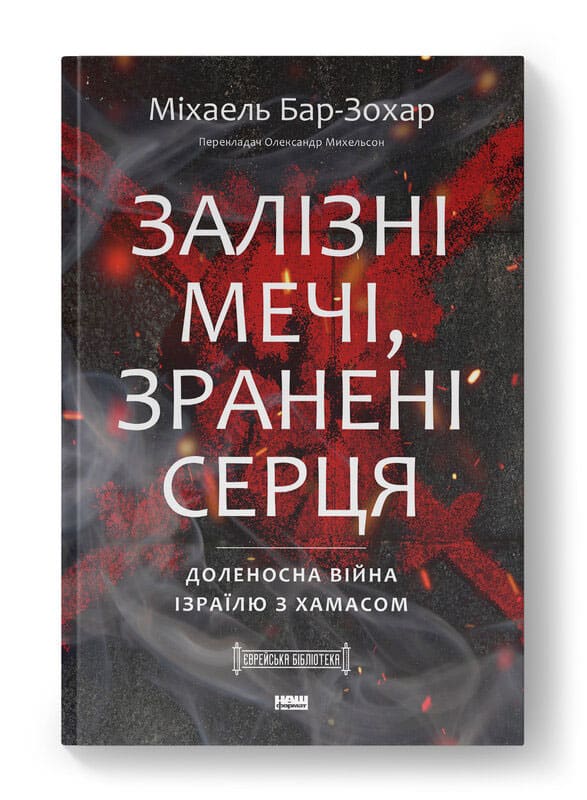
The annotation states that Bar-Zohar began writing it already on October 8, 2023, the day after the Hamas attack, to capture what was happening before reality was distorted by fanaticism and propaganda.
And this is precisely what makes the Ukrainian release of the book important not only for the book market. Before us is not an ordinary translated novelty and not another volume about the Middle East for a narrow audience. Before us is an attempt to transfer to the Ukrainian language the Israeli internal view of the catastrophe of October 7, 2023 — with pain, with names, with awareness of the scale of the failure, with the question of the price of illusions, and with the understanding that the war with Hamas was never just a war with Hamas.
Why this book is not just about October 7
On the publisher’s page, the book is described in several dimensions:
“October 7, 2023, became one of the most tragic dates in Israel’s history. The barbaric attack by Hamas on border settlements and a peaceful rave party brought mass killings, destruction, and hostage-taking. The world saw horrifying footage of terrorist crimes and at the same time — waves of support for Hamas in foreign capitals. Already on October 8, writer and historian Michael Bar-Zohar began writing this book to capture the truth, not yet distorted by blind fanaticism and propaganda.
The author describes the heroism of ordinary Israelis, weaving in the personal tragedies of hostages; analyzes the prerequisites for the catastrophic failure of the security forces that made the attack possible; evaluates the actions of the Israel Defense Forces in response — the ‘Iron Swords’ operation. The advantage of the book is a deep study of the historical context of Arab-Israeli relations to explain the causes and scale of the conflict.
This is not just a document or chronicle. It is simultaneously an emotional report and a scientific study — about pain and determination, about the search for truth amid a sea of fakes, about a people fighting for their survival.”
That is, Bar-Zohar is not just writing a chronicle of the tragedy. He is essentially engaged in a more complex task: restoring cause-and-effect relationships where international discussion quickly began to blur them. In the first days after October 7, the world saw not only footage of massacres and kidnappings but also a wave of attempts to immediately fit the Israeli tragedy into already prepared ideological schemes. It is against this, if the book’s description is to be believed, that the author hurried to speak with the text — as a person who understands that in the modern war for memory and legitimacy, a delayed explanation almost always loses.
In this sense, the book is important even today, when the conversation about Israel’s security has once again expanded far beyond the Gaza Strip. After October 7, many wanted to present what was happening as a local flare-up, as another round of the old Palestinian-Israeli confrontation. But as events developed, it became increasingly clear: it is about a broader system of threats, where Hamas is just one of the elements.
Why the Ukrainian edition sounds stronger than an ordinary book news
The series “Jewish Library”, in which the book was released, has long been a notable project. On the store’s page, it is described as a cycle of modern books about the history, politics, science, military affairs, and leadership of modern Israel; among the authors are Michael Bar-Zohar, Nissim Mishal, Ronen Bergman, and others. Special emphasis is placed on topics such as “Mossad”, secret operations, the role of women in intelligence, and the practice of targeted killings as a tool of state defense.
But the history of the series is broader than a specific store display. In publications by the Jewish Confederation of Ukraine, the series is directly named as a project that started at the initiative of the JCU, and its distinctive feature has been the first Ukrainian translations of world bestsellers about Israel and outstanding Jews.
At the end of 2024, JCU President Boris Lozhkin said that the series selects precisely those books about Israel and the Jewish world that have become world bestsellers but have not previously been published in Ukrainian.
…
Boris Lozhkin is a Ukrainian businessman, investor, and public figure. According to the Jewish Confederation of Ukraine itself, he has been its president since 2018; there he is described as an entrepreneur, philanthropist, and author. Previously, he was the head of the Administration of the President of Ukraine under Petro Poroshenko from 2014 to 2016.
JCU is the Jewish Confederation of Ukraine. Simply put, it is not a state body but a large public association of Jewish organizations in Ukraine. On Lozhkin’s website and the confederation itself, it is stated that the JCU unites independent social, charitable, and religious Jewish organizations.
…
This changes the perspective on the release of ‘Iron Swords’. Before us is not just a translation of a book by a famous author. Before us is part of a larger process: systematically opening Israeli historical, political, and military experience to the Ukrainian reader in their own language. And for a country that itself lives in war, this has a completely different weight than for the academic book market in peaceful Europe.
It is important to say directly: Ukrainians read books about Israel today not out of curiosity about a ‘foreign region’. They read them as texts about a state that has lived under the threat of rockets for decades, faces terror, debates the cost of intelligence failures, experiences the shock of losing citizens, and is simultaneously forced to repeatedly prove its right to defend itself. In this context, the Ukrainian translation of the book about October 7 is not a cultural courtesy towards Israel. It is a conversation in a language that is almost painfully familiar.
That is why NANovosti — Israel News | Nikk.Agency sees in this publication not only a literary event but also an important element of the overall Ukrainian-Israeli dialogue. Because both countries, each in their own way, have long lived in the same nerve: how not to let the enemy steal not only territory and lives but also the very logic of what is happening.
What Boris Lozhkin’s post adds and why it is important
Boris Lozhkin in the presentation of the book for Ukrainian readers writes that Israel’s operation ‘Iron Swords’ was a direct response to the terrorist attack on October 7, 2023, by Hamas, and the current operation against Iran can be considered its logical continuation. This is a strong formulation because it gathers the war into a single chain: the Hamas attack, the Israeli response, and then the move to the source of a broader threat — the Iranian center of the proxy system.
This is no longer a publisher’s annotation. This is a political explanation of the book.
If you look closely at Lozhkin’s text, he does several important things at once. First, he places Bar-Zohar’s book in the current strategic framework. Not as evidence of a completed stage, but as a document that helps explain the current moment. Second, he emphasizes that Bar-Zohar began writing immediately after the attack precisely because it was necessary to counter the wave of disinformation about the causes of the war and Israel’s motives. And third, Lozhkin specifically translates the emotional meaning of the book into the Ukrainian experience: he writes that this is a book about the pain of loss, the right to freedom, and the value of every life — things that are extremely understandable to Ukrainians.
And this is perhaps one of the most accurate thoughts in this whole story.
Because the book about October 7, translated into Ukrainian, really begins to work not only as a story about Israel. It becomes a mirror. For a Ukrainian, it reads not only as the Middle East but also as their own experience: the suddenness of a major blow, the monstrosity of violence against civilians, the weakness of previous illusions, the cost of an underestimated threat, and the daily struggle to prevent the world from getting tired, distancing itself, or turning the plot upside down.
Why this book is especially important for the Israeli audience in Ukraine and Israel
For Israelis, for Jews of Ukraine, for the Israeli audience that follows the topic of October 7 in its international reflection, the release of this book in Ukraine is important for another reason. It shows that the Ukrainian space not only sympathizes with Israeli pain but also tries to understand it from within, through an Israeli source, and not through third-party retellings.
This is not a trifle.
Too often, stories about Israel outside the country begin to live a separate life: someone removes the context from them, someone blurs the subjectivity of the victims, someone turns terror into an abstraction, and self-defense into a problem. Bar-Zohar, judging by the book’s description, is trying to go against this. He writes about ordinary Israelis, about hostages, about the catastrophic failure of the security forces, and about the military response of the IDF, while simultaneously returning the historical context of Arab-Israeli relations.
And this is especially important now, when the discussion about Israel’s war again rests not only on Gaza but also on Iran, Hezbollah, the proxy network, and the general question: can we still pretend that each new flare-up exists separately from the previous one.
Therefore, the Ukrainian release of the book ‘Iron Swords, Wounded Hearts’ looks so precise right now. Because it coincided not just with interest in the topic of Israel, but with a moment when the very meaning of October 7 again requires protection and explanation. The book becomes a way to fix: the Hamas attack was not a random autonomous flare-up, and the Israeli response cannot be honestly discussed without talking about the broader architecture of the threat.
And there is another important layer in this. For Ukraine, which itself lives under the pressure of Russian disinformation and constant attempts to erase the original causes of the war, such a book is not a foreign plot, but a very understandable experience of resisting semantic blurring. For Israel, it is a sign that its tragedy and its right to self-defense in Ukraine are not just observed but are being seriously, attentively, and in their own language, understood.
In the end, we are indeed not just looking at a book novelty.
This is a cultural gesture. A political signal. And, if you will, another quiet but very important bridge between Ukraine and Israel — a bridge built not on slogans, but on memory, pain, facts, and an attempt to preserve the truth about the war before it is completely blurred by foreign versions.
How to buy the book
The book is already available in Ukrainian on the publisher’s website – https://nashformat.ua/products/zalizni-mechi-zraneni-sertsya.-dolenosna-vijna-izrailyu-z-hamasom-709830
