
On November 2, 2026, the Ukrainian publication UA.NEWS published a large interview by journalist Kristina Lomenko with Abbess Elizabeth, who heads the community of Ukrainian nuns at the Alexander Courtyard in the Old City of Jerusalem. 11 women live near the Church of the Holy Sepulchre, receive pilgrims, help Ukrainians, and fear that the historic complex will come under Russian control.
Author: R. Verter
At the end of the publication, the editorial team noted that the material was prepared with the assistance and support of the Embassy of Israel in Ukraine and the Ministry of Foreign Affairs of Israel. This circumstance deserves special attention, as the dispute over the Alexander Courtyard has been the subject of legal proceedings and diplomatic negotiations for many years.
However, the interview is interesting not only for the political aspect of the issue. Elizabeth provides a detailed account of the origins of the Ukrainian religious community, which appeared in Jerusalem long before the full-scale Russian invasion, her own life, her attitude towards Ukraine, and the people whom the nuns help during the war.
From Kyiv to Jerusalem: the story of the sisterhood that began in 1998
The origins of the current community are in Kyiv. In 1998, at the Church of St. Michael, the first Metropolitan of Kyiv, on the territory of the Alexander Hospital, Archpriest Roman Baranovsky created a sisterhood of mercy in honor of St. Elizabeth Fyodorovna. The materials about the association also mention Nun Barbara.
This was not a monastic community in the usual sense. Women who wanted to help those in need joined the sisterhood, not necessarily giving up their ordinary lives. They cared for hospital patients, visited the elderly, helped orphans, the homeless, and large families. Their activities extended to psychiatric institutions, a women’s correctional colony in Chernihiv, and people who needed home care.
Over time, the association became quite numerous. One historical description mentions 126 sisters, and the register of Orthodox sisterhoods lists 130 sisters of mercy and three assistants. The spiritual leader of the community was Archpriest Roman Baranovsky, and the senior sister was Irina Tobolina.
The name of the sisterhood is associated with Elizabeth Fyodorovna Romanova, the widow of Grand Duke Sergei Alexandrovich, the first chairman of the Imperial Orthodox Palestine Society (IPPO) and brother of Russian Emperor Alexander III.
After her husband’s murder in 1905, Elizabeth Fyodorovna dedicated herself to charity and founded the Martha and Mary Convent of Mercy in Moscow. In 1918, she was killed by the Bolsheviks. Subsequently, the Orthodox Church canonized her.
It was with this tradition of mercy and religious service that the appearance of Ukrainian sisters in Jerusalem was associated.
On October 18, 2010, the historic Imperial Orthodox Palestine Society, which managed the Alexander Courtyard, officially announced the creation of the Jerusalem St. Elizabeth Sisterhood of Mercy.
The first participants came from Kyiv at the invitation of Nikolai Vorontsov-Hoffman, who headed the society. Women with experience in charitable and church work were selected for service in Jerusalem.
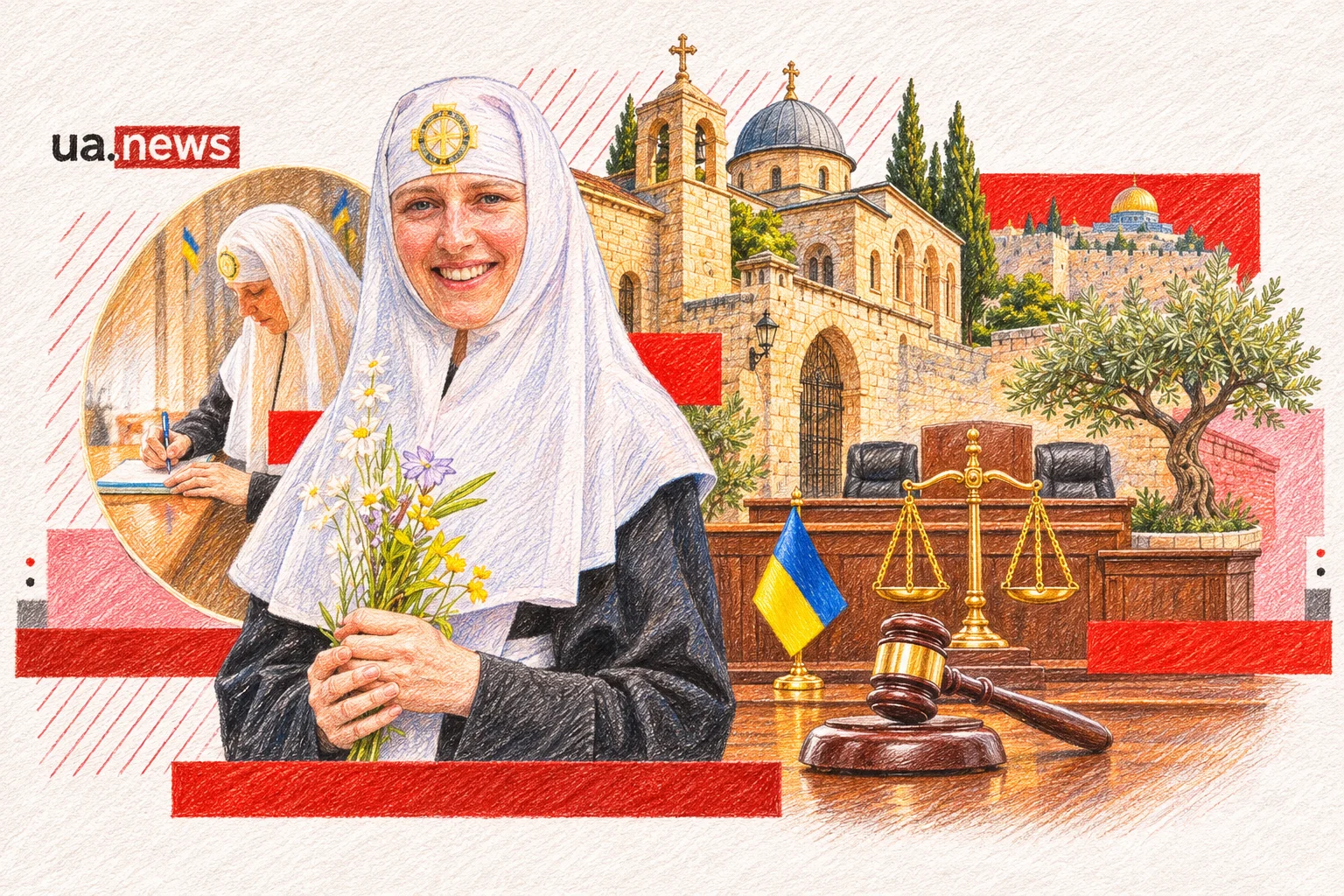
On November 1, 2010, the dedication of the first sisters took place. The ceremony was conducted by Hieromonk Makary Butin, who served as the spiritual leader of the monastics at the Church of Mary Magdalene in Gethsemane. The participants received white garments reminiscent of the traditional clothing of the sisters of the Martha and Mary Convent.
The main task of the new association was to resume the continuous reading of the Unceasing Psalter at the Threshold of the Judgment Gate, an archaeological shrine on the territory of the Alexander Courtyard. According to the society’s historical materials, such a prayer tradition existed here before but was interrupted in the 1920s.
The renewed service has continued since 2010. The sisters take turns so that the reading of the Psalter does not stop for a long time.
Initially, the appearance of Ukrainians in unusual white garments aroused distrust among some religious communities of the Old City. Elizabeth recalls stories from the first sisters about how some representatives of the local clergy did not understand who these women were and on what grounds they served near the Church of the Holy Sepulchre. There were even cases of refusal of communion.
Gradually, attitudes changed. The sisters continued to receive pilgrims, help visitors to the complex, and participate in the religious life of Jerusalem.
On November 1, 2015, the society celebrated the fifth anniversary of the sisterhood. The report on the celebration explained separately that it included both laywomen and women who had taken monastic vows. Being dedicated as a sister of mercy does not in itself mean taking monastic vows.
Elizabeth emphasizes this distinction in the new interview. Participants in the sisterhood can have families, work, study, and help at the church in their free time. Nuns, however, dedicate their lives to religious service.
Today, there are eleven Ukrainian nuns at the Alexander Courtyard, but they cannot be equated with the entire sisterhood. The Kyiv and Jerusalem communities are linked by origin and religious tradition, although it is not documented that they are a single legal entity.
How a student from Kamianets-Podilskyi became an abbess in Jerusalem
Elizabeth was born in Kamianets-Podilskyi, Khmelnytskyi region of Ukraine, and grew up in an ordinary family. After school, she entered Lazarski University in Warsaw, where she studied international economics and diplomacy.
In the summer of 2014, after her first year, she came to Kyiv and got acquainted with the sisterhood at the Church of St. Michael. She was surprised that among the participants were young women, including students, who combined education and daily responsibilities with helping those in need.
When the church announced a trip to Jerusalem, Elizabeth decided to join. Thus, she first found herself at the Alexander Courtyard, a place she later connected her life with.
For her family, her choice was unexpected. Her mother hoped that her daughter would return to ordinary life and continue her university education. However, Elizabeth decided to stay with the community and later took monastic vows.
This story was known long before the current escalation of the property dispute. On March 31, 2018, the publication LifeGid published the material “The Path of Christ and the Ukrainian Woman — Alexander Courtyard in Jerusalem”, in which Elizabeth talked about her acquaintance with the Kyiv sisterhood, studying in Poland, and her decision to stay in Jerusalem. In that publication, Nun Elena also spoke, introducing readers to the history of the complex.
Thus, the presence of the Ukrainian community near the Church of the Holy Sepulchre has a documented history that began long before the 2022 war.
Ukraine in Elizabeth’s life: war diary, prayers, and appeal to Kyiv
Although Elizabeth has spent many years in Jerusalem, she continues to perceive what is happening in Ukraine as part of her own life.
After the start of the full-scale Russian invasion in February 2022, the abbess began keeping a war diary. Being thousands of kilometers from home, she recorded news about shelling, the experiences of relatives and acquaintances, and her own thoughts about what was happening.
Everyday life near Golgotha continued, while her loved ones remained in a country where war threatened everyone. These two worlds — Jerusalem’s religious service and events in Ukraine — became inseparable for her.
Elizabeth says that living abroad has only strengthened her respect for the Ukrainian people. She speaks of the abilities of Ukrainians, their spirituality, attitude towards their own culture, and desire to preserve freedom.
In this context, the fate of the Alexander Courtyard takes on special significance for her. The abbess sees the Ukrainian presence in the Old City not only as part of church life but also as an opportunity to maintain a connection with her country directly near one of the main Christian shrines.
According to her, Ukrainians living in Israel or coming here find at the courtyard a place where they can communicate in their native language, celebrate religious holidays, maintain traditions, and pray for their loved ones.
Elizabeth appeals to the Ukrainian authorities to pay more attention to the fate of this complex. She understands that the main forces of the state are directed towards the war, but she considers it necessary to think about preserving the Ukrainian religious and cultural presence abroad.
The abbess perceives the confrontation over the Alexander Courtyard as another dimension of the conflict with Russia — this time in the religious, historical, and diplomatic sphere. In her conviction, the loss of the opportunity to continue serving here would be a loss that would be difficult to make up for later.
At the end of the interview, Elizabeth read her own poem for Ukraine’s Independence Day. In it, she addresses her homeland, recalls the Ukrainian language, faith, freedom, Taras Shevchenko, Lina Kostenko, and Maidan. As journalist Kristina Lomenko recounts, the nun recited the last lines with tears.
Ukrainian soldiers who were helped in Jerusalem
After the start of the great war, people appeared in the life of the sisterhood who needed not only religious support.
In the interview, Elizabeth talks about former Ukrainian prisoner of war Alexei Anul. He spent ten months in Russian captivity, and after his release, he wrote the book “Jingle Bells.” Upon arriving in Israel, Alexei stayed at the Alexander Courtyard for several days and had long conversations with the abbess about his experiences.
Another case involves a 29-year-old Ukrainian serviceman Artem, who underwent a severe amputation. After unsuccessful prosthetics, he found himself in a state of deep despair. Elizabeth maintained phone contact with him, listened to him, and tried to help him get through this period.
Later, Artem underwent successful prosthetics in Ukraine and began walking again.
In stories about such meetings, the activities of the community are revealed, which rarely appear in official reports about the Alexander Courtyard. While diplomats and lawyers discuss ownership, inside the complex live women for whom helping specific people remains part of their daily service.
Why Russia seeks the Alexander Courtyard
The historic complex is located in the Old City of Jerusalem, near the Church of the Holy Sepulchre. It includes the Church of Alexander Nevsky, the Threshold of the Judgment Gate, and other archaeological monuments.
The land was acquired back in the 19th century when Jerusalem was under the rule of the Ottoman Empire. After the 1917 revolution and subsequent political changes, various organizations emerged claiming the historical heritage of the Imperial Orthodox Palestine Society.
It is precisely the differences between these organizations that have become one of the central problems of the ownership dispute.
NAnews dedicated a separate large study to the history of the Alexander Courtyard, tracing the fate of the site from ancient times to modern registration documents. The material explains in detail why identical or similar society names do not automatically mean legal succession.
Special attention in the study is given to the Orthodox Palestine Society (OPS), the historical society headed by Nikolai Vorontsov-Hoffman.
In the interview, Elizabeth talks about his activities in restoring the courtyard and protecting the society’s interests in the dispute with the Russian side. At the same time, she specifically emphasizes that the Ukrainian nuns are not the owners of the complex and do not make decisions about its legal fate. They are here at the invitation of the managing society.
In March 2022, the Jerusalem District Court canceled the registration of the Russian Federation’s rights to the Alexander Courtyard but did not establish a final owner. Due to the special status of the holy site, the issue fell under the competence of the Israeli government. This procedure is related to legal norms dating back to British legislation of 1924.
Despite this, the Russian side continued to seek the transfer of the complex.
In August 2026, Russian diplomats announced that the process had reached the “final stage.” Israel then did not confirm either a final decision or a date for the transfer of property. NAnews reported on these events in a separate publication.
Thus, by the time the UA.NEWS interview was published, the dispute remained open. For the eleven Ukrainian nuns, it is about the future of the place where their religious life continues, although they have no legal authority to determine the fate of the courtyard.
Why the UA.NEWS interview was prepared with the support of Israeli diplomatic departments
At the end of the interview, the Ukrainian publication placed a note:
“Матеріал підготовлено за сприяння та підтримки Посольства Ізраїлю в Україні та Міністерства закордонних справ Ізраїлю”.
In Russian, this means that the publication was prepared with the assistance and support of the Embassy of Israel in Ukraine and the Ministry of Foreign Affairs of Israel.
The editorial team added:
“Редакція продовжить слідкувати за перебігом подій”.
That is, Ukrainian journalists intend to continue monitoring the developments around the courtyard.
At the same time, UA.NEWS does not specify in what form the Israeli diplomatic structures participated in the preparation of the interview. From the published note, it is impossible to determine whether it was about organizational assistance, providing information, or other support.
The very fact of such support does not mean that the Israeli Ministry of Foreign Affairs has taken an official position in favor of the Ukrainian nuns or one of the parties to the property dispute.
For Israel, the issue of the Alexander Courtyard remains simultaneously legal, religious, and diplomatic. It affects property rights, the special regime of Jerusalem’s holy sites, and relations with foreign states.
NAnews has been covering this story for several years, publishing materials on court decisions, Russian diplomatic statements, and the historical grounds of property claims.
The new UA.NEWS interview complements the already known chronicle with testimonies of Ukrainian women whose community traces its history from Kyiv in 1998 and continues its service in Jerusalem since 2010.
For Elizabeth and the other nuns, the Alexander Courtyard has long become home. And now they are appealing to Ukraine not to ignore the place where the Ukrainian religious tradition has been preserved for sixteen years.
The final decision on the legal fate of the complex still depends on the authorized bodies of Israel.
If it is important for you to see how world events affect Israel and Ukraine, add NAnews to Google and follow our publications.