
It was built from old Ukrainian oak, with a starry sky depicted on the ceiling on September 29, 1941, and the opening was turned into a collective action. How the unusual synagogue appeared in Kyiv, why its construction caused controversy, and what happened to the memorial after the Russian invasion.
Author: Lev Varshavsky
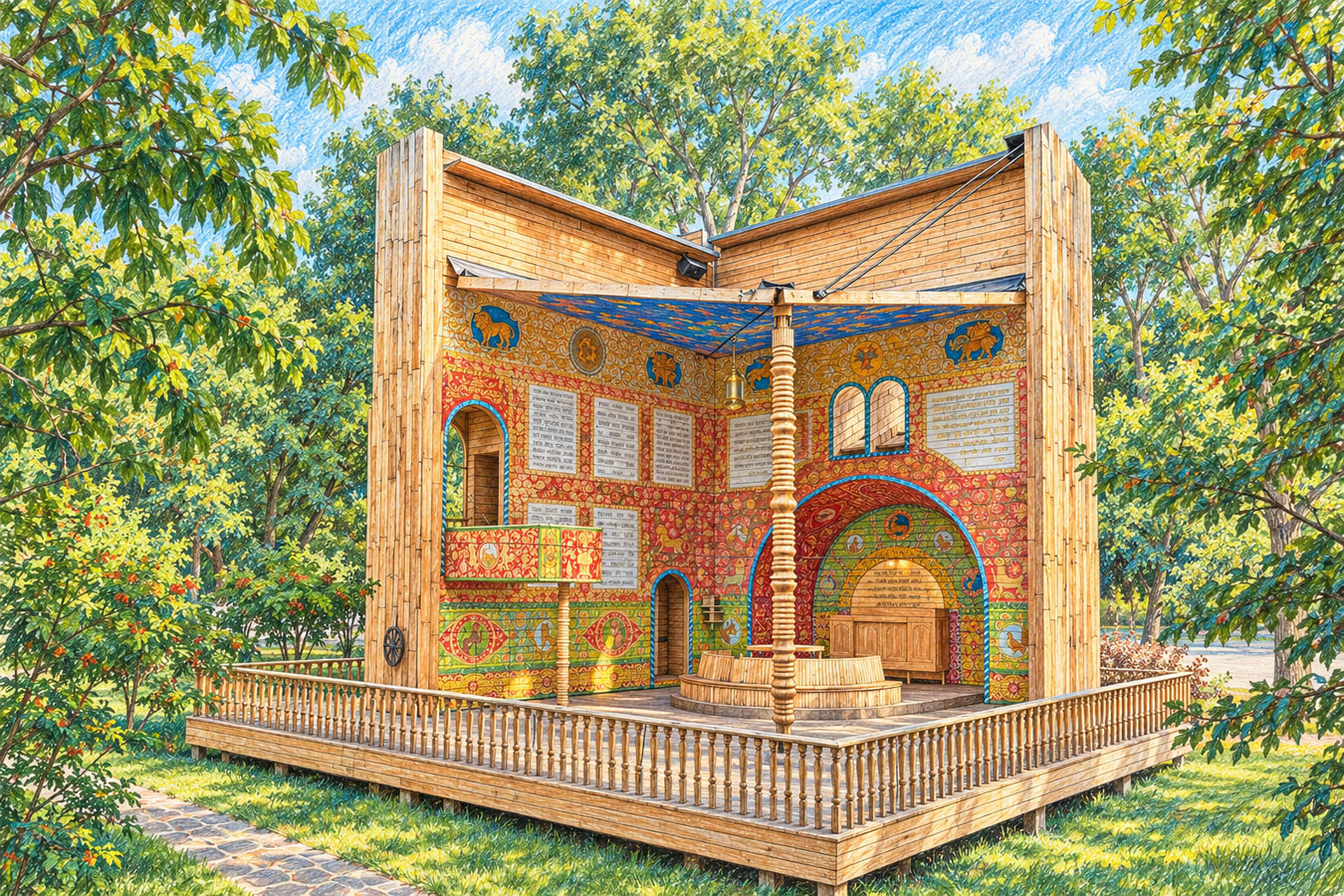
In Babyn Yar, among the trees, near the bronze Menorah, stands a wooden structure eleven meters high. At first glance, it’s hard to understand what is in front of you. A vertical structure made of oak, a metal frame, practically no familiar signs of a religious building. But when people start turning a special wheel, the walls come into motion, the roof opens, benches and a prayer space appear.
In front of visitors is a synagogue. A real one, although completely unusual.
It is called a “Place for Reflection.” Built in Kyiv in 2021 according to the project of Swiss architect Manuel Herz, specifically for the Babyn Yar Holocaust Memorial Center. Jewish prayers are written on the walls, the paintings resemble the interiors of destroyed Ukrainian synagogues, and the flowers on the ceiling repeat the arrangement of stars over Kyiv on the night when the Nazis began the mass murder of local Jews.
This structure has a complex biography. It appeared thanks to an international memorial project, survived conflicts around construction on historical land, and received architectural awards. Less than a year after the opening, Russian missiles struck the Babyn Yar area. The large museum project was halted, and the synagogue itself now exists in completely different conditions.
What is the Babyn Yar Holocaust Memorial Center
The Babyn Yar Holocaust Memorial Center (BYHMC) is an independent charitable, research, and memorial organization established in Kyiv in 2016. Its mission is to preserve the memory of Holocaust victims, restore the names of the deceased, study archives, and create a modern museum complex.
The initiative was announced on September 29, 2016, on the 75th anniversary of the tragedy. The charitable foundation was officially registered on October 18 of the same year.
The center’s facilities are located in different parts of the historical Babyn Yar ravine in Kyiv, near the Dorogozhychi metro station. It is not a single fenced museum area: there are monuments, park spaces, former cemeteries, and separate memorial structures. BYHMC should not be confused with the state National Historical and Memorial Reserve ‘Babyn Yar’ — these are two independent organizations.
Among the implemented objects of the Memorial Center are four memorial installations, each of which tells the story of Babyn Yar in its own way.
“Mirror Field” (September 29, 2020). A round mirror platform with a diameter of about 40 meters with ten metal columns six meters high. The surfaces have 33,771 bullet holes — the number of Jews killed by the Nazis on September 29–30, 1941. The columns resemble destroyed trees, symbolizing broken human lives. During the day, the installation reflects the sky, at night light passes through the holes, archival recordings and the names of the deceased are heard.
The book-synagogue “Place for Reflection” (2021). Created according to the project of Swiss architect Manuel Herz. The first religious ceremony took place on April 7, the official opening on May 14. The wooden structure eleven meters high opens like a giant prayer book. Its interior resembles destroyed ancient synagogues of Ukraine, and the ceiling reproduces the starry sky over Kyiv on September 29, 1941. It symbolizes the preservation of Jewish tradition and the continuation of life after the Holocaust.
“Crystal Wall of Crying” (October 6, 2021). A work by world-renowned artist Marina Abramović, presented on the 80th anniversary of the tragedy in the presence of the presidents of Israel, Ukraine, and Germany. A forty-meter wall made of Ukrainian anthracite contains 93 large quartz crystals. According to the artist’s concept, it symbolically continues the Jerusalem Wailing Wall. Black coal and transparent crystals represent darkness and light, death and hope. Visitors can touch the crystals — the space is designed for personal prayer, memory, and reflection.
“A Look into the Past” (2020–2021). A series of installations in Babyn Yar and other parts of Kyiv. Special stone structures contain monoculars with historical photographs by German war photographer Johannes Hähle, taken during the occupation. They were installed at the exact points from which the shots were originally taken. The visitor looks into the lens and sees what happened at this very place in 1941. The compositions also use parts of a dried tree without roots — a symbol of broken lives and destroyed family memory. One of the installations was created by Ukrainian artist and architect Anna Kamyshan.
Initially, the construction of a large museum complex with exhibition halls, an archive, research, and educational centers was planned. After the Russian invasion in February 2022, large-scale construction was halted, but the organization continued its work: searching for the names of victims, digitizing historical documents, collecting photographs, restoring family histories, organizing exhibitions, and educational events.
The General Director is Maksym Yakover, the Chairman of the Supervisory Board is Natan Sharansky, a well-known Israeli public figure and former Prisoner of Zion.
The scale of this work is detailed in our material ’29 Thousand Returned Names and Almost 10 Million Documents: Why Natan Sharansky Continues to Travel to Kyiv During the War’.
Official resources: Babyn Yar Memorial Center website and YouTube channel of Babyn Yar Holocaust Memorial Center.
Why the synagogue was built specifically in Babyn Yar
Kyiv, 1941–1991
Babyn Yar is a historical ravine in the northwestern part of Kyiv, near the modern districts of Dorogozhychi and Syrets. Today it is a memorial area, but before World War II, there were ravines, cemeteries, and city outskirts.
On September 19, 1941, Kyiv was occupied by German troops. Nine days later, announcements appeared on the streets: all Jews of the city were ordered to appear at a designated gathering place on the morning of September 29 with documents, money, valuables, and warm clothing. Many thought it was about resettlement.
In reality, people were directed to Babyn Yar. There they were forced to leave their belongings, undress, and proceed in groups to the execution site. The killings were carried out by SS units, German police, and auxiliary forces, including Sonderkommando 4a of Einsatzgruppe C led by Paul Blobel.
On September 29–30, 33,771 Jews were killed. This is not a later approximate estimate, but a number from the preserved report of the Nazi units themselves. The shootings took place on the eve of Yom Kippur — the Day of Atonement, one of the most important days in the Jewish calendar.
The killings continued until 1943. Among the subsequent victims were Jews, Roma, Soviet prisoners of war, patients of a psychiatric hospital, and other people. The United States Holocaust Memorial Museum estimates the total number of victims in Babyn Yar during the German occupation at about 100,000 people.
After the war, the Soviet authorities avoided separate public recognition of the Jewish component of the tragedy for decades. In 1976, a large monument to the deceased citizens and prisoners of war appeared, but Jews as the main group of victims of the September 1941 shootings were not highlighted in its official dedication.
Only in 1991, on the fiftieth anniversary of the tragedy, was a bronze Menorah installed — a seven-branched candelabrum that became a place for Jewish memorial ceremonies. It was next to it that a new synagogue arose thirty years later.
The story of how Soviet censorship tried to change the narrative of the crime is detailed in our material about the new Ukrainian edition of Anatoly Kuznetsov’s documentary novel ‘Babyn Yar’.
Who decided to build a synagogue here and where did the idea of the book come from
The Babyn Yar Holocaust Memorial Center, created in 2016, initially developed a project for a large museum complex. Research institutions, archives, exhibition spaces, and separate memorial objects were planned.
But construction on the territory associated with mass killings and burials raised questions from the very beginning. Is it permissible to erect large structures here? How not to disturb the historical landscape? Should the memorial be one large building or consist of several separate spaces?
After the appointment of film director Ilya Khrzhanovsky as the artistic director of the project in 2019, the concept received new development. Instead of one monumental museum, a system of separate objects, each with its own story, began to be considered.
In 2020, Holocaust historian Robert Jan van Pelt, a professor at the University of Waterloo in Canada, proposed creating a symbolic synagogue. Architect Manuel Herz from Basel, Switzerland, was invited. By that time, Herz had already designed a new synagogue in Mainz, Germany — a city that in the Middle Ages was one of the most important centers of European Jewry.
The idea of an unusual form arose from the architect’s reflections on what a synagogue is in general.
Herz turned to the image of a siddur, a Jewish prayer book, and children’s pop-up books, whose pages unfold into three-dimensional pictures. He decided to combine these two structures: the prayer book becomes a building, and the very unfolding of the book is an action that unites people.
This was a rather bold choice for Babyn Yar. Instead of a heavy, immovable monument, a structure was proposed that constantly changes shape and requires human participation. Herz wanted visitors not just to observe the architecture but to become part of what was happening.
Six months for construction, a century-old oak, and a roof weighing several tons
Design began in October 2020. By April of the following year, the synagogue was almost ready. Only about six months — an extremely short time for such a non-standard structure.
The work proceeded simultaneously: Ukrainian engineers designed the mechanical system, builders assembled the steel frame, carpenters prepared wooden elements, and artists painted the interior.
In the closed position, the building looks like a vertically placed book about eight meters wide and eleven meters high. Its base is oak wood with an internal metal frame. According to architectural documentation, the project’s area is about 150 square meters.
The wood was collected from old structures in various regions of Ukraine. The age of the wood exceeds one hundred years. For Herz, it was essential to use material that existed before the Holocaust and has survived to this day.
The structure is opened by a special mechanism. When the wheel is turned, the wooden parts gradually move, forming the roof, an internal balcony, benches, and a bimah — an elevation from which the Torah is read during worship. The architect conceived the manual opening as a joint action of several people. At the same time, the technical possibility of using an auxiliary motor drive is provided.
The work was carried out by Ukrainian specialists. The engineering part was developed by Dmytro Pysarevaliy and Yaroslav Novytsky, construction supervision was handled by Oleksandr Laptev, and the general contractor was the Kyiv company Budsok. The lighting design was created by the Ukrainian company Expolight.
There is also a less noticeable but extremely important feature. The synagogue was installed on a raised platform, without a deep foundation. This was done intentionally to minimize interference with the historical soil. Subsequently, the issue of land became one of the main subjects of public conflict around the project.
Inside — the vanished world of wooden synagogues of Ukraine
When the structure is open, the interior appears before the visitor, completely unlike familiar modern prayer halls.
Bright plants, animals, floral ornaments, decorative inscriptions. The model was taken from the wooden synagogues of the western Ukrainian lands of the 17th–18th centuries, primarily Khodoriv and Hvizdets. Their rich paintings were a characteristic part of the Jewish culture of Eastern Europe. Many such structures perished during World War II, and the original appearance is now known mainly from drawings and archival photographs.
The walls of the new synagogue were painted by Ukrainian artist Halyna Andrusenko. The ceiling design was handled by the Kyiv team CiForma. Other Ukrainian specialists also participated in the work — from mechanics to wood craftsmen.
The walls feature the texts of the prayers “Shema Yisrael” and “Kaddish.” These names are well known to Israelis. But there is a detail that deserves explanation: above the Aron ha-Kodesh, a special cabinet for storing Torah scrolls, is a blessing for turning a bad dream into a good one. Its historical sample was written in the old synagogue of Hvizdets.
The synagogue of Hvizdets itself was located in the territory of modern Ivano-Frankivsk region. It was famous for its complex wooden structure and paintings. Today the original building no longer exists. Therefore, the artistic solution in Babyn Yar does not copy one specific old synagogue but returns elements of an entire lost architectural tradition.
The fate of another similar heritage is discussed in our material about the Great Synagogue of Stryi from 1817, which survived the Holocaust and the Soviet attempt to convert it into a swimming pool. In Stryi, it is about preserving an authentic historical building. In Babyn Yar, it is about a modern memorial that used artistic motifs of the vanished Jewish world.
Why each flower on the ceiling corresponds to a star
The ceiling of the synagogue seems like an ordinary decorative composition of plants, birds, and other colorful images. But the arrangement of the flowers is not random.
Each flower corresponds to a specific star. Together they reproduce the picture of the starry sky over Kyiv on the evening of September 29, 1941 — the first day of mass shootings.
Herz explained this decision by the desire to connect the modern visitor with a specific historical moment. Not to show scenes of murder, not to imitate what happened in the ravine, but to preserve the image of the sky that was over the city on the day of the crime.
Interestingly, the meaning of the painting can go unnoticed. A person looks at the bright flowers, and before them, it turns out, is a celestial map. The architect did not turn it into a literal illustration of the tragedy.
April and May 2021: why two opening dates meet
The synagogue is often dated May 14, 2021. This is the correct date of the official public opening, but the religious ceremony took place earlier.
On April 7, on the eve of Yom HaShoah — Israel’s Holocaust and Heroism Remembrance Day, rabbis, including Yaakov Dov Bleich, gathered in Babyn Yar. During the ceremony, Torah scrolls that survived the Holocaust were used.
The project was supported by former Chief Ashkenazi Rabbi of Israel Yisrael Meir Lau, himself a Holocaust survivor. In his assessment, the creation of a prayer space at the site of mass murder meant the continuation of Jewish religious life.
And on May 14, the state public opening of the ‘Place for Reflection’ took place. The date was timed to the Day of Remembrance of Ukrainians who saved Jews during World War II. Ukraine celebrated it at the state level for the first time in 2021.
Present were Prime Minister Denys Shmyhal, Head of the President’s Office Andriy Yermak, representatives of Jewish communities and other denominations, Righteous Among the Nations and their relatives. Among the participants were Rabbi Moshe Reuven Azman and the head of the Ukrainian Greek Catholic Church Sviatoslav Shevchuk.
Thus, the April ceremony was primarily associated with Jewish memory of the Holocaust, while the May ceremony also with Ukrainian memory of those who saved Jews, risking their own lives.
Why a conflict arose around the synagogue
The history of construction was not limited to ceremonial events. Even before the opening, a serious dispute arose about the permissibility of erecting the object on the chosen site.
One of the most well-known critics was Iosif Zisels — a Ukrainian dissident, former Soviet political prisoner, and activist of the Jewish public movement.
Opponents of the construction argued that the site near the Menorah belongs to the territory of the former Kyryliv Orthodox cemetery. They believed that the appearance of a new structure on the historical necropolis violates the principles of respect for burials. Objections were also expressed by some representatives of Jewish organizations.
In March 2021, public organizations went to court, challenging the construction and related permits.
Representatives of the Memorial Center responded that special studies were conducted on the chosen site, no burials were found directly under the object, and the structure does not provide for a deep foundation. At the same time, during studies of the upper soil layers, individual bone fragments were found, and the question of their origin also became a subject of discussion.
There was also a broader conflict around the very concept of the Memorial Center. Among the participants in the funding were Viktor Pinchuk, Mikhail Fridman, and German Khan. The Russian origin of some sponsors raised concerns among critics about the independence of the project and possible influence on the interpretation of history. Representatives of the center rejected accusations of political dependence in research work.
Some Ukrainian historians and public figures advocated for the development of a state memorial project that would provide for more cautious work with the historical landscape.
In other words, the dispute concerned several issues at once: who is responsible for memorialization, what is permissible to build on the territory of former burials, who finances research, and who makes decisions about how the history of Babyn Yar will be presented.
There was no unified position of all Jewish organizations in Ukraine here. Some opposed the construction, others participated in the opening of the synagogue. This conflict is part of its history, and excluding it for the sake of a beautiful story about architecture would be wrong.
October 2021: Presidents of Israel, Ukraine, and Germany in Babyn Yar
By the eightieth anniversary of the mass shootings, the synagogue had already become part of the memorial complex, which included other artistic objects.
Among them is the ‘Mirror Field,’ an installation with metal columns, mirror surfaces, holes reminiscent of bullet marks, and sound accompaniment.
Another object is Marina Abramović’s ‘Crystal Wall of Crying.’ It is made of anthracite and quartz crystals, and its name and artistic solution refer to the Wailing Wall in Jerusalem.
On October 6, 2021, an international memorial ceremony was held in Kyiv, attended by the Presidents of Ukraine Volodymyr Zelensky, Israel Isaac Herzog, and Germany Frank-Walter Steinmeier. Herzog recited the memorial prayer ‘Yizkor.’
For Israeli society, this event had a very specific significance. Kyiv and other cities of Ukraine before the war were home to numerous Jewish families. Among today’s residents of Israel are descendants of those who managed to evacuate, survived the occupation, or lost relatives in Babyn Yar. This is not the story of some distant community that we know only from museum documents.
By this time, the structure had already received international architectural recognition. In 2021, the synagogue was noted at the Dezeen Awards as the small building of the year, as well as in the public vote in the cultural buildings category.
Russian strike on March 1, 2022: what really happened to the memorial
Less than a year after the opening, Russia began a full-scale invasion of Ukraine.
On March 1, 2022, Russian missiles struck the area of the Kyiv TV tower near Babyn Yar. Five people were killed. The first reports of damage to the memorial area caused a sharp international reaction.
There were also claims that the synagogue itself was destroyed. Later it turned out that this was not true.
According to Natan Sharansky, who held the position of chairman of the supervisory board of the Memorial Center, the synagogue and a number of other memorial objects survived. The strike affected nearby areas, including the Jewish cemetery and the Soviet sports complex. The direct target of the Russian strike was in the area of the TV tower.
The distinction is important. The Russian attack did indeed occur near one of the main Holocaust memorial sites, led to the death of people and damage, but did not destroy the book-synagogue itself.
NANews — News of Israel | Nikk.Agency previously reported on how the work of the Memorial Center changed after the start of the full-scale war. The construction of the large complex was stopped, but archival, educational, and research activities continued. The synagogue was preserved, although the conditions for visiting it became dependent on the military situation.
The synagogue remains in Kyiv, and its history is shown in Canada
In April 2023, a separate exhibition dedicated to the Babyn Yar synagogue opened at the Koffler Gallery in Toronto.
Its title is The Synagogue at Babyn Yar: Turning the Nightmare of Evil into a Shared Dream of Good.
The project was prepared with the participation of Manuel Herz and historian Robert Jan van Pelt. The exhibition featured a large architectural model of the synagogue, photographs, and materials about the construction. Photographers Iwan Baan, Maksym Dondyuk, and Edward Burtynsky participated.
The exhibition opened on April 17, 2023, and was later extended until January 14, 2024. It simultaneously told about the mass killings of 1941, the appearance of the memorial structure in 2021, and its fate after the Russian invasion.
This was another way to show Babyn Yar to an international audience. People who have never been to Kyiv could see how the synagogue was created, why its interior resembles lost wooden prayer houses, and how architects tried to work with the memory of mass murder without turning the structure into an imitation of a historical building.
What remains of the idea five years later
By September 2026, the symbolic synagogue remains one of the most famous implemented objects of the Babyn Yar Holocaust Memorial Center. The war has changed its daily life: due to the threat of Russian missile and drone attacks, the structure is closed most of the time, and visits are usually possible as part of organized tours or special events.
Meanwhile, the research work continues. In September 2026, Natan Sharansky spoke about more than 29,000 identified names of the deceased, nearly ten million digitized archival documents, and tens of thousands of collected photographs. These are the data provided by Sharansky himself in an interview, not an independent assessment by the editorial team.
Read about how researchers reconstruct the fates of individuals from scattered documents in the NAnews article “29,000 Returned Names and Nearly 10 Million Documents: Why Natan Sharansky Continues to Travel to Kyiv During the War”.
In this context, the synagogue is just one part of a larger effort. It does not replace the state National Historical and Memorial Reserve “Babyn Yar,” does not substitute historical research, and is not a reconstruction of a pre-war prayer house.
But it has its own, rather rare quality. The creators did not attempt to build a structure at the site of the mass murder that would depict preserved antiquity. They used wood from different regions of Ukraine, motifs of destroyed synagogues, preserved prayers, and a modern engineering system.
The result is a space that literally has to be opened.
And here is something particularly understandable to the Israeli reader. In our country, many know the surnames of their ancestors, the names of Ukrainian towns and shtetls, sometimes preserved photographs of family homes. But what did the synagogue look like where the great-grandfather went? What paintings were on its ceiling? What was above the cabinet with Torah scrolls? Most often, there is no one left to answer. The building itself has long been gone.
The Kyiv synagogue-book does not bring destroyed communities back to life. It preserves some features of their culture and allows them to be seen not only in archival photographs but in an active space.
On the ceiling here remains the sky of September 29, 1941. On the walls are Jewish prayers. In the center is a place for reading the Torah.
And to get inside, you first need to open the book.