
The creation of the “Kultur-Lige” coincided with the period of the Ukrainian Central Rada, in the era of the “nation’s revival,” when it proclaimed national-cultural autonomy for minorities. Registered on January 28, 1918, by the Kyiv District Court. The founders of the organization were M. Zilberfarb, D. Bergelson, I. Dobrushin, Nahman Maizel, M. Litvakov.
To mark the anniversary of the branch’s creation, the Museum of Avant-Garde, the Museum of the History of Kyiv, together with the new branch within the framework of Avant-Garde Kyiv Fest 2025, presented two exhibition projects. These are the exhibitions “Avant-Garde. ARMU. History” and “Avant-Garde. Kultur-Lige“.
These are the first art exhibitions in the building of the Museum of Avant-Garde at 16 Lipska Street. This was reported by the Kyiv City Administration on November 20, 2025.
The project was implemented with the support of the Embassy of Israel in Ukraine, the Israeli Cultural Center “Nativ” in Kyiv, and the Honorary Consulate of Israel in the western region of Ukraine. These partners play a key role in cultural exchange and strengthening ties between Ukraine and Israel through art.
Opening of Two Key Exhibitions
Within the framework of the Museum of Avant-Garde, two important exhibitions have opened, which will reveal not only the artists but also the historical processes of that time:
The exhibitions “Avant-Garde. ARMU. History” and “Avant-Garde. Kultur-Lige” are held under one roof and showcase the most famous names of Ukrainian avant-garde, while the museum team continues to explore the weight of avant-garde ideas and defend cultural heritage from hybrid encroachments of the enemy – imperial Russia.
“The extraordinary importance of these initiatives is obvious today. Our mission is to actively return the names of Ukrainian avant-gardists to the modern cultural space. We strive to open the path to high art for everyone. At the same time, it is important for us to worthily present to the community and patrons the result of work on replenishing the collection of the Museum of Avant-Garde. This becomes possible thanks to the common care for our cultural heritage,” emphasized the Director of the Department of Culture of the Kyiv City State Administration, Serhiy Anzhiyak.
“Avant-Garde. ARMU. History”
This exhibition is dedicated to the Association of Revolutionary Art of Ukraine (ARMU), which actively developed in the 1920s and had a significant influence on the Ukrainian avant-garde. ARMU sought to break old canons and offered viewers a new approach to art through revolutionary ideas.
The exhibition “Avant-Garde. ARMU. History” features works by artists-participants of ARMU — Mykola Hlushchenko, Maria Kotliarevska, Oksana Pavlenko, Vasyl Sedliar, Ivan Padalka, Oleksandr Bohomazov, Vadym Meller, Vasyl Yermilov, Victor Palmov, Onufriy Biziukov, Mykhailo Boichuk, Oleksandr Khvostenko-Khvostov, Vladimir Tatlin, Anatol Petrytsky, Vasyl Kasiian, Oleksandr Dovhal, Mykhailo Zhuk, and Mykola Rapai.
These artists sought new forms to convey ideas of revolution and social justice.
“Avant-Garde. Kultur-Lige”
The exhibition project “Avant-Garde. Kultur-Lige” presents the legacy of the Jewish cultural and educational organization. Kultur-Lige operated from 1918 to 1924 in Ukraine and other regions of the then Russian Empire, and its composition included Ukrainian avant-gardists of Jewish origin. The exhibition features works by artists such as Marc Chagall, Mane Katz, David Shterenberg, Abraham Manievich, Ossip Zadkine, and others.
Here you can see paintings that reflect not only the evolution of avant-garde art but also the significance of Kultur-Lige as a cultural and educational force that supported theaters, schools, and libraries, as well as spread literature and art among the Jewish community.
These two exhibitions give viewers a unique opportunity to immerse themselves in the atmosphere of the early 20th century when art was not just a form but became an integral part of social and political changes.
Museum of Avant-Garde
The branch of the Museum of Avant-Garde was officially founded in November 2024 as the tenth branch of the Museum of the History of Kyiv. In May 2025, the Kyiv City Council supported the decision to provide the museum with premises in a historic building on Lipska Street, which is an architectural monument. The museum focuses on preserving and popularizing avant-garde art, exploring its influence on the cultural heritage of Ukraine and the world.
What is “Kultur-Lige”?
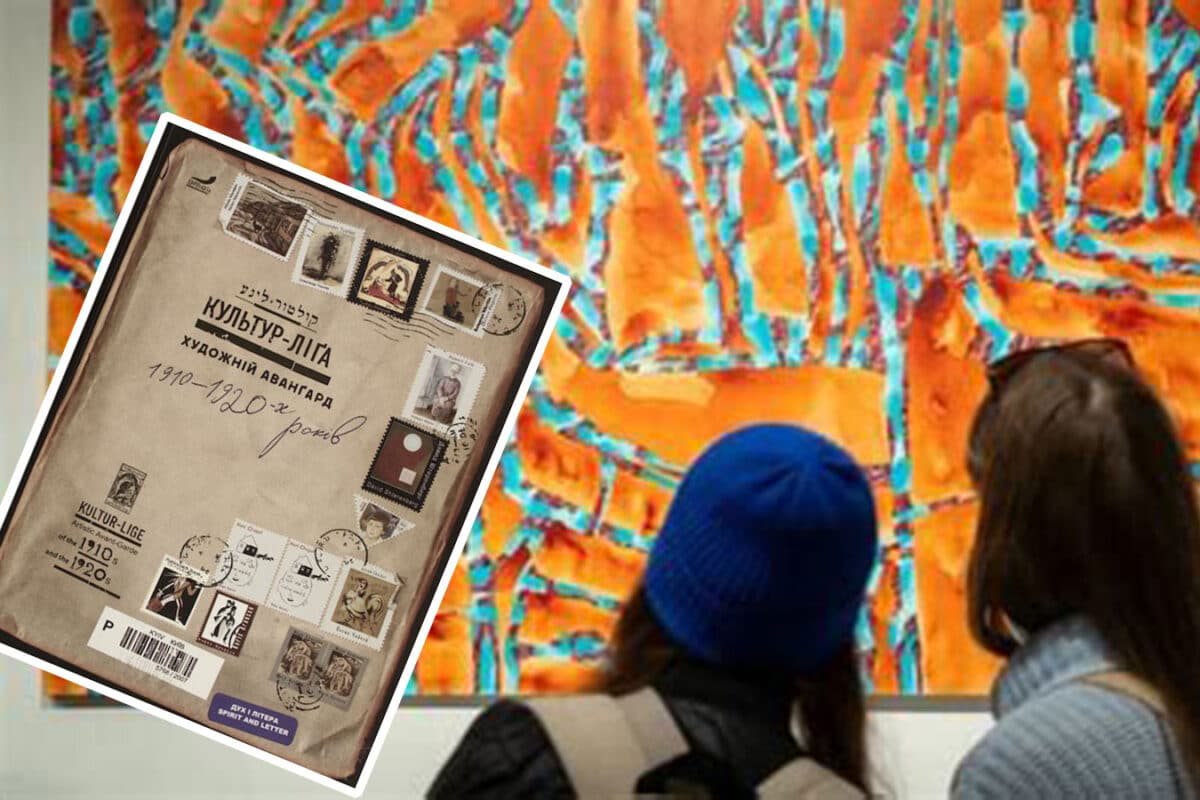
“Kultur-Lige” (Yiddish: קולטור-ליגע, “Kultur-Lige”, “League of Culture”, “League of Jewish Culture”, “Kyiv Kultur-Lige”) is a Jewish secular charitable and cultural-educational organization founded in 1918 in Ukraine. The organization played a key role in the development of Jewish culture, education, and art, as well as in creating cultural autonomy for the Jewish people in conditions of political instability.
Foundation and Goals
Kultur-Lige was registered on January 28, 1918, by the Kyiv District Court. The founders of the organization were M. Zilberfarb, D. Bergelson, I. Dobrushin, Nahman Maizel, and M. Litvakov. The creation of Kultur-Lige coincided with the period of the Central Rada when Ukraine sought national revival and was aimed at supporting and developing Jewish culture as an important component of national self-awareness.
The main task of Kultur-Lige was the development of secular Jewish culture in the Yiddish language, which at that time served as the language of the majority of the Jewish population of Eastern Europe. The organization actively promoted the ideas of cultural and educational autonomy for the Jewish community in Ukraine, striving to create conditions for the support and dissemination of art, literature, theater, music, and science among the Jewish people.
Structure and Activities
Kultur-Lige consisted of several sections: literature, music, theater, painting, sculpture, folk schools, preschool education, and adult education. Within its framework, branches were created throughout Ukraine, as well as beyond its borders, in other parts of the Russian Empire (Russia, Bessarabia, and other regions). By the summer of 1918, 27 branches had been created, and by the end of the year, their number had increased to 120. In 1924, the organization already had representations in cities such as Kyiv, Odessa, Berdychiv, Bila Tserkva, Kamianets-Podilskyi, as well as in a number of cities in the territory of the Soviet Union.
For coordination of work, a Central Commission (21 members, which met once a month) was created, and for current affairs — an Executive Bureau (7 members, which met weekly).
Educational and Enlightenment Activities
One of the main achievements of Kultur-Lige was the work on creating a network of new-type educational institutions that had no analogs in the Russian Empire. In 1918, the Jewish People’s University was opened, which became the first higher educational institution for Jews in Eastern Europe. The rector of the university was Moses Zilberfarb.
In Kyiv, for example, there were 5 schools, three of which were intended for adults, and two for teenagers aged 13 to 17. These schools taught not only Jewish history and Yiddish but also other subjects, including Jewish literature.
Kultur-Lige also organized and supported numerous cultural events, including literary readings, exhibitions, and lectures, which served as an important platform for promoting the ideas of Jewish culture and education in Ukraine.
Influence and Cultural Activities
Within the framework of Kultur-Lige, active publishing activities were launched, starting in 1918 with the creation of the “Kultur-Lige” publishing house, which began publishing books and publications in Yiddish. The publishing house specialized in literature of various genres: historical, philosophical, artistic, as well as popular science and children’s. In 1921, it became cooperative and began actively working with Jewish libraries, which began to open in the territory of the USSR.
In Kultur-Lige, theatrical activities were also supported. Already in 1919, the first Jewish theatrical studio was founded, headed by Yefraim Loiter. Subsequently, this studio became the basis for the First All-Ukrainian Jewish State Theater in Kharkiv.
Closure and Legacy
After the Soviet authorities came to power in 1924, the activities of Kultur-Lige were stopped, and the organization itself was closed. Most of its members were repressed, and its achievements in the field of education and culture were forgotten for decades. However, the legacy of Kultur-Lige continues to live in the works of art, literature, and theater created within its framework.
NANews — News of Israel | Nikk.Agency continues to monitor important cultural initiatives, emphasizing the significance of cultural exchange and the preservation of cultural heritage through art and history.
…
