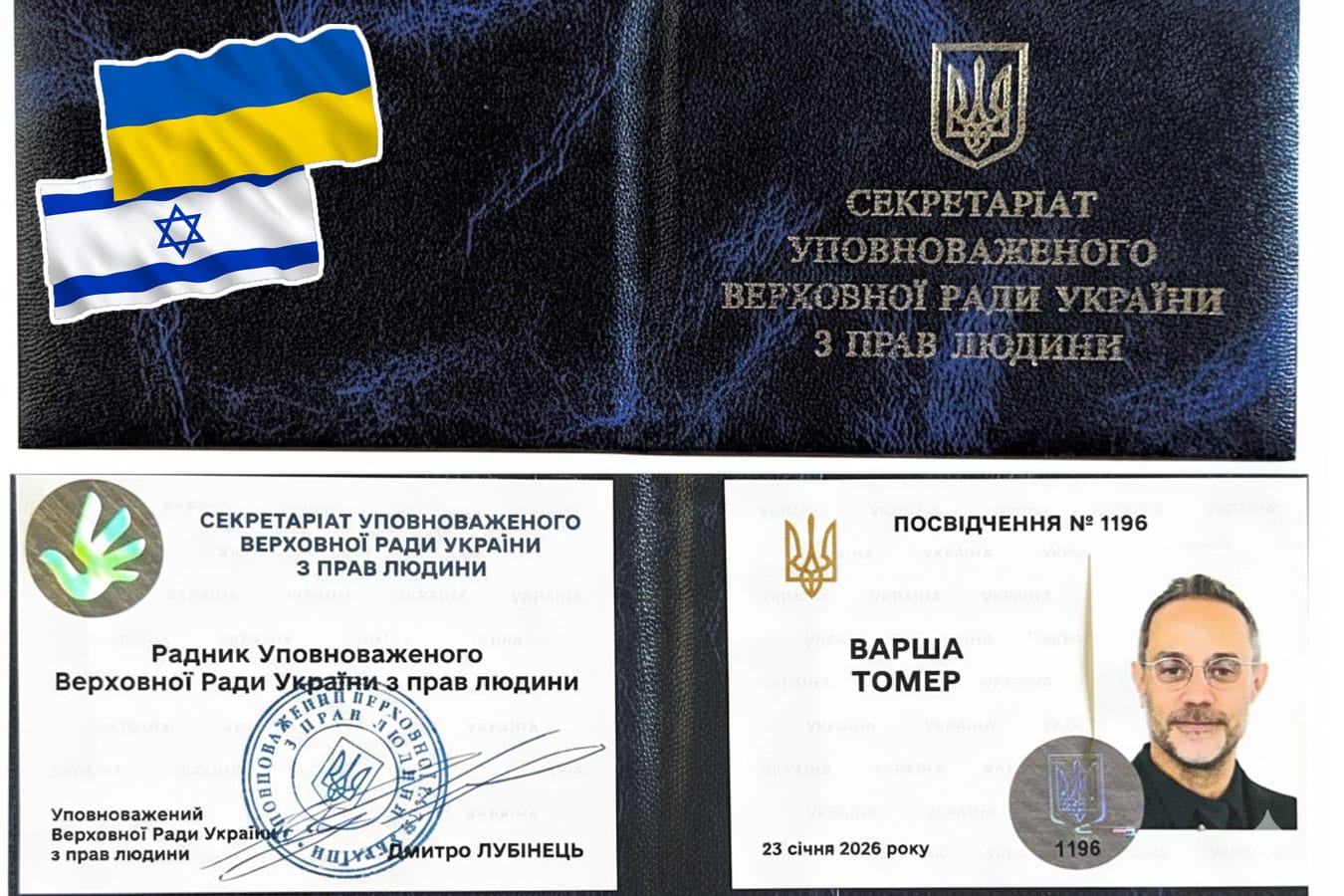
Israeli lawyer Tomer Warsha has been officially appointed as an external advisor in Israel at the Office of the Commissioner of the Verkhovna Rada of Ukraine for Human Rights. On his Facebook page, Tomer Warsha announced that the appointment has already been approved by the decision of the Ukrainian Ombudsman Dmytro Lubinets and came into effect on January 23, 2026.
In the Ukrainian Ombudsman’s office, his name is listed in the section “Representatives and Advisors Abroad“, where a network of contacts is being formed to protect the rights of Ukrainians outside the country.
Contacts listed:
State of Israel
Tomer Warsha
+972 54 255 2556
Tomer.Warsha@ombudsman.gov.ua
tomer@warsha-adv.com
Besides Israel, the Ukrainian Ombudsman has “advisors” (external advisors) in Canada, USA, Germany, Italy, Austria, Sweden, Norway, Denmark, Belgium, Czech Republic, Portugal, Greece, Estonia, Lithuania, Ireland, Bulgaria, Serbia, Montenegro, North Macedonia, Georgia, and Armenia, while “representatives” (official representatives) work in Poland, United Kingdom, Luxembourg, Slovakia, Spain, and Moldova.
The event seems unusual even by the standards of international human rights cooperation: it is not about a memorandum with a public organization or a private initiative, but about working with a state institution of Ukraine responsible for monitoring human rights compliance and interacting with the parliament.
Why this appointment is considered rare
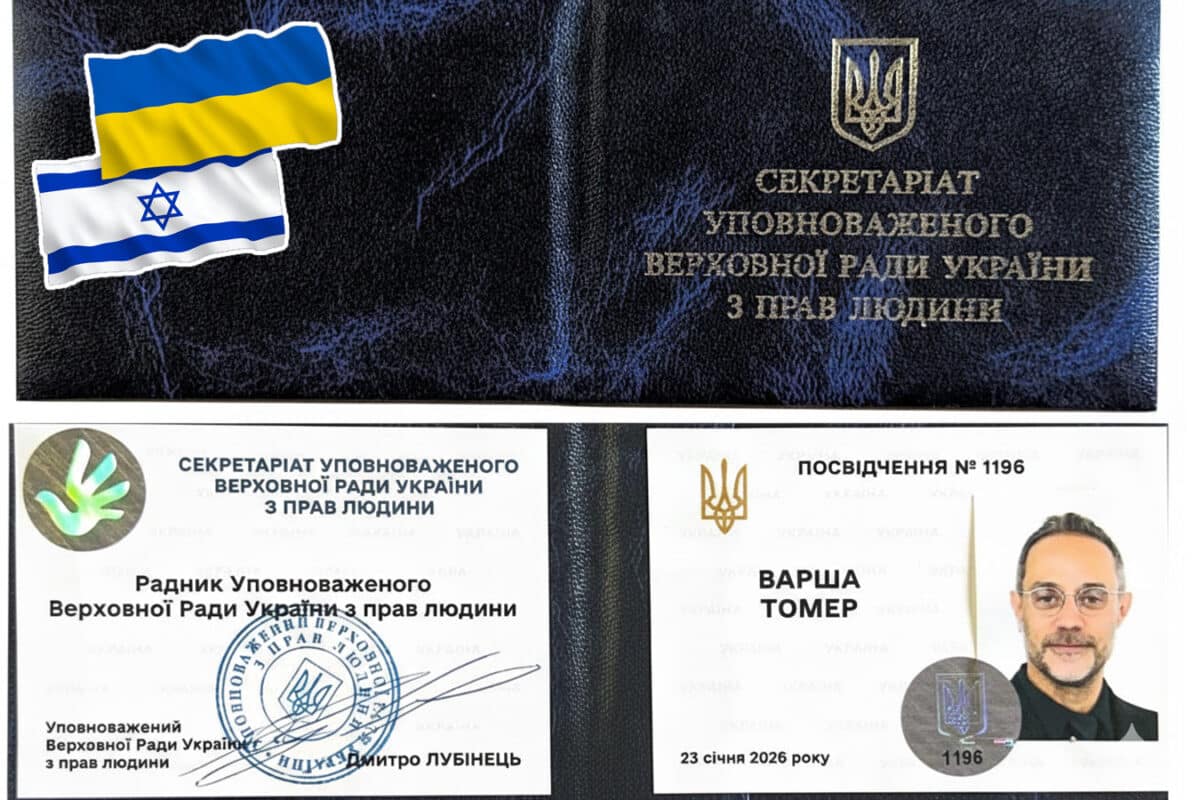
The Ukrainian Ombudsman institution itself is an independent mechanism accountable to the Verkhovna Rada of Ukraine. It does not replace the court or substitute agencies but works as a human rights “control layer”: it reviews appeals, records violations, forms positions, and conducts international contacts on human rights.
This is why the status of “external advisor” in a country where Ukrainians have accumulated many complex cases since 2022 does not seem symbolic. Rather, it is an attempt to make the channel of assistance and communication more sustainable and professional.
Who is Tomer Warsha and what is he known for in Israel
Warsha is the founder and head of a law firm specializing in immigration law and humanitarian issues. He is known as a human rights lawyer and as a person working at the intersection of migration, status, and human rights.
18th Rival St., Tel Aviv, tel.: 03-5615845,
website: www.warsha-adv.com
Email: office@warsha-adv.com
Facebook: https://www.facebook.com/warsha.weitzen.adv.rus
His role in the professional community is particularly noted: Warsha heads the immigration committee in the Israel Bar Association. This is an important marker — not about “media presence,” but about professional status and participation in developing approaches to migration practice.
The firm’s recognition in industry rankings is also mentioned, including Dun’s 100 for 2024, where the firm’s immigration direction is again featured as one of the leading ones.
What preceded the appointment: helping Ukrainians after the war began
The key context of this story is Warsha and his office’s work with Ukrainian citizens in Israel after the start of the full-scale war.
According to the description, it was not just about consultations but about legal actions against restrictive practices: decisions related to entry were challenged, and approaches perceived as selective application of policy towards Ukrainian citizens were contested.
A particularly notable petition, filed at the request of Ukrainian diplomatic representatives, is highlighted. It is reported that it led to the cancellation of a decision by the Israeli Ministry of Interior and became a factor that helped reunite families.
This episode is important for one reason: it explains why the appointment does not seem “for profile.” In such matters, reputation is built on results, and here the result is not an abstract “dialogue,” but a change in a specific administrative decision.
The role of the Ukrainian Embassy in Israel
A separate line in the discussion of the appointment is the fact that Warsha’s law office is listed among the lawyers on the website of the Ukrainian Embassy in Israel. A standard disclaimer is made: the list is purely advisory and compiled based on interaction experience.
Such wording is typical for diplomatic websites: embassies do not take responsibility for private client-lawyer relationships. But the mention itself, especially in the sensitive topic of Ukrainian appeals after 2022, is usually perceived as indirect confirmation of practical interaction.
What exactly will the external advisor to the Ombudsman do
It is important to immediately define the boundaries: an “external advisor” is not a position in the Israeli power system and not a “replacement for the Ministry of Interior” or consulate. It is a consultative and coordination role that helps build professional connections and support international human rights communications.
In his new role, Warsha, as reported, will assist the Ukrainian Ombudsman’s office in three areas:
- protection of human rights in cases related to the stay and status of Ukrainians in Israel;
- development of international connections of the Ukrainian human rights institution;
- interaction with legal and public structures outside Ukraine.
In simple terms, it is about providing the Ukrainian human rights institution with a clear “contact on the ground” — a person who understands the local legal reality of Israel, knows the professional environment, and can translate sensitive issues from the level of emotions and chaos to the level of legal procedures.
This is where the editorial position is contextually fixed: NAnews — Israel News | Nikk.Agency perceive this story as a practical step that can make working with difficult Ukrainian cases in Israel more structured.
Why this fits into the agenda of the Ukrainian Ombudsman
Ukraine appointed Dmytro Lubinets as Ombudsman in 2022, and since then, the office has publicly emphasized several priorities: the rights of those affected by armed aggression, children’s rights, issues of places of detention, the security and defense sector, as well as international cooperation and European integration.
If this list is translated into practical terms, it becomes clear why countries where Ukrainians face status and humanitarian problems en masse become points where new partners and advisors are sought. In this logic, Israel is one of the key directions: there are many mixed families, many “borderline” situations, many cases where bureaucracy conflicts with humanitarian logic.
Diplomatic significance for Israel
The appointment of an external advisor in Israel is also a diplomatic signal. It shows that the Ukrainian side is interested not only in consular communication but also in professional legal dialogue at the level of human rights.
This is a sensitive area for any country: issues of migration policy and humanitarian exceptions inevitably become subjects of public discussion. In this sense, the emergence of a stable professional channel can simultaneously reduce the chaos of individual stories and increase the transparency of how such stories are resolved.
What is known about the “headquarters” in Tel Aviv
Reports about the appointment also mention that preparations for opening a “headquarters” in Tel Aviv will be completed in the coming weeks. After that, contact details, work schedule, and interaction procedures will be published on social media.
The term “headquarters” may sound different, but the meaning is clear: they want to create a public and understandable format of communication so that people do not have to search for help routes through random chats and retellings.
What this changes for Ukrainians in Israel in practice
The mere fact of the appointment does not turn complex migration issues into “simple” ones. It does not cancel procedures and does not guarantee results in every case.
But it can change something else: the speed and quality of communication between the Ukrainian human rights institution and the professional environment of Israel, as well as the ability to quickly raise cases where it is not just about paperwork, but about human rights — about families, children, humanitarian grounds, and vulnerable groups.
In the coming weeks, it will become clearer whether this mechanism will be widespread and accessible, or whether it will primarily work on the most difficult human rights cases. But it is already clear: the Ukrainian side is establishing a professional channel in Israel, formalized not at the level of slogans, but through a specific figure of a lawyer with public practice.