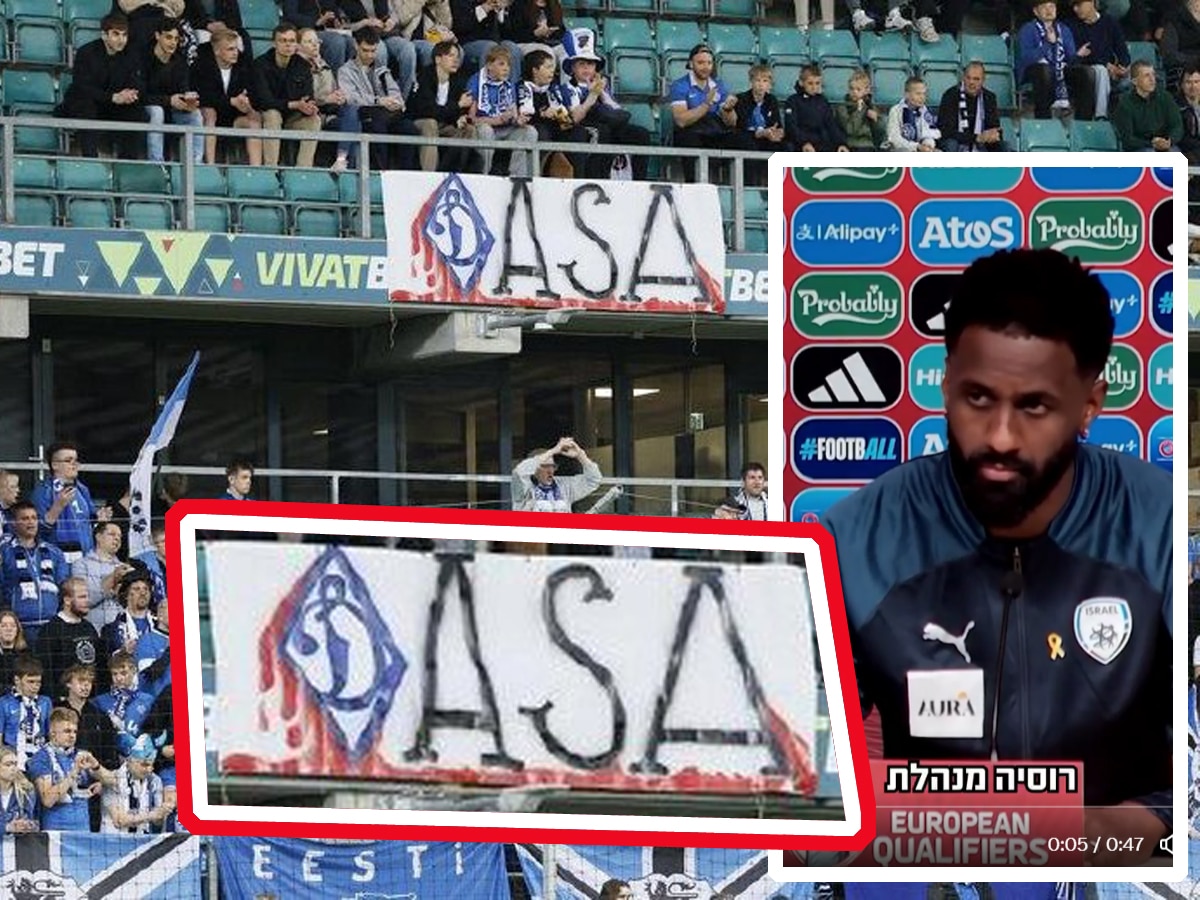
Protest by Estonian Fans in Tallinn
On June 6, 2025, at the A. Le Coq Arena in Tallinn, the Israel national team defeated Estonia 3–1, but the entire match was overshadowed by a political protest. A massive banner reading DASA appeared in the stands, with the letter “D” styled as the logo of Moscow’s Dynamo, from which symbolic drops of red blood streamed.
This gesture targeted the fact that in September 2022, seven months after the start of Russia’s full-scale aggression against Ukraine, Eli Dasa transferred from Maccabi Haifa to Dynamo Moscow.
Fans’ Reaction on the Field
Each time Dasa touched the ball, the stands erupted in whistles and shouts of “Shame!” and “No normalization of the aggressor!” The protest reached nearly 100 decibels, creating the impression that the stadium was recording a roar of dissent rather than the national team’s victory. For Estonians living close to the conflict zone, such a transfer appeared not merely a sporting decision but a political statement.
UEFA Intervention
During the half-time break, UEFA inspectors arrived in the stands and demanded the immediate removal of the banner. In less than ten minutes, the fabric was dismantled, and the match continued without further incidents.
Questioning at the Team Hotel
On the morning of June 7, Estonian police visited the hotel housing the Israel national team with the intent to question Dasa on charges of “pro-Russian agitation.” The questioning lasted about an hour, but thanks to intervention by the Israeli Ministry of Foreign Affairs and the Estonian Football Association, the police left the hotel without filing any charges.
Eli Dasa’s Statement
At the pre-match press conference, journalists asked Dasa: “Is it ethical for you to play in a country conducting military actions in Ukraine?” In response, Eli Dasa emphasized:
“I am an ethical person. I am grateful for the years I spent in Russia as a player, and I do not engage in politics. I often get asked, ‘How can you play in Russia if you are from Israel?’ I came from Israel and am proud to be a citizen of that country playing in Russia. I am grateful to the club that treats me as an athlete. That’s it; may we move on to the next question.”
Political Context and European Perception
The transfer of Eli Dasa to Dynamo Moscow amid war is seen by European fans as an attempt to “normalize” aggression through sport. They believe that if political or cultural events do not help condemn violence, they become a tool of propaganda. This protest was purely political and held no antisemitic motives—fans criticized the support of a regime, not the player’s nationality.
Absence of Antisemitism
No antisemitic slogans or symbols were heard during the protest. All official European and Estonian authorities confirmed that the action was directed against the choice of club, not against the athlete’s Jewish identity.
Conclusions and Lessons for Israel
It is important for Israelis to remember their own historical experience: cooperation with regimes that violate human rights leads to long-term reputational risks. In today’s world, sport, culture, and business form part of a unified front of values, and there is no “neutrality” in the face of aggression.
Reputational Risks and Recommendations
Every contract and public statement is automatically perceived as a political stance. Governmental and sports institutions must clearly declare that ties with aggressive regimes contradict Israel’s official line. The Football Association should develop an ethical code for players that takes the geopolitical context into account.
Personal and corporate decisions influence international perception. Only by upholding the principles of the democratic world and learning from Europe’s reaction can Israel maintain partner trust and strengthen its authority.