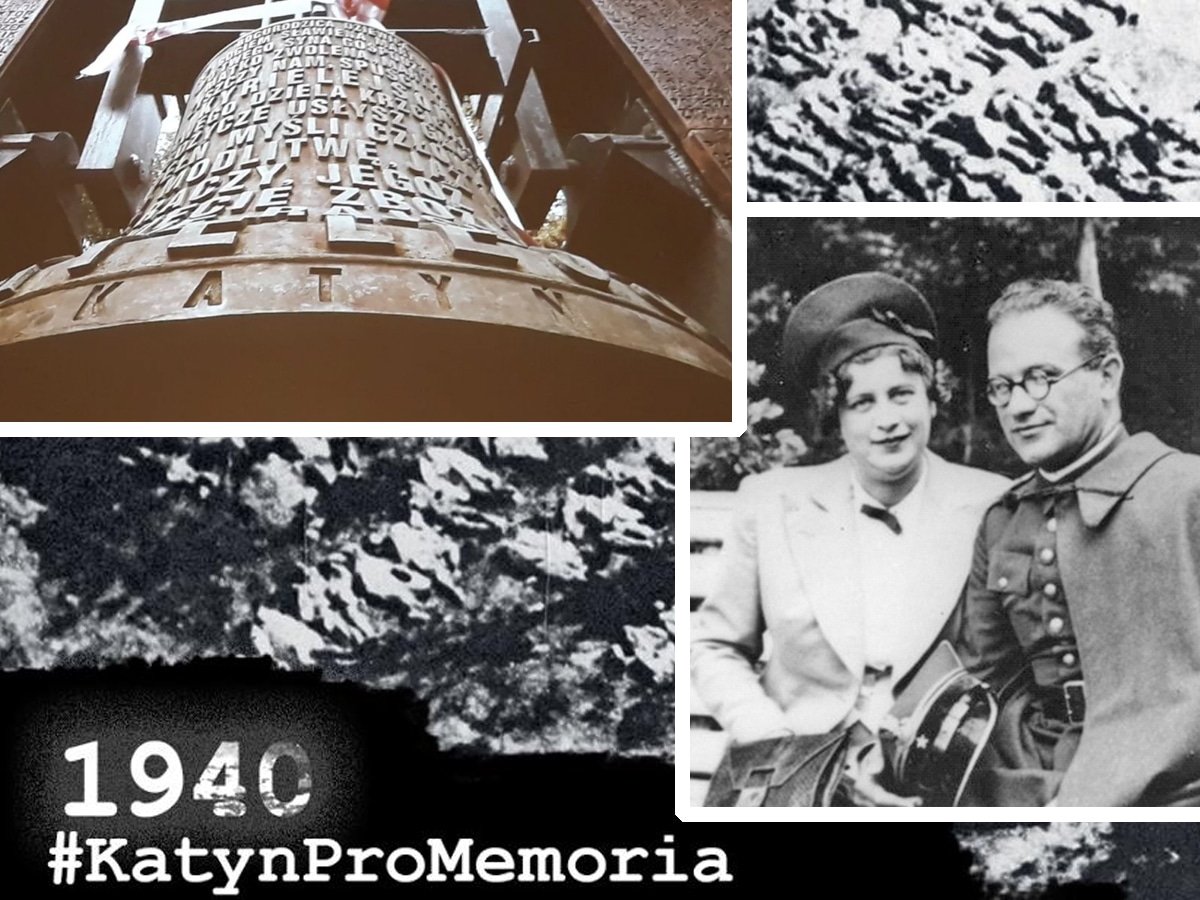
April 13 is not only a day of remembrance for the officers of the Polish Army who were executed by the NKVD in 1940, but also a day that reminds us of the tragic events that affected many nations. Among the victims were not only a large number of Polish officers but also Jewish officers.
This day serves as an important reminder of how the tragedy of World War II continues in the collective memory of nations and how it is connected to the present.
After the Soviet invasion of Poland, between 232,000 and 255,000 soldiers of the Polish Army and other formations were captured. More than half of these people were sent by the Soviets to prisoner-of-war camps, where, according to NKVD reports, there were 130,242 Polish citizens. From them, 8,348 officers were separated and placed in camps in Kozelsk, Ostashkov, and Starobelsk, then “transferred to the NKVD’s disposal.” In the spring of 1940, under Stalin’s order, the NKVD executed almost all of the captured Polish officers. According to various estimates, the mass graves — so-called “pits of death” — in Katyn, Tver, Bykivnia, Kharkiv, and other locations contain between 15,000 and 24,000 Poles.
Day of Remembrance for the Victims of the Katyn Crime: Historical Context
The Day of Remembrance for the Victims of the Katyn Crime was officially established by the Sejm of the Republic of Poland in 2007. This day was dedicated to the memory of Polish prisoners of war who were executed by the NKVD in 1940. The tragedy that occurred in Katyn became a symbol of the crime committed by the Soviet regime against the Polish people. In Katyn, around 20,000 Polish officers were executed, among whom there were many Jewish officers. The difficulty in determining the exact number of Jews among the victims is due to the fact that many names were not recorded, and most of the victims’ relatives perished during the Holocaust.
Quote: “On April 13, 1943, the radio station ‘Radio Berlin’ reported the discovery of mass graves of Polish officers in the Katyn Forest,” — thus began the story that immortalized the Katyn tragedy in global memory.
Facts and Data: Number of Jewish Officers Killed
According to historical research, at least 438 Jewish officers were among those killed in Katyn, along with many Polish officers of Jewish origin who served in the Polish Army. This fact highlights the deep historical ties between the Polish and Jewish peoples. In 1939, there were about 100,000 Jews in the Polish Army, and 6-7% of them held officer ranks.
Among them were not only active-duty officers but also reserve specialists — doctors, pharmacists, lawyers, and engineers, whose lives were tragically cut short by the NKVD’s actions.
Professor Marian Fuks from the Jewish Historical Institute published lists of Jewish victims in the 1990s in the “Folkshtimme” publication. In the book by Binyamin Meirchak, there are the names of 231 Jews killed in Katyn, 188 in Kharkiv, and 19 Jews who died in Medno. Among them were both active-duty officers and reserve officers — doctors, pharmacists, lawyers, and engineers.
How many Jews were among the victims:
- In Katyn, 231 Jewish officers were killed.
- In Kharkiv, 188 Jewish officers were killed.
- In Medno, 19 Jewish officers were killed.
There is also a study stating that “it should be assumed that the ratio of Jews to non-Jews was the same as in the camps. According to my estimates, there were at least 1,000 Jews among them. Thus, out of 26,000 people listed in the Politburo’s resolution, there should have been at least 2,000 Jews. Therefore, we must state that the first mass extermination of Jews on Soviet territory occurred in April 1940.”
Baruch Shteinberg: Chief Rabbi of the Polish Army and Victim of Katyn
One of the most well-known Jewish officers who perished in Katyn was Baruch Shteinberg, the chief rabbi of the Polish Army. He was born in Peremyshliany, now in Ukraine, and became the head of the spiritual care of the Polish Army. Shteinberg was one of the most prominent Jewish figures of his time, actively involved in the social life of Poland and a supporter of Józef Piłsudski.
In 1939, he was captured, and in the spring of 1940, he was handed over to the NKVD. He was most likely executed in the Katyn Forest on April 12 or 14, 1940.
Quote: “On Friday, when evening arrived, we went under the roof of a small shed. There, hundreds of Jews, under the leadership of chaplain Dr. Shteinberg, fervently prayed in Hebrew,” — recalls Bronislaw Mlynarski in his book “In Soviet Captivity”.
Facts About the Katyn Crime: Execution of Polish Officers
- Date of the tragedy: In 1940, after the Soviet invasion of Poland, about 20,000 Polish officers were executed.
- Places of burial: Mass burials took place in Katyn, Kharkiv, Tver, Bykivnia, and other locations.
- Methods of killing: The NKVD executed prisoners with shots to the back of the head, often binding their hands behind their backs or covering their heads with clothing.
- First exhumation: Exhumation was conducted by German troops in 1943. It revealed the mass graves, which became known to the world.
Parallels to the Present: How the Katyn Tragedy Is Connected to Putin’s Russia
Today, April 13, we remember the Katyn tragedy, which has not only historical but also deep political significance. The tragedy that occurred more than 80 years ago still resonates with current events. In particular, the reminder of the victims of Katyn and the many Jewish officers killed in that crime is particularly relevant in light of current events in Ukraine.
Now, as the world faces the ongoing Putin’s aggression, many historians and experts are drawing parallels with the methods used by the NKVD in 1940. This is mass killing of civilians, which is also happening in Ukraine, where Russian forces continue their violent actions. Such actions are reminiscent of those used by the NKVD in the past and demonstrate how historical lessons can be useful in a modern context.
Quote: “We cannot forget the past, or it will once again become part of our present,” — emphasizes historian Professor Marian Fuks.
Memory of Katyn as the Foundation for the Future
As a people, we must remember the tragedies of the past so they are not repeated. The memory of the Katyn tragedy should serve not only as a reminder of the victims but also as a lesson for us all. April 13 is not just a day of remembrance, but a day that calls us to reflect on how we can improve relations between peoples who have endured common tragedies.
NAnews – News of Israel continues to highlight such important events to emphasize the importance of historical memory and strengthening mutual understanding between nations. Respect for history and its facts helps us build a future free from myths and propaganda, and thus build stronger ties between Israel and Poland.
Conclusion
April 13 is a day that reminds us of the tragedy of the past and how important it is to remember those who gave their lives for the ideals of freedom and justice. We must preserve the memory of the victims of Katyn and continue to build a more just world where such tragedies will never repeat.
Follow publications in the “!! History and Facts” section, as knowing the past is the way to strong ties in the present.