
On November 4, 2026, an exhibition titled “Bakhmut. 9 Steps of Memory” opened in Kharkiv. It tells the story of the Jewish community in the city, where the Nazis killed thousands of civilians, mostly Jews, in 1942. Eight decades later, Russian troops destroyed almost all of Bakhmut, including the historic synagogue that survived World War II. Now the city’s history is being restored through family photographs, museum documents, and archives that have been preserved.
Author: Lev Varshavsky, NANews.
The exhibition is held at the Kharkiv Media Hub GALLERY, in the famous Derzhprom building on Freedom Square. It was created by Ukrainian artist and researcher of the history of eastern Ukraine Natalia Mikhaylenko. The project is based on the archives of the family of mathematician Lazar Gluskin, a native of Bakhmut, and the memories of his descendants.
The exhibition includes materials from the Bakhmut Local History Museum, the Israeli memorial complex “Yad Vashem,” and private collections.
But the story told by this exhibition did not end in 1942. Today, Bakhmut is under Russian occupation, its residents scattered across Ukraine and other countries, and a significant part of its historical buildings destroyed.
Nine works: why exactly nine steps of memory
The exhibition’s title is connected to nine traditional Jewish paper cutouts — reizele, created by Natalia Mikhaylenko.
Reizele is a type of Jewish decorative art reminiscent of Ukrainian vytynanka. Complex symmetrical compositions with plant ornaments, animals, and religious symbols are cut out of paper. Such images were used to decorate homes and festive spaces.
In addition to the nine works, visitors will see informational posters and historical photographs. The project has a digital continuation — an Instagram page @tet.bakhmut, where archival documents, video materials, and stories of Jewish families are posted.
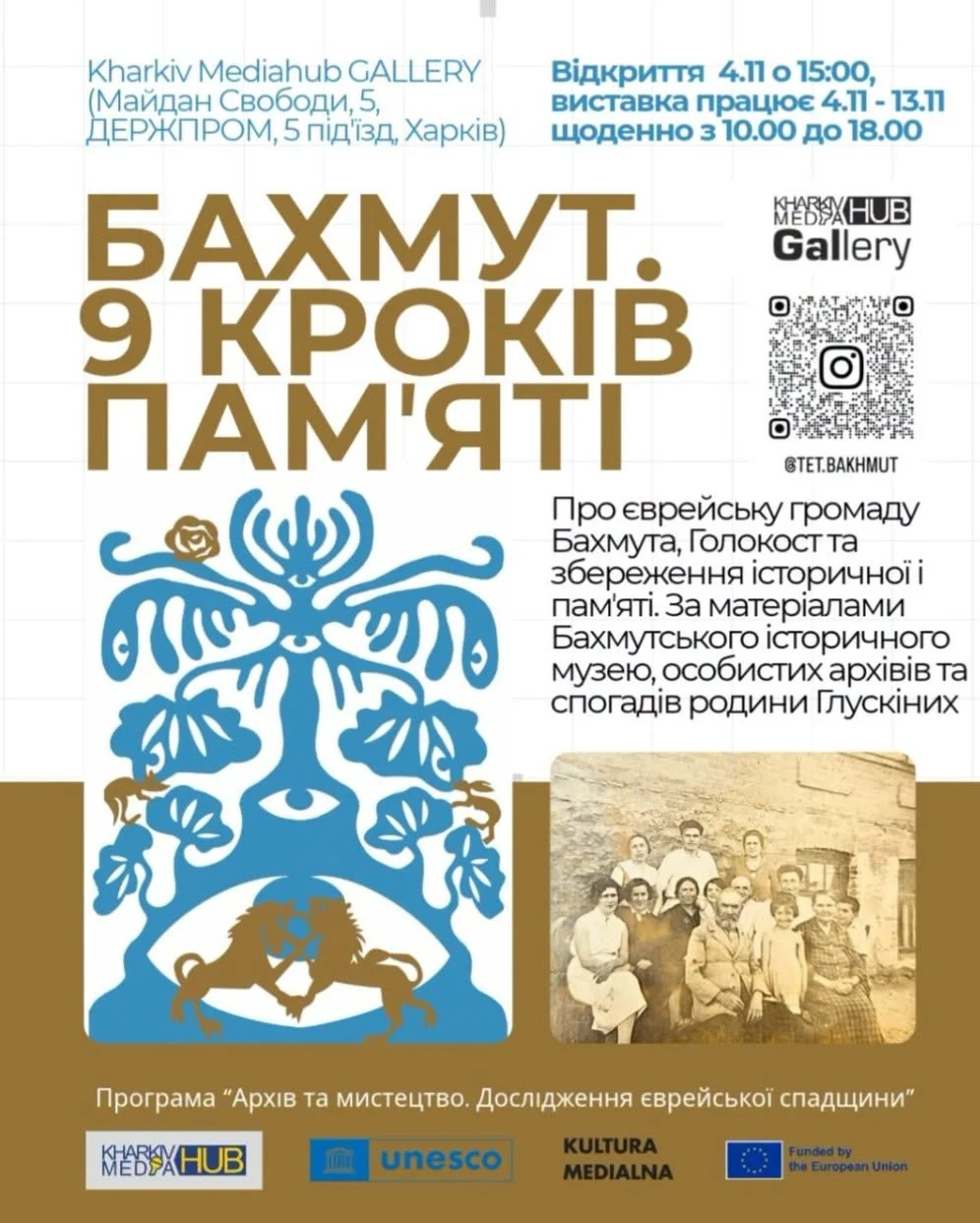
Why exactly nine? According to the organizers, this number symbolically connects grief, memory, light, and hope. In Jewish culture, the number nine has several meanings related to both the tragic events of the past and hope for the future. This is the artistic concept of the exhibition, not a statement about the sole meaning of the number nine in Jewish tradition.
The Ninth of Av (Tisha B’Av) is one of the main days of mourning in the Jewish calendar. On this day, Jews remember the destruction of the First and Second Temples in Jerusalem and other tragedies of their people.
On the other hand, the Hanukkah menorah has nine lights. Eight correspond to the eight days of the Hanukkah holiday, and the ninth, the shamash, is used to light the others. Hanukkah is associated with the memory of victory, the restoration of the Temple, and the miracle of light.
The numerical value nine is also associated with the ninth letter of the Hebrew alphabet — tet (ט). In Jewish religious symbolism, it is linked to the word “tov” (טוב), meaning “good.” The name of the digital archive @tet.bakhmut echoes the name of this letter.
At the same time, the organizers do not specify that each work is dedicated to one of the listed religious symbols. These examples help explain the cultural context of the chosen number but do not replace the author’s interpretation of each composition.
Mikhaylenko previously worked with materials from the Bakhmut Local History Museum and participated in projects researching the cultural heritage of eastern Ukraine, including the podcast “Women of Eastern Ukraine Speak.”
Jewish Bakhmut, which no longer exists
Jews began settling in Bakhmut at the end of the 18th century. In the 19th century, the community was replenished by settlers from Lithuania and Volhynia.
According to the Israeli Museum of the Jewish People ANU in Tel Aviv, in 1847 there were 496 Jews here. By 1897, there were already 3,259 — 16.8% of the population.
In 1926, the Jewish community numbered 6,631 people, or 17.1% of the residents. By 1939, its number had decreased to 5,299 people.
The Jews of Bakhmut were engaged in trade, industry, and crafts. They owned enterprises for the production of flour, beer, and soap, sawmills, and other industries. There were a synagogue, prayer houses, religious schools, and Talmud Torah — a traditional educational system for Jewish children.
There was a school in the city with instruction in Yiddish. In 1926, about 400 children studied there.
The community also experienced violence. During the anti-Semitic pogroms of October 1905, there were deaths and injuries, and Jewish property was damaged.
After the revolution and the establishment of Soviet power, life changed. Religious institutions were closed, people’s occupations and public organizations changed. But Jewish history remained part of the urban environment — in buildings, families, cemeteries, and memories.
In 1924, Bakhmut was renamed Artemovsk. The historical name was returned by the Ukrainian authorities in 2016.
Lazar Gluskin: a boy from Bakhmut who became a famous mathematician
The family archive used for the Kharkiv exhibition is connected with Lazar Matveyevich Gluskin.
He was born on March 10, 1922, in Bakhmut in a Jewish family. In 1939, he entered the Faculty of Physics and Mathematics at Kharkiv University.
When German troops approached Kharkiv in 1941, Gluskin managed to evacuate. According to his biography in the MacTutor History of Mathematics archive at the University of St Andrews, he traveled to safe areas on foot, by hitchhiking, and by freight trains. He continued his studies in Saratov.
The family was going through a difficult time. His father died, his mother supported two children, and Lazar himself worked unloading wagons and barges.
In 1943, he was drafted into the Red Army. He commanded an anti-aircraft battery, participated in the war against Nazi Germany, and then in military actions against Japan.
After the war, Gluskin returned to mathematics. In 1949, he graduated from Kharkiv University, later taught at the Kharkiv Pedagogical Institute, and headed the department of the Donbas Mining and Metallurgical Institute in Alchevsk.
In 1961, he became a Doctor of Physical and Mathematical Sciences, and in 1962, a professor. From 1965 to 1985, he headed the department of the Kharkiv Institute of Radio Electronics. His main area of research was the theory of semigroup transformations.
His wife’s name was Tamara, and his daughters were Irina and Valentina. Gluskin died on April 15, 1985.
Which specific relatives of the professor lived in Bakhmut during the Nazi occupation and whose documents are presented at the exhibition, the published announcements do not disclose. Therefore, it is impossible to associate specific family members with Holocaust victims without additional evidence.
January 1942: the road to the alabaster mines
German troops occupied Bakhmut at the turn of October and November 1941. Most of the Jewish population managed to evacuate, but hundreds of families remained.
On January 7, 1942, the occupation newspaper “Bakhmutsky Visnyk” published an order for the gathering of Jews.
They were instructed to appear on January 9 in the city park, at the former NKVD building, with keys to their apartments, food for eight days, and luggage weighing no more than ten kilograms.
People came, expecting to be relocated.
Instead, men, women, children, and the elderly were locked in basement rooms without water and food. Then the prisoners were led to the alabaster mines about two kilometers from the city.
In underground chamber No. 46, a Nazi unit of Sonderkommando 4b of Einsatzgruppe C carried out a mass murder. Some people were shot, others died after the exit from the mine was sealed.
In the city’s tradition of memory, the date of the tragedy is considered January 11, 1942. Some research directories attribute the killings to February 1942.
Estimates of the number of victims also vary.
A German SS security service report dated March 6, 1942, mentions the murder of 1,224 Jews. A Soviet commission that investigated the crime scene in October 1943 established a significantly larger number of victims — about three thousand.
The Bakhmut City Council and Ukrainian memorial institutions use the estimate of more than three thousand dead, mostly Jews. The discrepancy in historical documents does not allow the exact number to be considered definitively established.
This crime became part of the Holocaust on the territory of Ukraine. Unlike many places of mass shootings, here the Nazis used underground mining workings, which turned into a mass grave.
Wailing Wall: an underground memorial
After the liberation of Bakhmut in September 1943, residents and investigators discovered the bodies of the dead in the mines.
From October 13 to 17, work was carried out to extract and bury the remains. Some victims were identified. In 1960, they were reburied in the city cemetery.
On January 12, 1999, a memorial “Wailing Wall” was opened in underground chamber No. 46.
It was created by architect Vladimir Sotnik. The city Jewish community, the staff of the champagne wine factory on whose territory the murder site was located, and the director of the enterprise Arkady Klein participated in the construction.
The memorial composition depicts mourning women with bells — a symbol of memory that cannot be silenced.
The name “Wailing Wall” is associated with groundwater constantly seeping onto the rock surface. The drops resemble tears.
This name echoes the Jerusalem Wailing Wall, although the Bakhmut memorial has a completely different history and purpose.
The last commemorative ceremony in the underground hall before the full-scale Russian invasion took place on January 11, 2022.
Today, the territory is under occupation. There is no reliable independent information about the current physical condition of the memorial. It cannot be claimed that it is destroyed without an inspection.
From a city with 70,000 residents — to ruins
Before the full-scale Russian invasion, Bakhmut was an industrial, educational, and administrative center of the Donetsk region. More than 70,000 people lived here.
In the spring of 2022, intense Russian strikes began. Fighting intensified on the city’s outskirts in the summer. Russian army units and the Wagner PMC participated in the offensive.
The battle continued until May 2023. Russian troops captured Bakhmut after months of artillery shelling, airstrikes, and street fighting.
The scale of the destruction is confirmed by satellite images and data from the Ukrainian military administration.
In an investigation published on September 12, 2026, by “Vilne Radio,” a response from the Bakhmut City Military Administration is cited: all 769 apartment buildings and at least 13,000 of the 15,487 private houses were damaged.
This is at least 84% of the private housing stock. Assessments were partially conducted remotely, as the city remains inaccessible for a full inspection.
Schools, kindergartens, medical institutions, administrative buildings, enterprises, and engineering networks were damaged. There are no conditions in Bakhmut for returning to normal urban life.
As of January 1, 2026, more than 32,800 internally displaced residents, including 6,500 children, were registered in Bakhmut community support centers. A total of 32,698 reports of damaged or destroyed real estate objects in the community were received in the Ukrainian registry.
These figures do not cover all the people who went abroad and are not a census of the city’s population itself.
A 19th-century synagogue that survived the Nazi occupation
Another important testimony of Jewish history was preserved in Bakhmut — the building of the former Choral Synagogue on Nezalezhnosti Street, 80.
The construction dates back to 1856.
During Soviet times, the building ceased to be used as a religious center. Over the years, it housed the workshop of sculptor Ivan Kavaleridze, an aeroclub, a library, and production facilities. In the 21st century, the former synagogue was adapted into a store.
Despite the renovations, the historic building continued to exist.
It survived two world wars, the Nazi occupation, and decades of Soviet rule.
On December 27, 2022, local journalists published evidence of the building being damaged by Russian shelling. Parts of the facade and roof were destroyed.
On January 11, 2023, the Jewish Confederation of Ukraine reported that the historic synagogue had turned into ruins.
In October 2026, UNESCO continued to list the Choral Synagogue complex among the confirmed damaged cultural heritage sites of Ukraine. The list also includes the Bakhmut Local History Museum, historical gymnasiums, the city cultural center, former bank buildings, and other architectural monuments.
As of October 28, 2026, UNESCO confirmed damage to 567 cultural heritage sites across Ukraine.
The Bakhmut synagogue is also mentioned in the list of destroyed and damaged Jewish sites in Ukraine published by NANews, compiled based on data from the United Jewish Community of Ukraine.
It is not established that Russian troops specifically targeted the synagogue as a target. The consequences of Russian shelling for the historic building are documented.
Where the modern Jewish community disappeared
The Russian invasion also destroyed the life of the small Jewish community in Bakhmut.
In February 2023, the “Ukrainian-Jewish Encounter” project published testimonies from the former head of the community and director of the “Hesed-Zikaron” charitable center, Chaim Dubrov.
According to his estimate, up to 300 Jews lived in Bakhmut before the invasion. About a hundred people participated in community programs.
Dubrov himself, with his wife Liora and daughter Adelia, left Bakhmut in March 2022. The family ended up in Germany.
Other Jewish residents moved to Israel, Kyiv, Dnipro, Uzhgorod, and other places.
Dubrov said that his house and belongings, including computers with family and community photographs, remained in Bakhmut. He saw videos of the damaged house and destroyed neighboring streets.
It turned out that people were losing not only their homes but also their personal archives — photographs of families, community events, documents, and memories.
Dubrov also reported shelling of areas associated with the burial of Holocaust victims. But the exact extent of the damage to these places after the occupation is not established.
Twenty-seven trips for museum exhibits
The story of the evacuation of the Bakhmut Local History Museum explains how some documents were preserved for future exhibitions.
Before the invasion, the museum had approximately 17,000 items in the main collection and 25,000 units in the scientific auxiliary collection.
In the spring and summer of 2022, twelve employees, led by then-director Elena Smirnova, packed collections and sent them to safe regions. According to the current director Igor Kornatsky, the documentary collections were almost completely evacuated.
Later, the evacuation was continued by volunteers with the support of Ukrainian military personnel and police.
Historian and volunteer Leonid Marushchak, head of the organization “Museum Open for Repair,” played a special role.
He visited the Bakhmut museum 27 times.
His first trip took place in December 2022. Museum keys were hidden in a porcelain box under a tree by the staff to prevent them from falling into the hands of looters. Marushchak received a map of the hiding place.
During one of the operations, he had to turn to the police because of looters in the museum building. On another trip, the group waited out an artillery shelling in the police basement.
Among the rescued items was a medieval stone sculpture of a lion from the 13th-14th centuries. It was evacuated in the spring of 2023, shortly before the final capture of the city.
In an interview with the Bakhmut newspaper “Vpered,” published on April 5, 2026, museum director Igor Kornatsky said that the institution continues to operate in evacuation, participates in exhibition projects, digitizes materials, and documents the modern history of the destroyed city.
Evacuated collections allow the study of Bakhmut even when access to the city itself is impossible.
Two tragedies of Bakhmut have already been shown in Kyiv, Lithuania, and Lviv.
The Kharkiv exhibition by Natalia Mikhaylichenko is not the first attempt to connect the history of the Holocaust with the modern fate of Bakhmut.
In August 2023, the National Historical and Memorial Reserve ‘Babyn Yar’ presented the exhibition ‘Bakhmut. Faces of Genocide 1942 | 2022’ in Kyiv.
On August 23, 2024, it was opened in Kaunas, Lithuania, at the IX Fort Museum. Then, on March 15, 2025, the exhibition was presented in Lviv.
It combined archival materials about Nazi crimes, photographs of modern destroyed Bakhmut, and works by Ukrainian documentary photographers.
The organizers drew parallels between the crimes of Nazi Germany and the actions of Russian troops in 2022–2023.
However, historical accuracy is required here.
The Holocaust is an established fact of the deliberate genocide of Jews carried out by the Nazi regime. The Russian invasion and the mass destruction of Bakhmut are separate events requiring their own legal assessment.
The similarity lies not in the identity of circumstances, but in the human consequences: killings, expulsion of residents, loss of family homes, and destruction of material evidence of the past.
About how in another Ukrainian city they preserve the memory of the Holocaust during the Russian war, NANovosti reported in the article about an unusual synagogue-book in Babyn Yar.
Why this exhibition is important for Israel
For Israeli families whose ancestors lived in the territory of modern Ukraine, the history of Bakhmut is part of their own family history.
Many Israelis know the names of the cities and towns from where their parents, grandparents, and great-grandparents came. Sometimes photographs of relatives or birth documents have been preserved. But the buildings, schools, synagogues, and cemeteries associated with these families are often long lost.
Therefore, the participation of ‘Yad Vashem’ as a source of archival materials makes practical sense. The Jerusalem memorial complex preserves documents about Holocaust victims, testimonies, photographs, and information that allows the reconstruction of individual people’s fates.
The ANU Museum in Tel Aviv, for its part, preserves the history of communities that existed outside of Israel, including the history of Jewish Bakhmut.
After the Russian invasion, another task emerged — to preserve documents and material evidence that survived the Holocaust but may disappear due to the current war.
Where the exhibition is held
‘Bakhmut. 9 Steps of Memory’ opened on November 4, 2026, at 3:00 PM at Kharkiv Media Hub GALLERY.
Address: Kharkiv, Svobody Square, 5, Gosprom, fifth entrance.
The exhibition runs from November 4 to 13 inclusive, daily from 10:00 AM to 6:00 PM.
The project is implemented within the framework of the program ‘Archive and Art. Grants for the Study of Jewish Heritage’, conducted by the public organization ‘Cultural Media’ with financial support from UNESCO and the European Union.
Nine paper cutouts cannot replace a destroyed synagogue or return Bakhmut to its pre-war streets. But photographs, documents, and memories allow preserving information about families who lived here long before both wars.
In 1942, the Nazis destroyed a significant part of the remaining Jewish community in the city. In 2022–2023, Russian troops destroyed the environment where traces of its history were preserved.
Now this history is presented in Kharkiv — the city where Lazar Gluskin once studied and worked, and where his family archive became the starting point for new research.
Bakhmut cannot be freely visited today. But as long as there are saved documents and people capable of telling the story of their families, the history of its Jewish community has not disappeared along with the destroyed buildings.