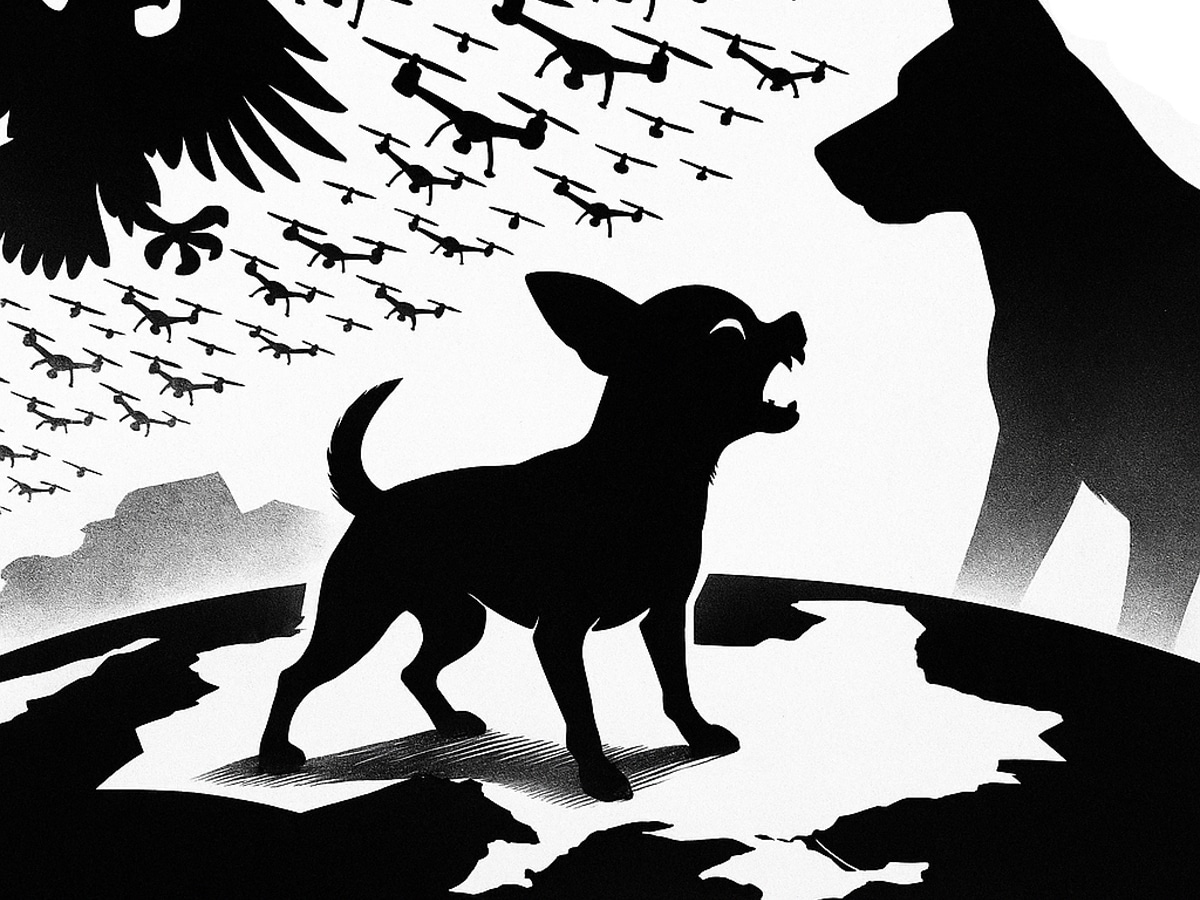
On June 1, 2025, the Security Service of Ukraine carried out the audacious “Web” operation, during which 117 inexpensive FPV drones launched from cargo containers simultaneously struck four strategic Russian air bases.
This action proved to be no less shocking for the White House than for the Kremlin.
First, it demonstrated that the massive U.S. air defense system “Iron Dome,” into which roughly $175 billion has been poured, is powerless against inexpensive drones costing only a few thousand dollars, launched from deep within enemy territory.
Second, the logic of the operation itself challenged American hegemony: Ukraine, the “little Chihuahua,” dared to strike the “big dog” (Russia) without coordinating with Washington.
It is this contrast—between “great” powers and “small” states that supposedly must remain passive—that underpins the current relationships among Trump, Putin, and Xi Jinping. Their nations compete directly for spheres of influence, yet at a personal level they are “spiritually aligned” players: they share the belief that “the great may do as they please, while the small must stay silent.” And as Ukraine confidently shows that the “little one” can not only withstand a strike but also hit back at the strongest, the world watches old “maps” being redrawn.
U.S. Reaction: When the “great” feel a nip from the “small”
Ukraine’s “Web” operation dealt a severe blow to the prestige of the American administration. Almost immediately, bland media headlines were replaced by declarations that “Ukraine did not inform the U.S. of the strike on Russia.”
For Donald Trump, Ukrainian attacks appear provocative: if “great” nations (in Trump’s view, including himself and the U.S.) are allowed to strike the weak (as in U.S. bombings of Houthis in Yemen), then when the “small” Ukraine wounds Russia, it becomes “insolence” and an “insult” to the U.S.’ status as leader of the “progressive world.”
“Strike the ‘great’—it’s provocation. Strike the ‘small’—it’s greatness,”—this paradox defines Trump’s logic, in which “the right of the strong” outweighs international law.
American media uniformly stress: “If Ukraine could do this, why should the U.S. spend hundreds of billions on air defense?”
As a result, the White House found itself in an awkward position: public opinion no longer believed that endless investment in expensive systems guaranteed absolute protection. More than that, Washington saw a direct threat to its own infrastructure: if Ukraine can reach Russian air bases, similar drones could target U.S. ports or critical military installations.
Ultimately, the debate split the administration. Some called for tougher sanctions on Russia and increased support for Kyiv; others urged a rethinking of priorities and cuts to air-defense spending.
NAnews — Israel News published reports on how U.S. lawmakers had launched an inquiry into the effectiveness of spending on “Iron Dome.” Notably, rumors even surfaced of possible limits on further arms deliveries to Kyiv to “avoid angering Moscow,” underscoring the U.S. ambivalence toward the “little Chihuahua” Ukraine.
Israeli Perspective: A Lesson for Jerusalem
For Israel, whose “invincible skies” myth—built on “David’s Sling” and “Iron Dome”—seemed unshakeable, the Ukrainian drone strike was a stark reminder that any air-defense system has vulnerabilities. Calls immediately arose: “If Ukraine could do it, why can’t we?” Indeed, Israeli military analysts began studying the potential of low-cost drones capable of evading sophisticated radar networks.
Israel is particularly focused on two points:
- Cost asymmetry. For Ukraine, a drone costs a few thousand dollars, whereas Israel has invested billions in a multi-layered air-defense network.
- Tactical flexibility. Ukraine’s approach shows that deploying swarms of small drones can sometimes be more effective than countering traditional aircraft.
Within a week of the “Web” operation, IDF accelerated tests of counter-drone technologies, requesting new radars and electronic-jamming systems from U.S. partners. Simultaneously, consultations began in Jerusalem with Ukrainian engineers, who shared their experience of using FPV drones in terrain similar to that in Gaza.
Still, Israelis recognize that besides “little Chihuahuas” such as the Houthis or Hezbollah, they must contend with the “big dog” in the form of Iran, armed with missiles and turbocharged drones of its own design.
The Iranian Factor: From “Web” to Its Own “Hands”
Iran watched the SBU operation with mixed feelings. On one hand, Tehran aims to showcase its independence from the U.S. by supporting “little players” like Hezbollah, which also deploys low-cost drones against Israeli positions. On the other, Iran saw Ukraine’s move as a way to intensify pressure on the U.S. and weaken American influence in the region.
Consequently:
- Tehran sped up development of Shahed-136 attack drones similar to those used by the SBU, secretly delivering them to allies in Lebanon and Yemen.
- Leaders of the Islamic Revolutionary Guard Corps (IRGC) made it clear: “We are ready to use asymmetric methods to escalate tensions between Israel and the U.S.”
- Contacts with Russia and China were deepened to gain access to advanced satellite guidance technologies for drones.
“If Ukraine can show the Americans that Day X has arrived, we can show the same to Israel and the U.S. on their own battlefield,”—conspiracy-oriented Telegram channels quote an IRGC general.
Thus, the balance is shifting not only in Europe but also in the Middle East. Israel now faces a direct question: how to defend against cheap yet precise strikes when its neighbors already possess adapted prototypes for urban and rugged terrain.
Global Table: Key Players’ Reactions After the “Web” Operation
| Player | Action | Outcome |
|---|---|---|
| USA | Inquiry into air-defense spending; debate over new grants for Ukraine | Risk of reduced support for Kyiv; criticism of Trump administration by Congress |
| Israel | Accelerated counter-drone tests; cooperation with Ukraine | Increased R&D in electronic warfare; bolstered air defenses at rising cost |
| Iran | Mass export of Shahed-136; stronger ties with Russia and China | Heightened confrontation with Israel; intensified U.S. sanctions pressure |
| Russia | Rebuilding air-defense perimeters; procuring Chinese systems | Lost faith in Pantsir and S-400; growing reliance on China |
| EU & Japan | Review of joint investments; pressure on U.S. over Ukraine aid | New trade disputes and a “cascade effect” of rejecting U.S. demands |
Why the “Great” Become Vulnerable
- Revaluation of costly systems. When investments reach hundreds of billions, yet an air force worth $7 billion is partially destroyed (per SBU estimates), it appears as a “loss of face” for the U.S.
- Psychological impact. The “Chihuahua” example shows that the weakest can strike the strongest in its softest spot, shattering myths of invincibility.
- Shift in focus. While the U.S. and Russia debate advanced missiles, Iran and Israel examine “drone warfare” tactics, preparing for new conflict scenarios.
Conclusion: Who Will Claim the “Leader of Resistance” Mantle?
As Ukraine proves that asymmetrical tactics can outmatch direct confrontation, Israel and Iran are already adapting to modern realities. Jerusalem recognizes that even local air-defense failures can have far-reaching ground consequences, driving new alliances and knowledge exchanges so Israeli engineers can adopt Ukrainian expertise.
Iran, pursuing a different path, leverages “missile coercion” and drone proliferation among allies to form a “belt of instability” around Israel. Meanwhile, the U.S. finds itself caught between supporting Ukraine and fearing that the “small vs. great” logic will spread to the Middle East.
Ultimately, NAnews continues to monitor how these developments affect the Jewish state’s fate: can Israel preserve its technological and strategic independence when global belief in “invulnerable” air defenses has eroded? And how will Tehran respond if the “little Chihuahua” (Ukraine) gave a lesson they’re ready to learn but deploy against Israel and its allies?
In the end, “little” Ukraine has become a forerunner of a new era of asymmetrical conflict, and the geopolitics map is rapidly being redrawn. In this game, everyone—from Washington to Tehran—must seek new “maps” to avoid becoming the “little Chihuahua” under the crosshairs of inexpensive yet lethal drones.