(original: “This is (not) my war / זו (לא) מלחמה שלי”)
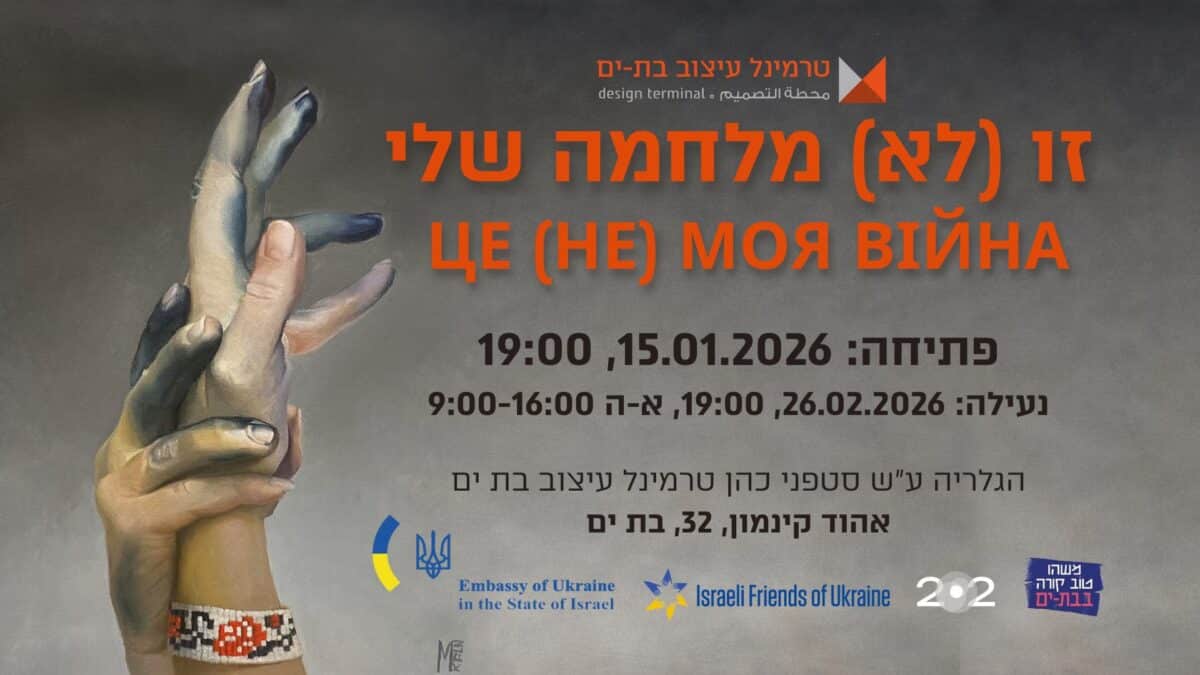
On January 15, 2026, a group exhibition of Ukrainian artists living and working in Israel opens in Bat Yam.
The project “This is (not) my war” is an open invitation to a conversation about war as a common experience and shared responsibility, where neutrality ceases to be a possible position.
The exhibition is open to everyone. Free entry, no prior registration required.
The exhibition is held at the Stephanie Cohen Gallery, located in Design Terminal Bat Yam — one of the key cultural spaces of the city.
Detailed information about the exhibition
Title: “This is (not) my war / זו (לא) מלחמה שלי”
Format: group exhibition
Venue: Stephanie Cohen Gallery, Design Terminal Bat Yam
Address: Ehud Kinamon St., 32, Bat Yam
Opening: January 15, 2026, 19:00
Exhibition dates: January 15 — February 26, 2026
Opening hours: Sunday–Thursday, 09:00–16:00
Gallery curator: Ilana Carmeli-Laner
Exhibition curators: Vera Gailis, Svetlana Matveenko
Event on FB – https://www.facebook.com/events/1231377285536646/
Registration for the opening: here.
Opening and program
During the opening of the exhibition, a welcoming speech will be given by
Yevhen Korniychuk, Ambassador Extraordinary and Plenipotentiary of Ukraine to the State of Israel, as well as representatives of the organizations co-organizing the project.
After the opening and during the exhibition, tours will be conducted in Ukrainian and Hebrew (🇺🇦 UA | 🇮🇱 HE), making the project accessible to both Ukrainian-speaking and Israeli audiences.
Exhibition participants
The project involves Ukrainian artists currently living in Israel:
Tali Ratzker, Moria Kaplan, Nadine Osovik, Alexander Gorenstein, Margarita Hertzman, Polina Veller, Oksana Fedchyshyn, Tanya Gushchina, Taisia Levitskaya, Ekaterina Lagoda, Ekaterina Didenko, Marianna Nazaruk, Elina Nazaruk, Irina Kremer, Svetlana Matveenko, Zhanna Gailis.
What the exhibition talks about
The project “This is (not) my war” grows out of the pressure of the external context, in which Ukrainian artists in Israel are increasingly being asked to distance themselves — to determine “whose war this is” and “which pain is greater.”
In this context, the phrase “this is not my war” sounds not like a personal choice, but as a demand addressed to the artist: an attempt to impose distance, divide loyalties, and simplify a complex lived reality.
“The phrase ‘this is not my war’ sounds not like a statement, but like an expectation — to distance oneself, to remain silent, not to take a position,” note the exhibition curators.
The brackets in the title fix the internal tension of the project: this cannot not be my war. It is this impossibility of neutrality that becomes one of the key internal drivers of the presented works.
Art as a form of resistance
“Ukraine is resisting an enemy that seeks not only to seize territories but also to erase our culture. In this existential struggle, art becomes a form of active resistance,” emphasizes Yevhen Korniychuk.
“The title of the exhibition ‘This is (not) my war’ is a conscious provocation, questioning the comfort of so-called neutrality. In today’s global reality, there is no longer ‘yours’ and ‘mine’ — there are common enemies and common challenges.”
According to the ambassador, Israeli society — well aware of the cost of survival — largely shares this position and shows solidarity with Ukraine.
Language, identity, and the cost of choice
For many participants, the strengthening of Ukrainian identity is manifested not in the direct depiction of war, but in the radicalization of artistic language: through national motifs, ornament, folklore structures, bodily and landscape memory, the image of home as an archive.
These gestures do not illustrate the war directly. They express a refusal of erasure and externally imposed ambiguity, as well as a demand for the right to independently determine the form of their belonging.
In the Israeli context, such a choice has its price. In an environment dominated by the Russian-speaking cultural space and with different legal and civil regimes for immigrants from Ukraine, language and identity become a field of constant negotiation. Refusal of familiar communication infrastructures can lead to the loss of audience, professional connections, and public visibility.
Organizers
The exhibition is organized with the participation of Israeli Friends of Ukraine, the Embassy of Ukraine in the State of Israel, Stephanie Cohen Gallery, Design Terminal Bat Yam, and the platform for Ukrainian artists “202”.
The exhibition “This is (not) my war” in Bat Yam is an invitation to an open conversation without distance and without illusions of neutrality.
NAnews — News of Israel | Nikk.Agency
Event on FB – https://www.facebook.com/events/1231377285536646/
Registration for the opening: here.
