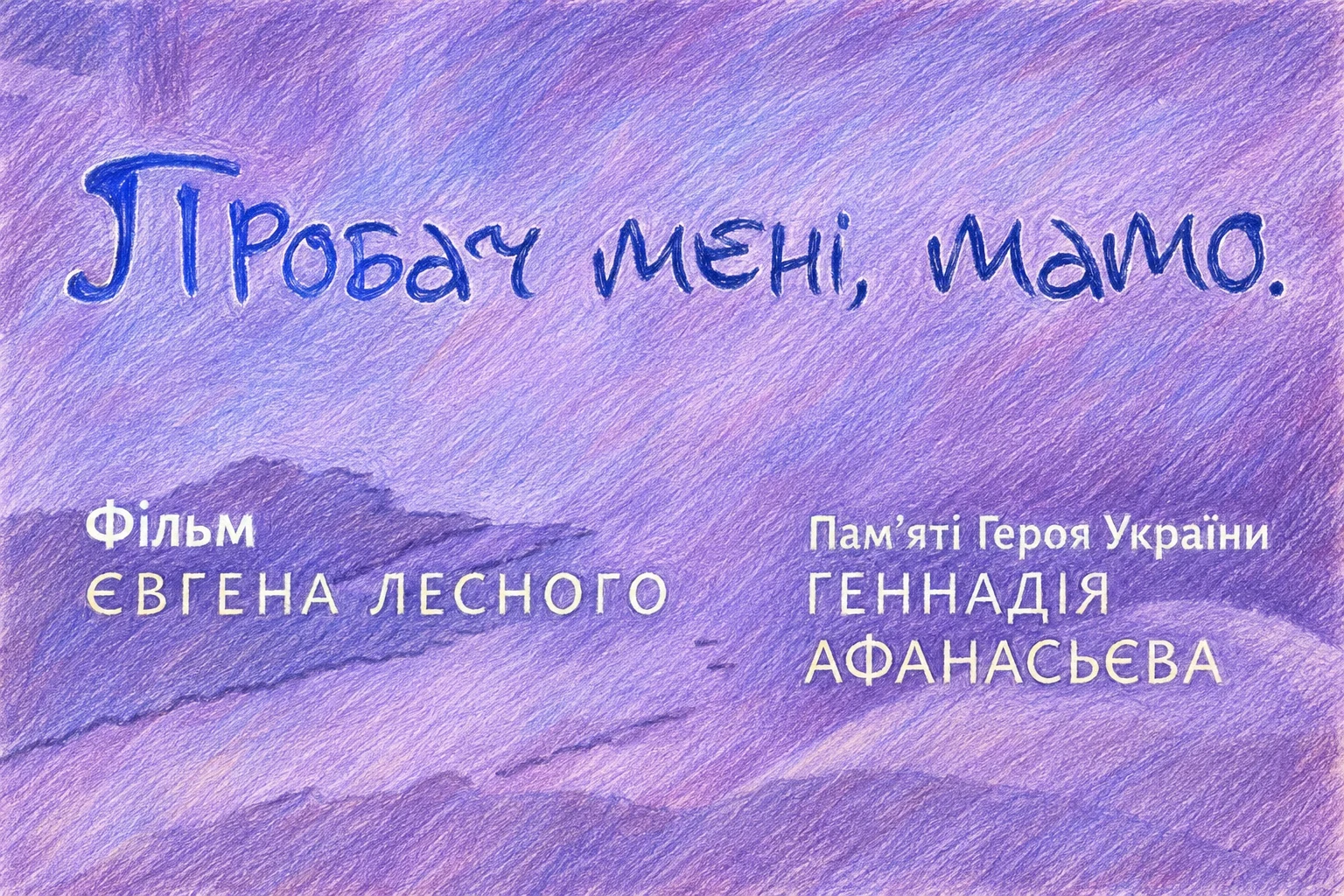
On November 18, 2026, at 19:00 in Israel, there will be a free screening of the Ukrainian documentary film “Forgive Me, Mom”. The film by director Yevhen Lesnoy is dedicated to Hennadiy Afanasyev — a native of Crimea, former Kremlin political prisoner, human rights activist, and Ukrainian serviceman who died in December 2022 near Bilohorivka in the Luhansk region.
Author: Victoria Katsman
The screening is organized by the Embassy of Ukraine in the State of Israel, the Ukrainian Cultural Center in Tel Aviv, and partners. Admission is free, but pre-registration is required.
Register for the screening on November 18 at 19:00
Venue address Ukrainian Cultural Center in Tel Aviv
The film is based on the memories of Hennadiy’s mother, Olga Afanasyeva, his wife, friends, and a fellow soldier. The story begins long before Russia’s full-scale invasion of Ukraine and covers events in Crimea, Russian imprisonment, return to freedom, and the decision to voluntarily go to the front.

Why is the film called “Forgive Me, Mom”
The title came from a conversation that Olga Afanasyeva remembered for a lifetime.
In February 2022, after the start of Russia’s full-scale invasion, Hennadiy decided to join the Ukrainian territorial defense. His mother herself took him to the military enlistment office.
They drove in silence. Then the son asked for forgiveness and explained that he understood how hard it was for her to accept his decision, but he could not act otherwise.
Olga had already fought for his life once. In 2014, Russian special services arrested Hennadiy in Crimea. For the next two years, she sought his release from Russian prisons. Now the son, who had returned from captivity, was once again heading into danger.
Ten months later, on December 18, 2022, he died.
Hennadiy was 32 years old. At home, he left behind his mother, wife Lyudmila, and little daughter Kvyatoslava, born in 2020.
The film that the mother wanted to make
The initiator of the film’s creation was Olga Afanasyeva herself. After her son’s death, she kept photos, videos, and other archival materials.
She approached a familiar Ukrainian journalist and director, Yevhen Lesnoy, with a proposal to make a documentary film.
Lesnoy knew Hennadiy personally. In 2016, after Afanasyev’s release from Russian captivity, he interviewed him. Later, they communicated on social networks, sometimes arguing. According to the director’s memories, Hennadiy was a sharp and principled person. In 2018, after disagreements, he even blocked the journalist on Facebook.
Lesnoy developed the concept of the future film. Producer Yuriy Bohdanov found funding, and filming began.
The director and the mother agreed not to create an idealized image of the deceased. In the film, Hennadiy remains a living person, with a complex character, beliefs, mistakes, and actions for which he had to pay.
The film combines two stories: the life of Afanasyev himself and the life of his mother after her son’s death. An important place is occupied by the memories of his wife and people who knew him at different times.
The film includes archival footage. The creators also used artificial intelligence to recreate Hennadiy’s voice and work on the subtitles.
A particularly difficult scene for the director was at the military cemetery, where Olga comes to her son. There she communicates with other people who have lost relatives in the war. The sound of metal flagpoles, conversations near graves, the habitual movements of people — these shots show the life of families for whom the war has not ended.
Who is Hennadiy Afanasyev
Hennadiy Afanasyev was born on November 8, 1990, in Simferopol. He received a legal education at the Tavrida National University named after Vernadsky, and before the Russian occupation of Crimea, he worked as a photographer.
During the Revolution of Dignity in 2013–2014, he traveled to Maidan in Kyiv. Returning to Crimea, he participated in pro-Ukrainian demonstrations, including a mass rally on February 26, 2014, near the building of the Verkhovna Rada of the Autonomous Republic of Crimea.
For readers in Israel, it is important to explain: February 26 became one of the symbolic dates of resistance to the Russian occupation of Crimea. On that day, supporters of Ukraine’s territorial integrity gathered at the Crimean parliament, trying to oppose the actions of pro-Russian forces. Subsequently, Ukraine established this date as the Day of Resistance to the Occupation of the Autonomous Republic of Crimea and the city of Sevastopol.
On May 9, 2014, Russian FSB officers detained Afanasyev in Simferopol.
He was included in the so-called case of the Oleg Sentsov group. Together with Ukrainian film director Sentsov and activist Oleksandr Kolchenko, he was accused of terrorist activities. In December 2014, a Russian court sentenced Afanasyev to seven years in prison.
Later, he spoke about torture during interrogations: beatings, the use of electric shocks, and suffocation. According to him, the testimonies used by the investigation against other defendants were obtained under pressure.
On July 31, 2015, in the Rostov-on-Don court, an event occurred that became one of the central episodes of his biography. Afanasyev publicly refused to confirm previous testimonies against Sentsov and Kolchenko and stated that they were extracted under torture.
He understood that after such a statement, he could be subjected to violence again.
On June 14, 2016, after spending 767 days in Russian captivity, Hennadiy returned to Ukraine as part of a prisoner exchange along with Yuriy Soloshenko.
Returning home and a new life
After his release, Afanasyev settled in Kyiv. He engaged in human rights activities, supported Ukrainian political prisoners of the Kremlin, and cooperated with the Ministry of Foreign Affairs of Ukraine as a special representative on issues of prisoner release.
He also helped veterans master information technology and acquire new professional skills.
The experiences in Russian prisons continued to affect his life. In an interview about working on the film, Yevhen Lesnoy said that Hennadiy did not immediately recognize the need for psychological help, but later turned to specialists and engaged in art therapy.
Afanasyev described his prison experience in numerous author columns. Based on them, an autobiographical book “Rise After the Fall” was published in 2018. It was released in Ukrainian, Russian, and English.
Hennadiy got married. In 2020, he and Lyudmila had a daughter, Kvyatoslava, whom the family calls Kvyatochka.
At the Kyiv premiere of the film in February 2026, Lyudmila said that their daughter knows who her father was and often asks to see recordings with him. For the family, the documentary became an opportunity to preserve his voice, memories, and stories of friends.
Why a former political prisoner voluntarily went to the front
After February 24, 2022, Afanasyev could have remained in civilian life. He had already survived Russian captivity and torture, was a well-known human rights activist, and the father of a young daughter.
However, he voluntarily joined the 130th Battalion of the 241st Separate Brigade of Territorial Defense of the Armed Forces of Ukraine. He served under the call sign “Thor”.
The unit participated in the defense of Kyiv and Kharkiv regions, later performing combat tasks in eastern Ukraine.
On December 18, 2022, Hennadiy died near Bilohorivka in the Luhansk region. He was buried in the city of Vyshneve, Kyiv region.
In 2023, Afanasyev was posthumously awarded the Order “For Courage” III degree. On October 1, 2025, President Volodymyr Zelensky signed Decree No. 741/2025 awarding Senior Soldier Hennadiy Afanasyev the title of Hero of Ukraine with the Order “Golden Star”.
This happened almost three years after his death.
From the Kyiv premiere to international screenings
The premiere of “Forgive Me, Mom” took place on February 26, 2026, at the Kyiv cinema “Zhovten” — on the Day of Resistance to the Occupation of Crimea.
The hall, designed for more than 400 spectators, was completely filled. Relatives, friends of Hennadiy, servicemen, human rights activists, and representatives of Ukrainian state institutions attended the screening.
The event began with a minute of silence in memory of those who died in the war. A poem by Vasyl Symonenko, which Hennadiy recorded during his lifetime, was recited.
In the summer of 2026, the film was selected for the competition program of the Madrid International Film Festival. A special screening in London was also announced for November 11. The next international event will be a meeting with viewers in Israel on November 18.
From the filming of one film, another was born
Yevhen Lesnoy’s work on Afanasyev’s story led to the creation of another documentary.
After completing “Forgive Me, Mom”, the director had materials shot at the military cemetery. He noticed the relationships between people who regularly come to the graves of their loved ones.
They get to know each other, talk, treat each other to coffee, discuss everyday problems. And they call each other neighbors.
This resulted in the short film “Neighbors” lasting about nine minutes.
On July 3, 2026, the film participated in the international NewBorn Short Film Festival in Berlin and won an award in the category “Best Documentary Film”.
Thus, the materials collected for Hennadiy Afanasyev’s story became the basis for two independent documentary works.
Screening in Israel: date, time, and registration
Title: “Forgive Me, Mom”.
Date: Wednesday, November 18, 2026.
Start: 19:00.
Country of event: Ukrainian Cultural Center in Tel Aviv
Director: Yevhen Lesnoy.
Organizers: Embassy of Ukraine in the State of Israel, Ukrainian Cultural Center in Tel Aviv, and partners.
Cost: free.
Registration: required, via the official form of the organizers.
The organizers did not specify in the available announcement whether director Yevhen Lesnoy or members of Hennadiy Afanasyev’s family will be present at the Israeli screening.
For the Ukrainian community in Israel, this screening is an opportunity to get acquainted with the story of a person who resisted the Russian occupation of Crimea back in 2014, survived prison and torture, returned home, started a family, and then went again to defend Ukraine.
But the film is not only addressed to Ukrainian viewers. For the Israeli audience, well-acquainted with themes of captivity, returning home, military service, and loss of loved ones, Afanasyev’s story can be understood even without detailed acquaintance with Ukrainian politics.
At the center of the film remains the mother, who first fought for her son’s release from prison, then let him go to the front, and after his death decided to preserve his story for others.
Free registration for the screening on November 18, 2026, at 19:00: fill out the form.
Other cultural events and happenings in Israel can be found in the sTDe poster.
NANews will continue to report on Ukrainian cultural events in Israel and on people whose stories connect Ukraine, Israel, and the international community.
Add NANews to Google to follow new publications.