
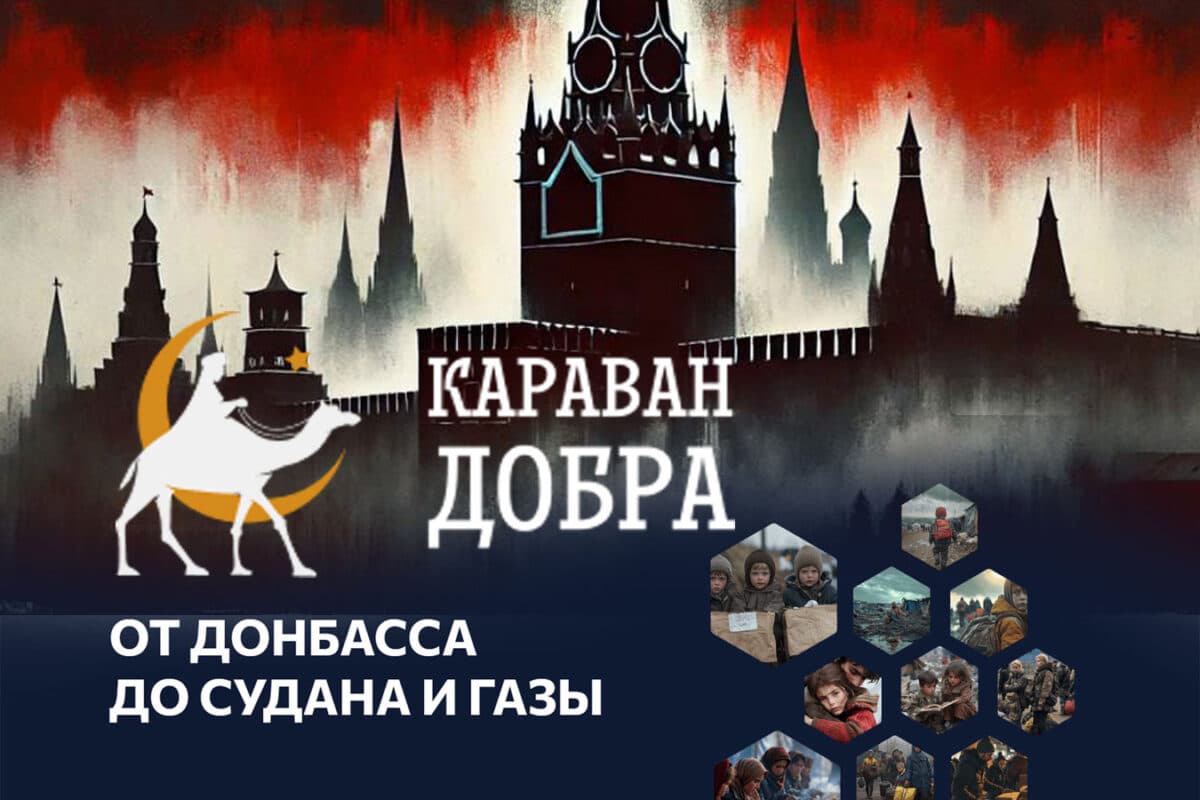
Under the banner of “humanitarian enlightenment,” an event titled “Good Without Borders from Donbass to Gaza and Sudan” took place in Russia. The organizers claimed it was a discussion about “mercy, helping civilians, and humanity beyond politics.” However, the actual content of the forum showed the opposite: the audience was offered an ideological product built on anti-Ukrainian and anti-Semitic rhetoric, carefully disguised in humanitarian language.
The forum in Kazan on December 4, 2025 was presented as a “foundation evening” and took place in the format of public speeches by pre-selected speakers. The very concept — “a single root of tragedies from Donbass to Gaza and Sudan” — became a key tool of manipulation. It allowed for the equalization of fundamentally different conflicts, erasing the distinction between aggressor and victim, and removing responsibility from the state that waged war against Ukraine.
“Without politics” — only in announcements
The program specifically announced the theme “Help without politics”. In practice, politics was not just part of the forum — it was its semantic center. Under the guise of a humanitarian conversation, the audience was imposed with the notion of Russian aggression against Ukraine as “forced protection,” and the occupied Ukrainian territories were called “affected regions of Russia.”
A separate block was dedicated to “support for participants of the Special Military Operation and their families,” called the “internal front of assistance.” This moment completely shattered the illusion of neutrality: the war against Ukraine was embedded in the humanitarian narrative and legitimized with the language of compassion.
Anti-Ukrainian propaganda: the victim is declared the source of evil
The key speaker of the forum was political scientist Kirill Semyonov, “Middle East Expert.” His speech was built around the thesis of an allegedly “unified misanthropic ideology” operating “from Gaza to Donbass.”
He stated that “the tragedies in Gaza, El Fasher, and Donbass” are manifestations of a “unified misanthropic ideology.”
The “political scientist” pointed to a direct connection “between the methods used in Gaza and Donbass,” calling the “Kyiv regime a faithful student of Israeli policy.”
He sees its foundation in the cynical division of humanity into “chosen ones,” whose lives have value, and “others,” whose rights can be trampled.
“The basis of this ideology is the cynical division of humanity into ‘chosen ones,’ whose lives have value and protection, and ‘others,’ whose suffering can be ignored, and rights trampled. Trampled not only in the name of geopolitical interests but also in a falsely understood ‘civilizational mission,'” Semyonov stated.
In this logic, Ukraine was presented not as a victim of invasion but as an active bearer of “terror.”
Semyonov stated:
“The Kyiv regime, which today so zealously supports and justifies the genocide of Palestinians, is itself its faithful student. It is no coincidence that even before 2022, Donbass was openly called ‘Ukrainian Gaza’ and a ‘terrorist enclave’ in Kyiv, whose population was subject to ‘cleansing.’
This quote concentrates several propaganda techniques at once: demonizing Ukraine through the lexicon of “regime” and “cleansing,” attributing support for “genocide” to it, and substituting the causes of the war. Russian aggression is completely excluded from the equation.
Further, Semyonov claimed that Kyiv allegedly adopts from Israel a “comprehensive strategy” that includes “constant military terror and extrajudicial executions.” In such a construction, Ukraine becomes the source of evil, and Russia’s invasion is a “necessary reaction.”
Anti-Semitism under the guise of “anti-Zionism”
A particularly harsh and dangerous block of the forum was related to Israel. In speeches, it was systematically portrayed as the source of a universal “genocidal model,” allegedly exported worldwide.
Semyonov used the formulation:
“Their goal, as in Israel, is the ‘final solution to the Russian question,’ now in Ukraine. But Russia could not allow these plans to come to fruition.”
The use of the term “final solution,” directly associated with the Holocaust, in relation to Israel is not just manipulation but a conscious distortion of historical memory. In this context, Israel is presented as a state acting in the logic of Nazi extermination, and Russia as a force supposedly preventing this.
As “evidence,” the speaker talked about the “presence of Israeli advisors and militants in Ukraine,” named specific names, and claimed that there is an “Israeli team” within the Ukrainian Armed Forces. He named Denis Desyatnik, a “reservist of the elite Israeli special forces,” who allegedly led the “Israeli team within the Ukrainian Armed Forces,” as well as Grigory Pivovarov and Viktor Friedman.
No sources or confirmations were provided. These statements were conspiratorial in nature and formed the image of an external conspiracy.
In the finale, Israel was accused of “genocide and apartheid” in Gaza, and its actions were declared a model “replicated” in other regions where it is beneficial to the West. Thus, a complex international conflict was reduced to a one-sided accusatory myth.
“Jewish anti-Zionist” as a propaganda screen
A separate role in the forum’s staging was played by the speech of Artyom Kirpichenko, whom the organizers presented as “our friend and ally, a Jewish anti-Zionist”. His identity was used as an indulgence: if such accusations come from a “Jew,” then they cannot be anti-Semitic.
He mainly talked about “Israeli soldiers committing war crimes in the Gaza Strip.”
He spoke on the topic “The Tragedy in Gaza: What Each of Us Can Do Here and Now?” He urged those gathered to “act regardless of nationality, demonstrating true solidarity and compassion for people regardless of origin.”
This technique has long been known as the instrumentalization of identity. An individual is brought on stage not for discussion but to cover generalizations and demonization of an entire people.
In the context of the forum, this slogan sounded like an element of mobilization propaganda, not a humanitarian appeal.
Other speakers and the absence of alternative voices
Political scientist Abuarkub Mohammed Ahmad spoke about the tragedy of the Gaza Strip. As the organizers write:
“His speech was dedicated to the tragedy of the Gaza Strip population lasting over 75 years. ‘We live in conditions of a double tragedy — light and darkness,’ he stated, urging the international community not to forget the suffering of his people.”
At the same time, as in other speeches, there was no discussion of Hamas attacks, the responsibility of armed groups, or the complex regional dynamics of the conflict. All speakers adhered to one line: “double standards of the West,” “a single root of tragedies,” excluding Russia from the list of responsible parties.
There were no representatives of international humanitarian organizations, human rights defenders, or experts with alternative positions at the forum. It was not a discussion but a coordinated performance.
Deception as a system
The forum “Good Without Borders from Donbass to Gaza and Sudan” became an example of systemic deception of its own population and electorate.
— promised “without slogans and propaganda,” but built the event as a propaganda product;
— declared “help without politics,” but promoted support for the war;
— talked about mercy, but spread the language of hatred;
— covered anti-Semitic constructs with “convenient” identities;
— replaced reality with a humanitarian facade.
Under the name “Good Without Borders,” the audience was offered not help and enlightenment, but an ideology where responsibility dissolves, aggression is justified, and anti-Ukrainian and anti-Semitic narratives are presented as a moral position.
This is precisely where the main danger of such events lies: humanism here is not a goal but a tool.
Who needs this?
Such forums do not arise “from humanitarian motives” and do not exist on their own. They have quite specific addressees and tasks.
Firstly, this is needed by the Russian propaganda system.
The format of a “humanitarian evening” allows for packaging the war in a soft, emotionally comfortable shell. When the audience is told not about missile strikes and occupation, but about “mercy,” “suffering,” and “help without borders,” people’s critical perception decreases. The war ceases to look like a crime — it begins to be perceived as a tragedy without the guilty.
Secondly, this is needed to justify the war against Ukraine to the internal electorate.
Through the thesis of a “single root of tragedies,” Russia is removed from the role of aggressor and turned into a supposedly forced participant in a global conflict. Ukraine in this scheme is demonized, deprived of subjectivity, and presented as the source of violence. This allows selling the war as “defensive” and morally permissible.
Thirdly, this is needed to legitimize the language of hatred.
Anti-Ukrainian and anti-Semitic rhetoric is presented not as extremism but as “expert analysis” and an “alternative point of view.” When words like “genocide,” “cleansing,” “final solution” are spoken from the stage of a “humanitarian forum,” they gradually become normalized. Hatred becomes acceptable if spoken in a calm tone and with an academic expression.
Fourthly, this is needed to redistribute moral responsibility.
The forum deliberately mixes different conflicts — Gaza, Sudan, and Donbass — to erase causal connections. As a result, the audience forms the impression that “everyone is equally guilty,” which means no one is truly guilty. This frees from the need to ask uncomfortable questions about Russia’s role, war crimes, and international law.
Fifthly, this is needed to create a manageable identity.
The use of figures like a “Jewish anti-Zionist,” Muslim speakers, and “heroes of the Special Military Operation” creates the illusion of a broad coalition and moral consensus. In reality, these are carefully selected roles designed to convince the audience that it is not about propaganda but the “voice of different peoples.”
And finally, this is needed to deceive their own citizens.
People are offered to feel good — to donate, sympathize, “be on the side of good.” But behind this feeling lies support for the war, justification of violence, and acceptance of an ideology that destroys the very concepts of humanism and compassion.
This is why such events are dangerous.
They do not just distort reality — they teach society to get used to lies, spoken in a soft voice and under the flag of “good.”
Under the guise of humanism, such forums sell the justification of war and the normalization of hatred. Anti-Ukrainian and anti-Semitic rhetoric is presented as “enlightenment,” and lies as a moral position. This is why it is important not to ignore or “understand” such events, but to call them by their names — as independent journalism does NAnews — Israel News | Nikk.Agency, documenting how under the guise of good, society is offered to accept violence as the norm.
