
Ukraine and Sweden on October 22, 2025 signed a protocol of intent, providing for the supply of up to 150 modern Gripen E/F fighters, developed by Saab. The deal is estimated at approximately 10 billion dollars — and has already been named the largest in Saab’s history. But the most interesting thing, writes the Israeli publication Walla on October 27, 2025, is that these aircraft will be equipped with Israeli combat and electronic systems, developed by Elbit Systems and Rafael Advanced Defense Systems.
The export of such components for aircraft intended for Ukraine is a sensitive issue in Israeli-Russian relations and will require approval from the Ministry of Defense. However, Israel has already crossed the threshold by allowing Americans to supply Ukraine with old Patriot batteries that were decommissioned and stored in the country.
For Ukraine, this is not just a purchase of equipment. It is a sharp turn from Soviet heritage to Western standards, and for Israel, a new level of participation in European defense projects.
Israeli presence in the skies over Europe
According to Walla, the Gripen aircraft for Ukraine will be equipped with Elbit Systems displays and Rafael containers with targeting and recognition systems.
These are technologies that have already proven themselves on F-16 and F-35 platforms, but are now being integrated into the Swedish aircraft, creating a unique combination — European aerodynamics and Israeli electronics.
The program includes training Ukrainian pilots and creating a technical base for aircraft maintenance. Swedish Gripens were chosen for their maneuverability, reliability, and cost-effectiveness, as well as their ability to take off from short runways.
The supply of such components requires official permission from the Israeli Ministry of Defense, as it involves dual-use military technologies.
As Walla notes, this means that Israel is not just “present” in a European defense project for the first time, but becomes an integral part of it through its systems and export channels.
Why Gripen: Ukraine’s rational choice
The Swedish Gripen has long been considered a cheaper and more flexible alternative to the American F-16.
It can take off and land on small airfields or directly on road sections, which is especially important for Ukraine — in conditions of regular missile strikes and infrastructure shortages.
The cost per flight hour for the Gripen is half that of the F-16, and the service requires less fuel and equipment.
The Swedes built the aircraft specifically for air forces operating in stressful conditions — and this logic perfectly matches Ukrainian realities.
According to Walla, the first aircraft could be delivered in 2028–2029, and the training of pilots and technicians will begin in advance at ranges in Sweden and in one of the Central European partner countries.
Israeli technologies for Gripen: a view from inside the cockpit
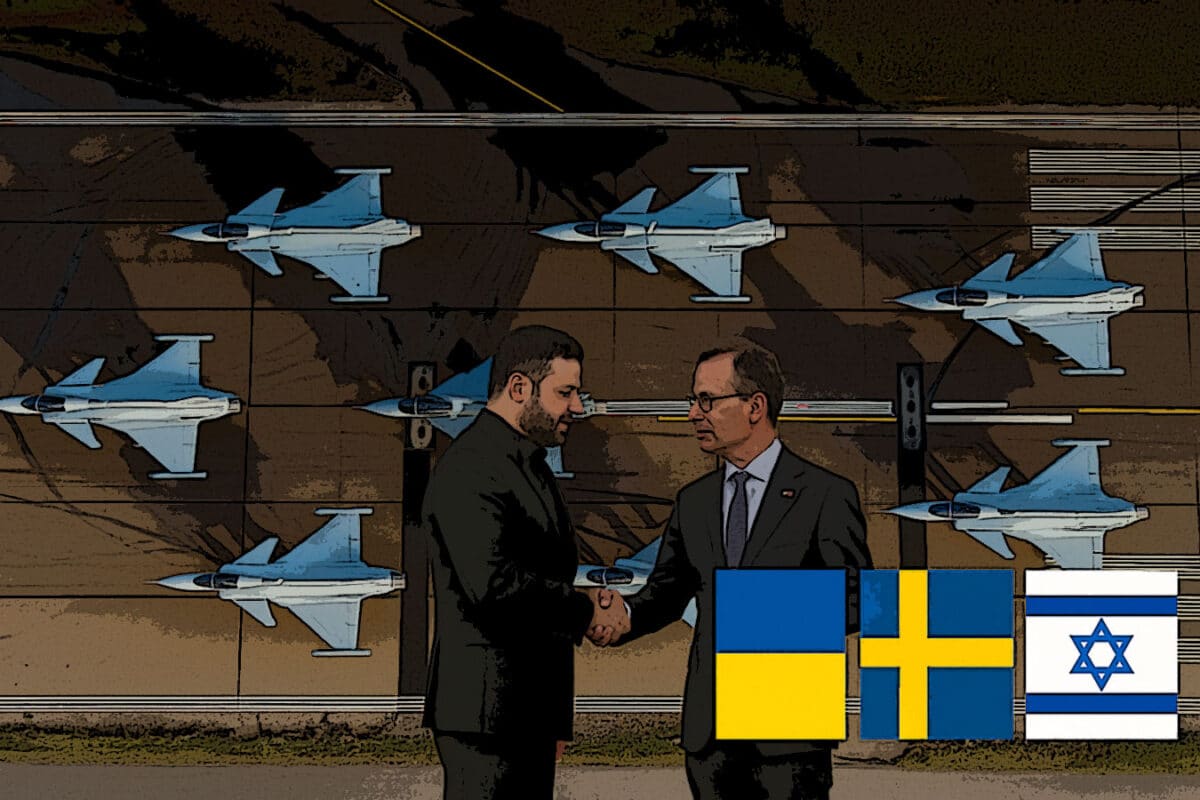
The Gripens intended for Ukraine will receive a unique combination of Swedish aerodynamics and Israeli electronics.
Two leading Israeli companies — Elbit Systems and Rafael Advanced Defense Systems — provide the aircraft with the latest control, targeting, and protection systems, turning them into universal combat platforms of the 21st century.
Elbit Systems: “smart cockpit” and pilot’s digital vision
Elbit is responsible for the pilot interface and combat information management.
The Ukrainian Gripens will be equipped with:
a widescreen touch display (Wide Area Display), replacing dozens of instruments with a single panel with tactile control;
helmet-mounted display system, which allows the pilot to see targets and flight parameters directly on the helmet visor and aim weapons by head movement;
integration of NATO data exchange, communication, and navigation systems — all in a single digital environment.
Such a “smart cockpit” turns the pilot not just into an operator, but into a commander of a tactical network. He can coordinate the actions of other aircraft and ground units directly from the cockpit.
Rafael: precision and protection
Rafael supplies pod containers with electro-optical and radar systems:
Litening V and RecceLite provide laser guidance, day and night observation, thermal imaging, and real-time video reconnaissance;
Sky Shield and Brite Cloud create active jamming for enemy radars and “confuse” missiles by releasing false targets;
compatibility with high-precision air-to-surface missiles allows attacking targets from long distances without entering the air defense zone.
In essence, Israeli modules give the Gripen the ability to see and act further than most modern fighters.
Israel between technology and diplomacy
For Israel, this deal has a dual significance. On one hand, it is an expansion of exports and strengthening of its position in Europe. On the other — a delicate diplomatic balance.
Elbit and Rafael are key players in the Israeli military-industrial complex. Their equipment is used in various armies around the world, but participation in the Ukrainian contract means de facto involvement of Israel in supporting a country at war with Russia.
Therefore, any decision on supplies must go through the Ministry of Defense in Tel Aviv and be coordinated with the Swedish government.
Israeli experts emphasize that the issue of exporting military technologies has now become not only commercial but also geopolitical — affecting relations with the USA, the EU, and NATO countries.
Saab and the Ukrainian order: the biggest challenge for Swedish industry
For Saab, this deal will be the largest in the company’s history.
To fulfill the Ukrainian order, production capacities in Linköping will have to be practically doubled.
The company has already announced the recruitment of additional engineers and plans to modernize workshops for export versions of the Gripen E/F.
Economists at Walla note that for Sweden, this deal is not only a financial but also a political victory. Gripen is entering the market beyond Northern Europe for the first time, and the project itself becomes part of the pan-European defense against Russian aggression.
Ukraine: from defense to strategic partnership
As a result of the deal, Ukraine becomes one of the few countries purchasing Gripen in serial volume.
This means not only the supply of aircraft but also the transfer of technologies, training of engineers, integration into the European aviation and communication system.
Given the participation of Israeli companies and the possible creation of training centers on the territory of Ukraine or in NATO countries, this could become the basis for a new form of partnership: a military-technological alliance Ukraine — Sweden — Israel.
What’s next: a test for three capitals
Kiev, Stockholm, and Jerusalem have now reached a new level of interaction.
- Ukraine — as a country boldly integrating into the Western defense system.
- Sweden — as a new exporter of technologies and one of the flagships of European security.
- Israel — as a supplier of critically important components, whose technologies determine the outcome of modern wars.
If the contract is approved and production launched, the first Gripens with Israeli components could take to the skies in three to four years. And this moment will be not only technical but also symbolic: Jewish know-how and Ukrainian courage meet in the European sky.
