
On August 22, 2025, the Dnipropetrovsk region hosted unusual guests.
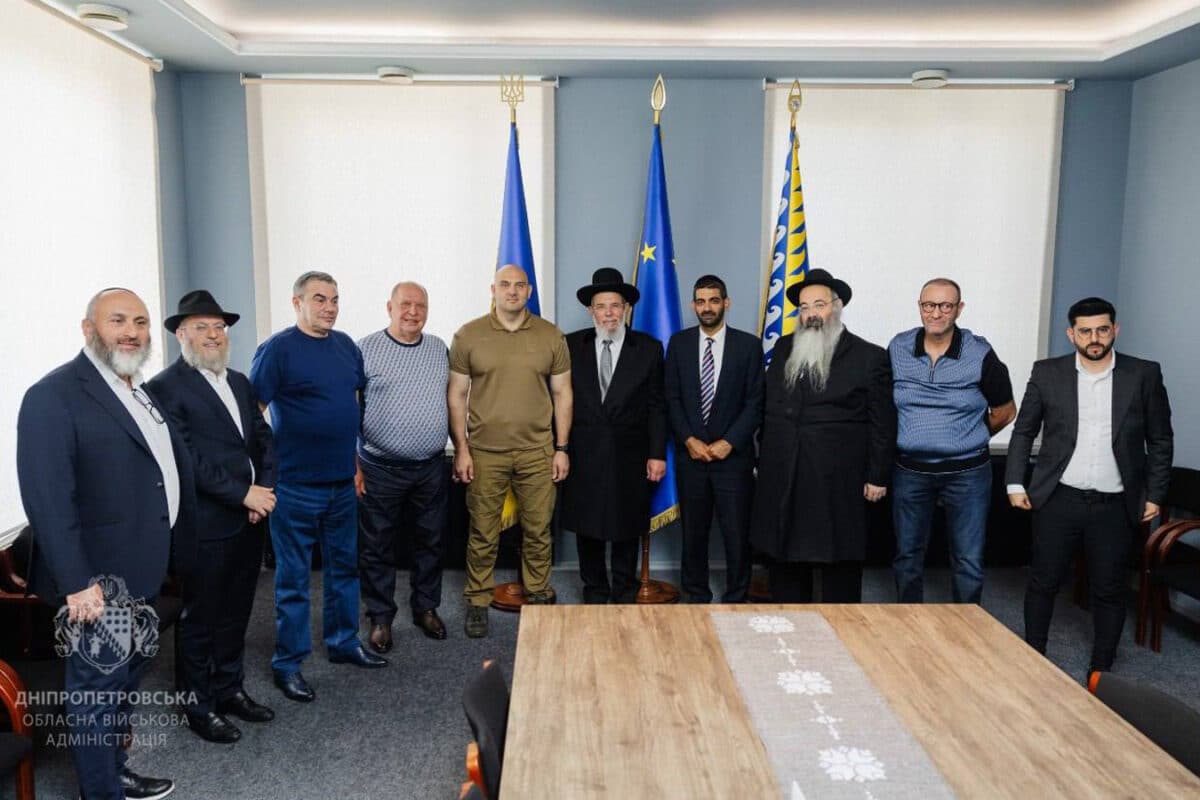
To the city where explosions are heard almost daily came the Chief Ashkenazi Rabbi of Israel Ber Meir Kalman and the Minister of Religious Affairs Michael Moshe Malchieli. The delegation was received by the head of the Regional Military Administration Serhiy Lysak.
The visit immediately sparked debates — some called it a sign of support, while others saw only a beautiful symbol.
Who arrived
Ber Meir Kalman
Ber Meir Kalman grew up in Tel Aviv, served in the army, taught in religious schools, and for a long time held positions in rabbinical courts. At the end of 2024, he became the Chief Ashkenazi Rabbi of Israel — a position that influences not only spiritual life but also relations with the state and international partners.
He came to Dnipro not as a private individual, but as a symbol: a world-class rabbi decided to personally support the Jewish community of Ukraine despite the risk. In Ukraine, Kalman’s arrival is perceived not only as a religious event but also as a gesture of solidarity: the rabbi came to a region where the largest Jewish community in Eastern Europe lives.
Michael Moshe Malchieli
Michael Moshe Malchieli was born in Jerusalem in 1982. He began his career in city politics, then became a member of the Knesset, and since 2022 has headed the Ministry of Religious Affairs. In 2023, he briefly served as Acting Minister of the Interior.
In Israel, he is considered a representative of a new generation in the Shas party, and the trip to Ukraine became an opportunity for him to show voters: caring for Jewry is not limited to the borders of the country. His visit to Ukraine is not only diplomacy but also a message to his Israeli electorate: Israel cares about the diaspora even far from home.
Serhiy Lysak welcomed the high guests
Serhiy Lysak was born in 1980 and built a career in the SBU, rising to the rank of major general. In February 2023, he was appointed head of the Dnipropetrovsk Regional Military Administration.
Today he is responsible for the defense and management of the region, which is regularly shelled. Welcoming the delegation from Israel, Lysak emphasized that Dnipro remains open to international contacts, and the Jewish community is one of the strongest pillars of the region.
“I am glad to welcome to the Dnipropetrovsk region a delegation from Israel led by Chief Rabbi Ber Kalman Meir and the Minister of Religious Affairs of this state Michael Moshe Malchieli.
This is a country that also knows what war is. What it means to defend the right to freedom. It supports Ukraine and condemns the actions of the aggressor. I thanked them for their courage and determination to visit our region, despite the fact that frontline communities are under enemy shelling every day,” — said Serhiy Lysak.
He added that the region has one of the largest Jewish communities in Ukraine, which makes a great contribution to the development of the region.
Dnipro: the regional center of Ukraine and the heart of Jewish life
A city on the Dnipro River
Dnipro is the administrative center of the Dnipropetrovsk region and one of the largest cities in Ukraine. Today, about 970 thousand inhabitants live here, making it the fourth most populous settlement in the country.
The city was founded in 1776 as Yekaterinoslav. In 1926 it was renamed Dnipropetrovsk, and in 2016, within the framework of the decommunization law, it received its current name — Dnipro. During the 20th century, the city was “closed” due to the defense and rocket-space industry. Today it remains the most important industrial, educational, and cultural center of Ukraine.
The Jewish community in pre-revolutionary times
Jews settled in Yekaterinoslav almost immediately after its founding. By the end of the 19th century, the community numbered about 50 thousand people — almost a quarter of the city’s population. Dozens of synagogues, schools, and cultural societies operated. Jews actively participated in economic and cultural life: doctors, lawyers, merchants, and engineers made up a significant part of urban society.
The Holocaust and catastrophe
In 1941, with the arrival of the Nazis, tragedy befell the community. About 30 thousand Jews were shot in the suburbs — in the area of the Botanical Garden and on the outskirts of the city. The Holocaust almost destroyed Jewish life in Dnipropetrovsk. Only a few returned after the city was liberated in 1943.
Soviet times
After the war, about 70–80 thousand Jews remained in the city, but their lives took place under strict control of the authorities. Most synagogues were closed.
On March 22, 1929, by decision of the district executive committee, the “Golden Rose” synagogue was transferred to the seamstresses’ union to organize a workers’ club. By the 1980s the building was used as a culture house. In the 1980–1990s it was used as a warehouse of the M. M. Volodarsky sewing factory.
Cultural life was almost absent, Hebrew teaching was banned. In the 1970s–1980s, Dnipropetrovsk became the center of the “refusenik” movement — Jews who were not allowed to leave for Israel. The city entered the world press as a symbol of the struggle for aliyah and a place where the right to repatriation was defended.
Revival in independent Ukraine
The turning point came at the end of the 1980s. Perestroika made it possible to revive community life. In 1990 Rabbi Shmuel Kaminezki (Chabad) came to Dnipro. Under his leadership:
- Jewish schools and kindergartens were opened;
- youth clubs and cultural centers began to operate;
- charitable funds began to work, helping the elderly and low-income.
In the 1990s, Hanukkah was again publicly celebrated in the city, Jewish newspapers were published, and cultural festivals were held.
In 1999, according to the project of architect A. T. Dolnik, the reconstruction of the “Golden Rose” synagogue (built in 1852) began. By September 2000, the reconstruction was completed.
From 1987 to 1996 the Jewish community fought for the return of the Choral Synagogue. The major repair and reconstruction lasted 4 years. In March 1994 the regional state administration decided to return the building of the Choral Synagogue to its owner by right.
The symbol of the 21st century — “Menorah”
In 2012, the cultural and business complex “Menorah” was opened in the city center, built by philanthropists Ihor Kolomoisky and Hennadiy Boholyubov. It became the largest Jewish center in the world — an area of more than 40 thousand sq. m, seven towers symbolizing the menorah.
The “Menorah” houses the Holocaust Museum, educational institutions, conference halls, a hotel, and offices of Jewish organizations. Nearby, the historic “Golden Rose” synagogue, destroyed in Soviet times, was restored.
Today the Jewish community of Dnipro numbers about 50 thousand people and is one of the most influential in Eastern Europe.
Dnipro during the war: defense and solidarity
Since the beginning of the full-scale Russian invasion in 2022, Dnipro has become one of the key stronghold cities of Ukraine. It is located only a hundred kilometers from the front line and is regularly hit. The city has become a humanitarian hub for hundreds of thousands of displaced people.
The Jewish community actively joined the defense and assistance. Under the leadership of Rabbi Shmuel Kaminezki, volunteer headquarters and refugee reception centers were opened in the “Menorah.” Jewish schools and cultural centers temporarily became shelters. Charitable organizations collected medicines, food, and equipment for hospitals.
One volunteer recalled: “In the winter of 2022, we laid mattresses right in the school corridors so that at least a dozen families could spend the night in warmth. At that time there were so many children in the ‘Menorah’ that it seemed — the whole city gathered in one house.”
This was also written about by NAnews – News of Israel, emphasizing that Dnipro became not only an industrial and humanitarian rear but also an example of how the Jewish community is able to preserve life even in the darkest times.
Why they came
The main question discussed after the visit: why did the rabbi and the minister come right now, in the midst of the war?
A gesture of support
Israel thus shows that it remembers Ukraine, even if it does not provide weapons or technology.
Work with the community
For the rabbi, the visit is a contact with the largest Jewish community in the country. He had to give a signal: the diaspora is not abandoned.
A political signal
For Malchieli, the visit is important as a demonstration of his work outside Israel. Within the country, he can say: “I was there where our people live.”
A symbol instead of action
Skeptics believe that the trip is purely diplomatic. Photos, words of support — and nothing more.
Public reaction
Opinions among the residents of Dnipro were divided. Some said: “It is good that they came, it is a brave step.” Others joked: “Well, yes, they came, took pictures, said a few words — and the rockets still keep falling.”
For the Jewish community of the region, the visit nevertheless became an event. When a world-class rabbi and a minister come to a frontline city, it is perceived as attention and recognition.
Ukraine and Israel: expectations and reality
Ukraine expects concrete steps from Israel — supplies of equipment, technologies, air defense systems. Israel, however, chooses a cautious position: it helps culturally and humanitarianly but tries not to quarrel with other players in the Middle East.
That is why the visit of the rabbi and the minister looks more like a symbolic gesture than practical support. But in wartime, even symbols sometimes play a role: they give a sense that the country is not alone.
Conclusions of the visit
In essence, the visit can be summarized in several conclusions:
- Israel showed attention to Ukraine through religious and cultural leaders.
- Dnipro confirmed its status as the center of Jewish life in the country.
- For the local community, the arrival became moral support.
- For Ukraine, the visit brought no practical benefit but was significant as a sign of solidarity.
FAQ
Why did the Chief Rabbi and the Minister of Israel come?
They expressed support for Ukraine and met with the Jewish community of Dnipro.
Why exactly Dnipro?
The largest Jewish community of Ukraine and the cultural center “Menorah” are located here.
How did the public react?
Some people perceived the visit as an important gesture, others consider it only a symbol.
What did the media write?
In Israel, the news was covered modestly, while in the Ukrainian diaspora in Tel Aviv and Jerusalem it was discussed more actively.
