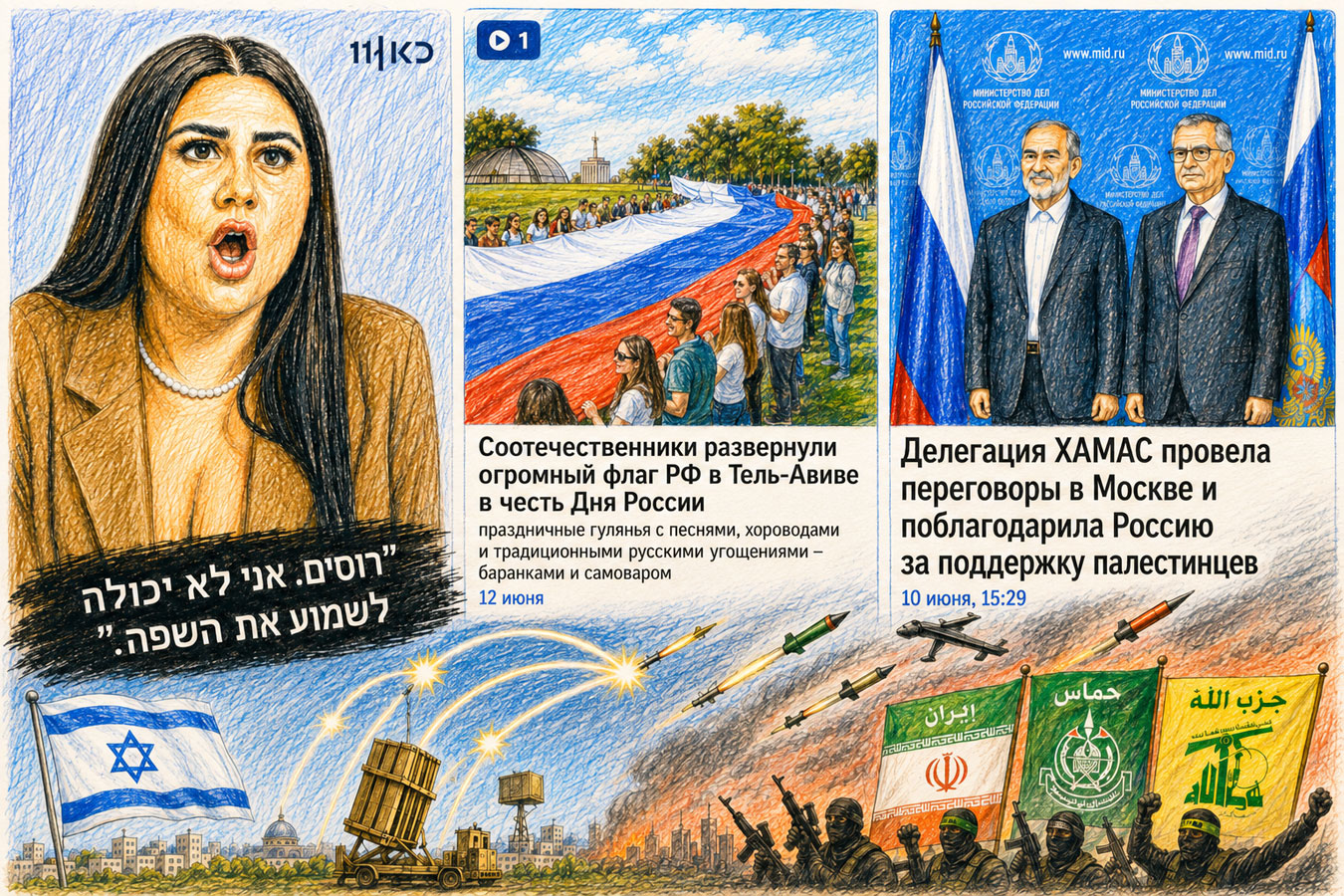
The remark by Dolev Cohen about the Russian language caused a scandal even before the premiere of the new season of ‘Four Weddings’ on Kan 11. But behind the controversy over the unsuccessful TV promo lies a broader issue: Israelis simultaneously observe HAMAS in Moscow, Russian weapons with Hezbollah, Russia’s alliance with Iran, and Russian state symbols inside Israel and… Russian speech in their favorite supermarket.
On August 21, 2026, a few seconds from the advertisement for the new season of ‘Four Weddings’ on Kan 11 turned into a political scandal. 27-year-old Dolev Cohen from Ramla said to the camera: “Russians. I can’t hear this language. I can’t hear this language. I walk through the supermarket and various places, and it seeps into my brain.” In the same remark, she similarly mentioned Amharic once.
Original – “״Russians. I can’t hear the language. Can’t hear the language. I walk through the supermarket and places, and it seeps into my brain ״. ”
There were two days left before the season premiere. But the discussion was no longer about weddings. The fragment was reacted to by Avigdor Lieberman, Vladimir Bliak, and Evgeny Sova, the latter sent an official letter to the management of the Israeli Public Broadcasting Corporation. Then came a response from Kan 11, and on August 22, a defense from Dolev’s brother, Matan.
For me, Stas Shifer, this story is interesting not only because I write about politics, wars, and their impact on ordinary people. I was born in Ukraine, live in Israel, and understand too well one dangerous substitution: the attitude towards the state gradually transfers to the language, and from the language to the person. In the case of Russia, this substitution becomes especially noticeable today because Israelis receive a very contradictory set of signals daily.
On one hand, Moscow receives HAMAS, Russia has been deepening cooperation with Iran for years, and Hezbollah has Russian weapons found by the IDF. On the other hand, inside Israel, Russian diplomacy continues to talk about ‘Russian-speaking compatriots’, Russian flags appear, state holidays, familiar cultural visual series with the tricolor, ‘Russian’ treats, matryoshkas, and other symbols of Russia.

NANews — Israel News | Nikk.Agency has written about this gap more than once. And therefore, the main question for me is not ‘Is Dolev Cohen a racist or not?’. It is much more interesting to understand, why Russian speech in Israel is beginning to acquire a political tint at all — and whether it is related to the fact that society sees Russian politics not as neutrally as it is still often presented by official Israeli diplomacy.
What exactly did Dolev Cohen say and why did the scandal go far beyond reality TV
‘Four Weddings’ is an entertainment reality show on Kan 11. Four brides visit each other’s weddings, evaluate them, discuss what they see, and the events are accompanied by humorous voice-over text. The new season is set to start on the evening of August 23.
Therefore, it is important to understand the origin of the scandalous video. This is not an old post by Dolev that someone dug up ten years later. Not a fragment of a secretly recorded conversation and not an accidental leak.
The remark was chosen for the official promo of the program.
And this makes Dolev’s story simultaneously the story of Kan 11. If a public television channel takes an emotionally charged phrase about the language of hundreds of thousands of residents of the country and makes it part of the new season’s advertisement, the responsibility for the result can no longer be left only to the reality show participant.
The reaction followed quickly. Avigdor Lieberman, chairman of ‘Our Home Israel’, accused the corporation of giving racism a place in prime time and emphasized that racism cannot be turned into entertainment. For Yisrael Beiteinu, the topic is especially sensitive: a significant part of its electoral history is connected with aliyah from the former USSR and the Russian-speaking audience of Israel.
Vladimir Bliak, a deputy from ‘Yesh Atid — Together’, went further. He demanded to remove Dolev from the screen and apologize, asking Kan 11 a rather unpleasant question: would the corporation allow itself the same television entertainment if it were about another group of Israeli society?
Evgeny Sova from Yisrael Beiteinu translated the dispute from Facebook and X into an official plane. He wrote to the general director of the public broadcasting corporation Golan Yochpaz and demanded the removal of the video, an internal investigation, and an explanation of how such material even passed editorial selection.
And here begins the part of the story that cannot be lost behind political statements.
Kan 11 responded that the corporation opposes any racist statements and itself works against racism in Israeli society. According to the channel’s explanation, the controversial remark was taken from a longer humorous episode where Dolev criticizes herself, her family, and her own wedding, and the program host directly reacts to her manner of expression.
This is an important context. But it leaves a completely different question.
If the full episode contains criticism of these words, why was the part where it is not yet present left in the promo?
It turns out to be a rather strange construction. Kan 11 simultaneously says: do not judge by a short fragment because the full context is different. But it was Kan 11 itself that offered this short fragment to the viewer as an advertisement.
On August 22, another twist appeared. Dolev’s brother Matan wrote to journalist Daniel Amram that people, in his opinion, ‘went out of proportion’: his sister is not a racist, loves everyone, but just doesn’t like some languages. As an analogy, he said that he himself cannot calmly hear Arabic speech because it causes him flashbacks from Gaza.
This is still Amram’s message from Matan’s words, not a separate public interview with Dolev. But it unexpectedly brings the conversation to a place where no one initially intended to go.
The brother suggests separating the person from the emotional reaction to the language.
And can they be separated at all?
We do not know why Dolev is irritated by the Russian language — and it is not permissible to invent a political biography for her.
The easiest way to protect Dolev now is to come up with a convenient explanation for her.
Russia is waging war against Ukraine. Russia supports Iran. Iran attacks Israel and has been building a network of armed organizations around it for decades. Russia receives representatives of HAMAS. So, perhaps, the young Israeli woman constantly sees all this in the news, after which the word ‘Russian’ begins to cause her a negative reaction.
This is psychologically possible.
But Dolev did not say this.
In the published fragment, there is no mention of Putin, Ukraine, war, HAMAS, Iran, or Russian politics. She talks about a domestic situation: hearing the Russian language in the supermarket and other places and not wanting to hear it.
Therefore, it would be unfair to first accuse her of racism based on a few seconds of video, and then just as baselessly justify it with Kremlin politics.
However, there is a question that does not depend on her personal motivation at all.
What has the ordinary Israeli seen next to the word ‘Russia’ in recent years?
For the answer, no secret Mossad reports or closed meetings of the military-political cabinet are needed. Most of the picture exists in open access.
Russia began a full-scale aggression against Ukraine on February 24, 2022. Iran supplied Russia with Shahed and helped develop a drone war against Ukrainian cities. Russia then deployed its own production of these systems. In March 2026, Volodymyr Zelensky told CNN that now Russian-made Shahed are being supplied back to Iran and used against the US and Israel. Reuters reported this statement with the caveat that the origin of each specific device is not always possible to establish.
In July, even more unpleasant information appeared. Reuters, citing American and Western officials, wrote about Russian technical assistance to Iran, improving the accuracy of Iranian drones, and checking the possible provision of targeting data by Moscow. There was no final conclusion on individual attacks, but the broader military-technical assistance from Russia to Tehran was already considered a reality.
And this already concerns not only Ukraine.
For Israel, the boundary between European and Middle Eastern wars is becoming less and less noticeable.
We recently wrote about how Russia and Iran are trying to influence Israelis themselves through social networks. There, it was not about the opinion of a Ukrainian activist, but about a special report by the State Comptroller of Israel on countering foreign influence.
There is another symptom. In July, the issue of Russian media presence unexpectedly began to be raised not only by Ukrainians and not only by opposition activists. Right-wing Israeli channels began to ask why the state practically does not react to Russian informational influence.
That is, irritation is already arising within that part of Israeli politics, which is difficult to accuse of special love for Ukraine or the desire to use Russia only as a tool in the fight against Netanyahu.
This shift seems much more important to me than a few seconds of reality TV.
HAMAS goes to Moscow, the IDF takes out Russian ‘Kornets’ from Lebanon, and Russia works more closely with Iran
On June 10, 2026, a meeting took place in Moscow that is difficult to overestimate for our topic.
Deputy Foreign Minister of Russia Georgy Borisenko received Musa Abu Marzouk from the leadership of HAMAS. Gaza, ceasefire, humanitarian aid, the future of the region, and political settlement were discussed. Abu Marzouk thanked the Russian side for its diplomatic efforts.
For Moscow, this is a diplomatic channel.
For a person in Israel after October 7, the picture looks somewhat different.
HAMAS killed Israelis, kidnapped Israeli citizens, and held hostages. Israel has been trying to destroy the organization’s military infrastructure for years. And simultaneously, its high-ranking representative flies to the capital of Russia for an official meeting at the Ministry of Foreign Affairs.
Moreover, HAMAS would like to see Moscow as a mediator for Gaza. We separately analyzed HAMAS’s attempts to promote Russia as a mediator, against which Israel objects.
Now let’s add Lebanon.
At the end of December 2024, the IDF showed journalists thousands of units of weapons captured from Hezbollah during battles in the south of the country. Among approximately 6,840 rocket-propelled grenades and anti-tank missiles were 340 Russian anti-tank missiles ‘Kornet’.
Here, the fact cannot be replaced with a convenient accusation. The presence of a Russian missile with Hezbollah does not in itself prove a direct supply of a specific batch of weapons from Moscow to the group. Russian systems have been supplied to Syria for decades, could be transferred through Syrian depots, and reach Lebanon by various routes.
But an IDF soldier entering a Hezbollah position is not engaged in diplomatic genealogy of a specific ‘Kornet’ at that moment.
He sees Russian weapons with Israel’s enemy.
In May, NANews detailed Hezbollah’s trophies and the Russian trace among the weapons that the IDF took from Lebanon. There, Iran, Russia, China, and older Soviet systems were found nearby — practically a material map of where Israel’s opponents were armed from.
And above this entire structure is Tehran.
On January 17, 2025, Russia and Iran signed a 20-year comprehensive strategic partnership agreement. It covers security, defense cooperation, military-technical interaction, exercises, and ties between security structures.
Neither Russia nor Iran formally signed a mutual military defense agreement. This is important. But the absence of an article in the style of NATO does not negate how close the relations between the two states have become.
It is here that the first serious dissonance arises for an Israeli.
The Israeli government has been explaining to society for years that Iran is a strategic threat. Israel strikes Iranian targets, destroys Tehran’s military capabilities, prepares for new attacks, and demands from allies not to allow Iran to obtain nuclear weapons.
Regarding Russia, a completely different vocabulary is used.
Although at the other end of this chain is the same Iran.
In Moscow — HAMAS, and two days later in Tel Aviv — 600 square meters of the Russian flag
And now to the most visual episode.
On June 10, HAMAS meets with the Russian Foreign Ministry in Moscow.
On June 12, on Russia Day, in one of Tel Aviv’s parks, dozens of participants unfold a Russian tricolor with an area of more than 600 square meters. Russian state sources described the participants as Israelis and ‘Russian-speaking compatriots’.
We have already analyzed these two news items in one article — ‘Russian Tricolor in Tel Aviv and HAMAS in Moscow’.
It is precisely next to each other that they look especially unpleasant.
Formally, everything is completely legal and belongs to different worlds. The Russian Foreign Ministry conducts diplomatic negotiations. People in Tel Aviv celebrate the national day of the state with which they associate themselves. The embassy holds an official reception. The program includes familiar cultural symbols: Russian folk visual series, matryoshkas, national treats, music, flags, talks about common history, and ‘compatriots’.
But mass perception rarely sorts all this into folders.
An Israeli scrolls through the same feed.
There, a HAMAS representative sits in Moscow.
There, the IDF shows Russian ‘Kornets’ found with Hezbollah.
There, Russia signs a long-term strategic agreement with Iran.
There, reports of Russian assistance to Iranian drone technologies and possible information exchange appear.
And then — Tel Aviv, a huge Russian flag, the Russian embassy, Russian state holidays, and the wording ‘Russian-speaking compatriots’.
And here it is worth making an important stop.
Russian-speaking Israelis are not ‘compatriots of Russia’ as a single political category. This is a Russian diplomatic formula, not a description of Israeli reality.
In Israel, Russian is spoken by immigrants from Ukraine, Russia, Belarus, Moldova, Latvia, Lithuania, Estonia, Kazakhstan, Uzbekistan, and other countries of the former USSR. Many have lived here for decades. Their children serve in the IDF. Among them are supporters of Putin, his opponents, people with no relation to Russian politics, and Ukrainians whose homes were destroyed by the Russian army.
But to a person unfamiliar with post-Soviet history, Moscow’s diplomatic programs, and the differences between Russian-speaking communities, a completely different visual series is shown.
‘Russian-speaking compatriots’.
Russian ambassador.
Russian tricolor.
Russian holiday.
And the next day — again Russian language in the supermarket queue.
Thus, the cultural marker begins to dangerously approach the political one.
Moreover, the relations of the Russian state with Israel themselves are becoming less unambiguous. In June, we analyzed how the level of Russia Day in Israel has changed: once figures like Benjamin Netanyahu and President Reuven Rivlin attended such events, and in 2026 the main Israeli guest was Minister May Golan. This already shows a cooling.
But it is still not a break.
Russian diplomacy remains within the Israeli public space — and continues to work with the Russian-speaking environment in terms of its own state policy.
Israel calls Iran an enemy, but continues to speak much more cautiously about Russia
Here arises the second part of the dissonance.
Benjamin Netanyahu speaks about Tehran without diplomatic nuances. Iran is a threat to Israel’s existence, its nuclear program should not be restored, missile and drone capabilities should be limited, and the ‘axis of resistance’ should be weakened.
Russia, meanwhile, cooperates with the same Iran.
But the tone towards Moscow is different.
On December 8, 2025, Netanyahu said in the Knesset that he regularly talks with Putin, and long-standing personal relations with the Russian president serve ‘vital interests’ of Israel.
During the first years of the war against Ukraine, such caution had an understandable explanation. Russia controlled a significant part of Syrian airspace, and it was important for Israel to maintain the IDF’s freedom of action against Iranian arms supplies and infrastructure in Syria.
Since then, Syria has radically changed.
Russian presence has changed.
The war in the Middle East itself has changed.
Russia and Iran have become much closer than before February 2022.
Nevertheless, in July 2026, The Times of Israel diplomatic correspondent Lazar Berman still noted Netanyahu’s reluctance to seriously reconsider relations with Moscow, even in a situation where Ukraine and Israel are effectively confronting two sides of the same Russian-Iranian military alliance.
I see no evidence of the popular version that Netanyahu simply ‘banned talking about Russia.’ Such an order cannot be presented as an established fact.
But the observed fact is different: Israeli official rhetoric towards Moscow remains much more cautious than rhetoric towards Tehran.
And society notices this too.
Moreover, the issue is gradually emerging from the usual Russian-speaking or Ukrainian bubble. When NANews wrote about Russian journalist Sergey Pashkov and questions about Russian state media influence, the most interesting thing was not even Pashkov himself.
The question came from the right.
From an environment where they like to talk about national security, sovereignty, foreign influence, and the need to be tough on Israel’s enemies.
For such a voter, it is becoming increasingly difficult to explain one construction: Iran is dangerous; Hamas is dangerous; Hezbollah is dangerous; the Russian state media system and Moscow work closely with Iran and maintain contacts with Hamas — but for some reason, Russia should remain almost a separate topic.
Previously, this inconsistency was easier to attribute to the Ukrainian war and the Syrian necessity.
In 2026, it is more difficult to do so.
Especially since the State Comptroller of Israel has already separately raised the issue of Russian and Iranian influence in the digital space.
So it’s long been not just about the emotions of Ukrainians.
It’s already about Israeli security.
How the Kremlin turns into the Russian language — and why the wrong person starts paying for Russia’s policy
Now we can return to the Dolev supermarket.
Russia is far away.
The Kremlin is far away.
Putin appears in the news.
The strategic agreement with Iran is a document of dozens of pages. The transfer of technologies, diplomats’ negotiations, arms routes from Syria to Lebanon, intelligence contacts — these are complex things.
The Russian language next to the checkout does not seem complex.
And here the most primitive psychological transfer can work:
Russia is waging an aggressive war against Ukraine. Russia cooperates with Iran. Iran is at war against Israel and supports its enemies. Hamas comes to Moscow. Hezbollah finds Russian weapons. Russian diplomacy inside Israel talks about ‘Russian-speaking compatriots.’ Russian state flags appear at public events.
After this, the word ‘Russian’ for part of society begins to mean more than just a language.
The problem is right here.
Because the next step is already false.
Kremlin → Russia’s policy → the state of Russia → Russian language → Russian-speaking person.
There is no political connection between the fourth and fifth links.
A person near Dolev in the supermarket may be an Israeli from Kyiv.
Or from Odessa.
Or Kharkiv.
Or Riga.
Or Chisinau.
May be a person who left Russia itself precisely because they do not want to have anything to do with Putin’s regime. May serve in the IDF. May raise money for Ukraine. May have relatives under Russian missiles.
The Russian language does not issue a passport, political views, or attitude towards Israel.
This is the paradox of the current story.
Hatred of the Kremlin’s policy does not require irrational explanations. After Bucha, Mariupol, the war against Ukraine, Moscow’s contacts with Hamas, the strategic alliance with Iran, and Russian weapons with Israel’s opponents, there are more than enough reasons to critically view the Russian state.
But if this hatred transfers to a person just because they spoke Russian, the original political logic already disappears.
And therefore, I still do not want to end this story with a verdict on Dolev Cohen.
Maybe she really just doesn’t like the sound of the language.
Maybe there is personal experience behind this reaction.
Maybe political news has nothing to do with it.
Until Dolev herself explains this, everything else will be speculation.
But the scandal accidentally opened a more serious topic.
Israeli society increasingly sees Russia alongside those whom the state of Israel itself calls enemies. At the same time, official policy continues to treat Moscow much more cautiously than Tehran, and Russian diplomacy within Israel itself still actively associates the state of Russia with the concept of ‘Russian-speaking compatriots.’
Perhaps it is from such a contradiction that the very everyday transfer we saw in the Kan 11 promo video is born.
Not necessarily with Dolev personally.
But in society — quite possibly.
And if this really starts to happen, the problem is no longer in a few seconds of ‘Four Weddings.’
The problem is that the bill for the Kremlin’s actions may gradually begin to be presented to a person who simply speaks Russian in an Israeli supermarket.
And this will not be a victory of Israel over Russian influence.
It will be yet another consequence of Russian influence itself.