
The situation changed after one short, unemotional gesture. On December 6, 2025, Donald Trump took a column on FoxNews, an op-ed by David Marcus, and reposted it himself – “Trump’s Aggression Toward Venezuela — A Warning to Putin.
Russia’s client states are collapsing one by one as Trump increases pressure on Moscow over the war in Ukraine”.
No explanations.
This was enough for the news to stop being local and enter the international circuit.
Marcus’s column, published in the Opinion section, was built on sharp logic. Venezuela is not the ultimate goal. Venezuela is a tool. The author literally writes the following:
“Venezuela is a client state of Russia. Just like Syria before the recent overthrow of Bashar al-Assad.”
He further develops the idea:
“Trump is proving one by one that in the face of US power, Putin is unable to protect his dubious allies on the world’s peripheries.”
And the key assertion:
“Russia risks facing a choice: either to return what it calls ‘territorial integrity’ at the cost of giving up its status as a world power.”
Marcus claims that US pressure on Venezuela is not aimed at Maduro. It is aimed at demonstrating that Russia is no longer able to maintain its network of external partners because the war in Ukraine has depleted its resources.
Trump’s repost turned this interpretation into a political signal. Trump did not write a word but made the column part of his public stance.
Russia loses control over the periphery but continues to talk about influence
For many years, Venezuela was a showcase of Russian presence in the Western Hemisphere. Loans, oil, diplomatic support — it seemed that Moscow could play the global game.
However, after 2022, this structure began to fall apart. Resources became scarcer, sanctions intensified, and the war in Ukraine consumed the Kremlin’s capabilities.
And the louder Moscow talks about its “presence,” the more obvious it becomes — it cannot intervene. This very weakness makes Venezuela a convenient pressure point.
Washington acts without direct confrontation
The American strategy is built on exploiting Russia’s vulnerabilities. Not by war, but by demonstrating the weakness of its alliances.
From Marcus’s point of view, such actions destroy the very image of Moscow as a power capable of maintaining a sphere of influence. Russia can no longer act as a guarantor — neither for Venezuela, nor for Syria, nor for other partners dependent on its support.
If Maduro takes a step back, it will be a blow to the foundations of Russian foreign policy.
Israel in a new reality: old interaction schemes no longer work
Now — the most tangible consequence for Israel.
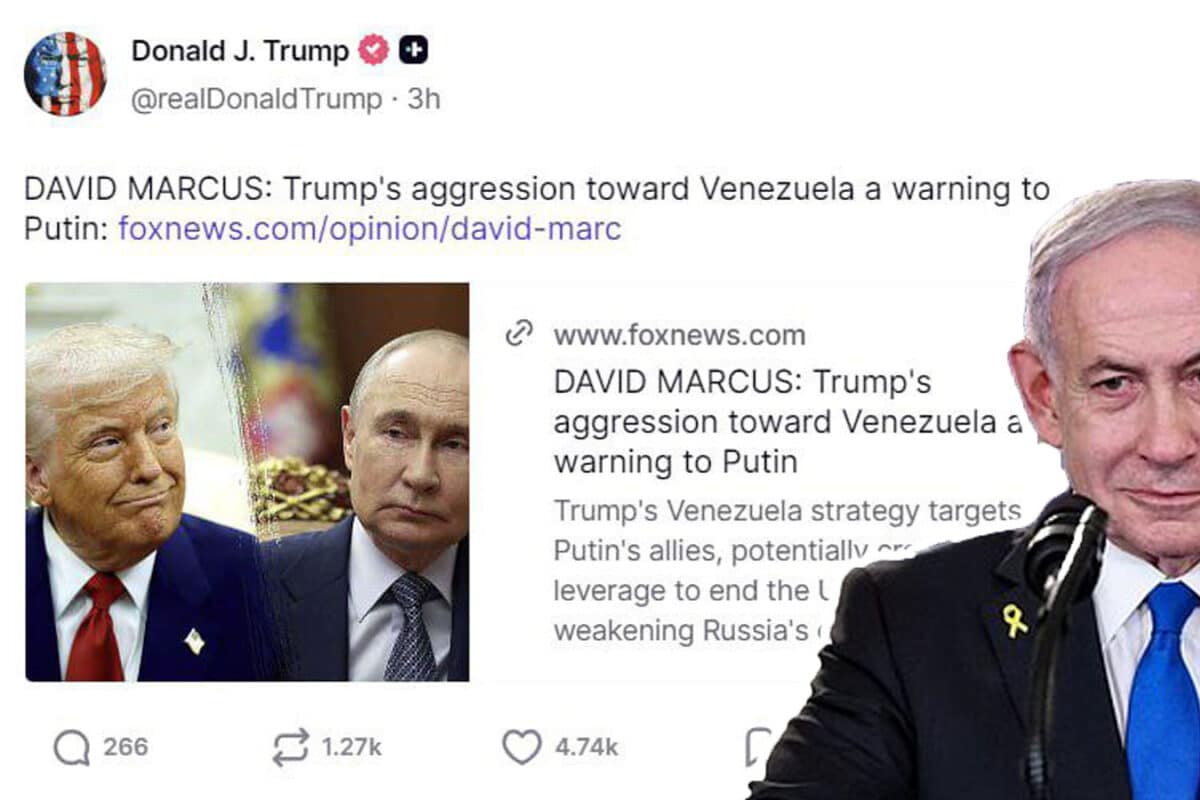
Years of “special relations” between Benjamin Netanyahu and the Putin regime created the illusion that Moscow was a “useful partner.” Personal channels, “trust,” direct contacts.
But when Israel, together with the US, struck Iranian infrastructure in Syria, Russia did not help. Did not intervene. Did not cover.
Russian air defense systems ignored what was happening. Moscow made statements but did not act.
This destroyed the myth of Russia’s role in ensuring balance.
Today this myth has completely disappeared. Russian presence in Syria is residual. There is no military influence. No ability to restrain Iran.
But the political habit of considering Moscow still exists. It is this that creates tension at a time when Washington’s strategy is becoming tougher.
A strange internal picture: the US pressures Putin’s Russia, while Russian tours and tourism continue in Israel
This is where the paradox arises.
The US is Israel’s main ally. Washington is increasing pressure on the Kremlin. Moscow arms Iran, participates in the production of drones and missiles, helps Tehran strengthen its positions.
But in Israeli everyday life — dozens of Russian tour posters, concert tours, tourist advertisements.
The public attends events. Business accepts groups. Tourist flows continue.
This creates a gap: US foreign policy and real practice within Israel do not coincide.
If the American line becomes even tougher, this gap will require explanation. Israel will find itself in a situation where cultural and economic contacts with Russian society will become part of a larger political discussion.
Strategic outcome: choice is inevitable
If US actions around Venezuela are indeed an element of a large strategy to pressure the Kremlin, and Russia no longer plays a role in the regional architecture of the Middle East, Israel will need to reconsider its own behavior model.
The old formula of balance — between the US and Russia — no longer exists.
There is the US and there is the strengthening of Iran.
There is Ukraine and there is a new configuration.
There is Russia, which has lost influence and found itself dependent on Tehran.
Now it is important for Israel to recognize: the period of uncertainty is over.
The country must determine whether its internal practice corresponds to the foreign policy reality in which it lives.
This is what makes the current moment pivotal. Not a momentary scandal, but a structural change.
And this is exactly how, in an analytical dimension, NAnews — Israel News | Nikk.Agency views the events, marking the transition to a new era where old diplomatic schemes no longer work, and new ones require clear decisions.
