
The Israeli Foreign Ministry has begun preparations for the year 2030, which the authorities and church leaders of Jordan call the 2000th anniversary of the Baptism of Jesus Christ in the Jordan River. However, there is no unified decision from the Vatican, the Ecumenical Patriarchate, or all Christian churches regarding such a jubilee. Moreover, the date 2030 itself is historically contentious.
On July 15, 2026, Israeli Foreign Minister Gideon Sa’ar ordered the creation of a special task force to prepare for events related to the supposed two-thousandth anniversary of the Baptism of Jesus Christ.
The group was headed by Ambassador George Deek, Israel’s special envoy for relations with the Christian world. In a statement from the Foreign Ministry, the event was described as having deep spiritual significance for more than two billion Christians. Israel expects that millions of pilgrims may arrive in the region.
At first glance, a logical question arises: why is the Foreign Ministry of the Jewish state involved in preparing for a Christian jubilee?
The answer is that Israel did not set the date, did not establish a religious holiday, and does not plan to conduct church rituals. The task of the Foreign Ministry is diplomatic contacts with churches, Christian organizations, religious leaders, and foreign governments, as well as coordination with other Israeli agencies ahead of the possible mass arrival of foreign citizens.
Israel joined an already existing project
The wording that the Israeli Foreign Ministry “began preparations for the celebration” creates the impression that it was Jerusalem that declared 2030 a jubilee year.
In reality, Israel joined an initiative that Jordan began promoting much earlier.
Jordanian shore and UNESCO site
The main center of future events, Jordan considers the place “Bethany Beyond the Jordan” — Al-Maghtas, located on the eastern bank of the Jordan River, nine kilometers north of the Dead Sea.
The archaeological area includes two main zones:
- Tell al-Kharrar, also known as Jabal Mar Elias, or the hill of the prophet Elijah;
- the area of the churches of John the Baptist near the river.
On the territory, remains of Roman and Byzantine churches, chapels, a monastery, hermit caves, water collection systems, and ancient baptismal pools have been discovered. In 2015, the site was inscribed on the UNESCO World Heritage List. Most Christian denominations recognize this area as the probable site of Jesus’ Baptism by John the Baptist.
On the opposite, western bank of the Jordan is Qasr al-Yahud, located in the Jericho area on the West Bank and under Israeli administration.
The Jordan at this point is quite narrow: pilgrims on both banks essentially look at each other. But each bank promotes its own version of pilgrimage infrastructure and its own access to the Baptism site.
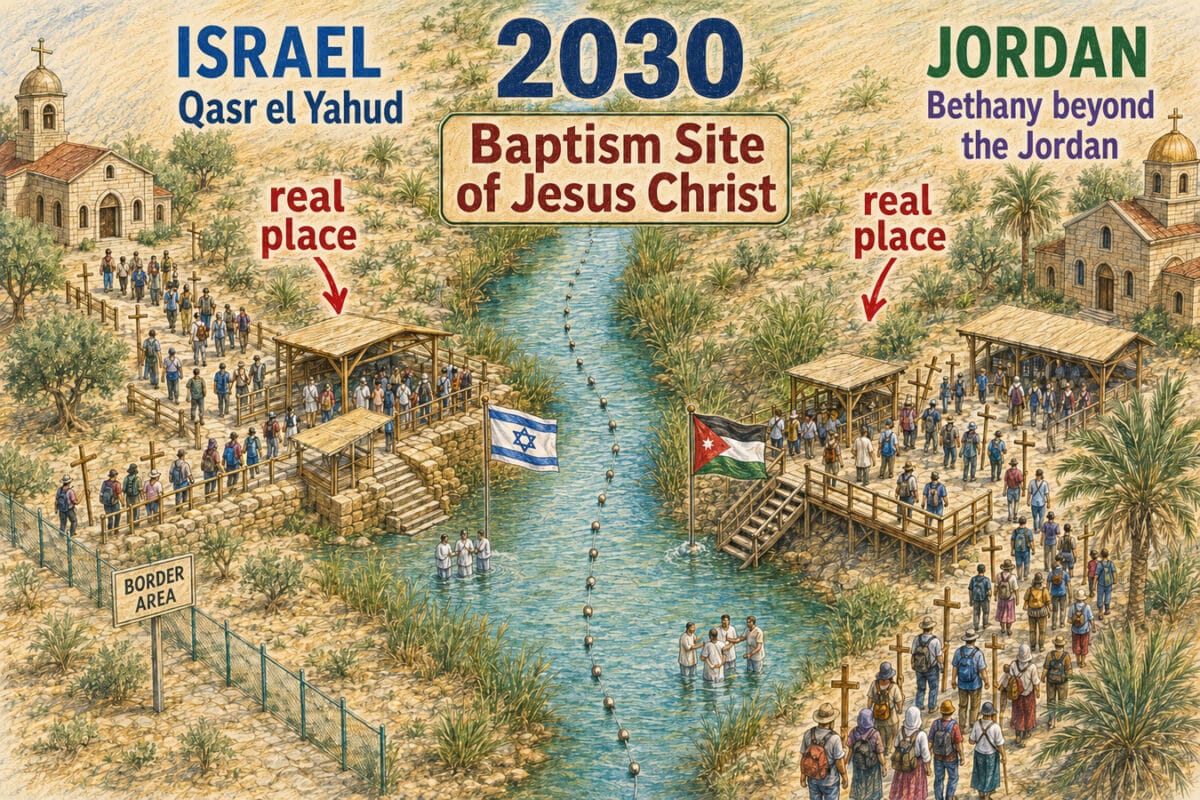
This is where religious history simultaneously turns into a matter of tourism, diplomacy, transportation, security, and international influence.
And Yardenit?
Yardenit is another well-known baptismal complex in the waters of the Jordan, located in northern Israel, near Kibbutz Kinneret, where the river flows out of Lake Kinneret and heads south.
It appeared in 1981 as a safe and convenient alternative to Qasr al-Yahud. After the Six-Day War of 1967, the traditional Baptism site of Jesus near Jericho ended up in a closed border zone: surrounded by minefields, military barriers, and free access for pilgrims was practically impossible.
In Yardenit, stairs and platforms for descending to the water, changing rooms, showers, places for worship, and group baptisms were equipped. Thanks to this, the complex quickly became popular among Christian pilgrims from around the world.
However, Yardenit is not considered a historical site of the Baptism of Jesus Christ. The evangelical event is traditionally associated with Qasr al-Yahud on the Israeli bank and Bethany Beyond the Jordan on the Jordanian side. Yardenit is a modern pilgrimage center that arose due to the long-term lack of safe access to the traditional site.
A $100 million project appeared back in 2022
On December 13, 2022, it became known that Jordan is launching a master plan worth about $100 million, aimed at attracting approximately one million Christian pilgrims in 2030.
The project was not presented by the Vatican or an ecumenical council, but by a non-profit foundation created with the participation of the Jordanian state to develop the “Bethany Beyond the Jordan” area.
The chairman of the foundation, businessman and former Jordanian Minister of Labor Samir Murad, explained that the area should retain its spiritual and natural character. The developers abandoned the idea of building luxurious five-star hotels and chose the concept of a “biblical village,” which should remind pilgrims of life two thousand years ago.
The first phase of the project was estimated at approximately $15 million. The second — up to $85 million.
The plan included creating comfortable tent accommodations, affordable lodging for pilgrims, establishments with local organic food, a three-star hotel, restaurants, a shopping area, a museum, a wellness center, botanical gardens, and a nature reserve on the bird migration route.
Electrical cables and communication lines were planned to be buried underground so that modern infrastructure would not disrupt the visual atmosphere of the historical site.
Nine religious organizations received the right to create their own facilities for receiving pilgrims. Among them was the World Baptist Alliance, cooperating with the Jordanian Baptist Convention.
At a dinner dedicated to the launch of the project, about 250 guests were present, including King Abdullah II of Jordan, his two sons, and the country’s prime minister. The Secretary-General of the World Baptist Alliance, Elijah Brown, stated that both phases should be completed by 2029 so that the area is ready for the 2030 events.
Thus, the first public presentation of the 2030 date was primarily associated with a specific Jordanian investment and pilgrimage project.
How a tourist date turned into a religious initiative
The next stage began in January 2025.
At the beginning of the month, a new Catholic Church of the Baptism of Jesus was consecrated on the Jordanian side of the Jordan. The ceremony was attended by the Vatican’s Secretary of State Cardinal Pietro Parolin, who arrived as a special representative of Pope Francis, and the Latin Patriarch of Jerusalem Cardinal Pierbattista Pizzaballa.
The construction of the church took about 15 years. The first stone was previously blessed by Pope Benedict XVI in the presence of King Abdullah II and Queen Rania.
On January 28, 2025, Father Rifat Bader, director of the Catholic Center for Studies and Media in Jordan, stated in an interview with Vatican News that Jordan is beginning a five-year preparation for its “Great Jubilee.”
He explicitly said that in 2030, Jordan intends to celebrate 2000 years since the Baptism of Jesus. However, this was a statement from a representative of the Latin Patriarchate in Jordan, published by Vatican News, not a papal bull or an official act of the Holy See establishing a worldwide jubilee year.
In other words, the presence of high-ranking Vatican representatives gave the project significant ecclesiastical weight, but in itself did not turn 2030 into a mandatory jubilee for the entire Christian world.
Pizzaballa linked 2030 and 2033
On December 17, 2025, in Amman, at the Al-Husseiniya Palace, King Abdullah II met with Christian and Muslim religious leaders of Jerusalem and Jordan.
At this meeting, the Latin Patriarch of Jerusalem Cardinal Pierbattista Pizzaballa stated:
- 2030 should mark 2000 years since the Baptism of Christ;
- 2033 should mark 2000 years since the Resurrection.
Pizzaballa added that representatives of churches from around the world should come to Jordan, primarily to “Bethany Beyond the Jordan.”
Here, the overall structure of the project became visible: the period from 2030 to 2033 should be presented as a symbolic path from the Baptism and the beginning of Jesus’ public ministry to the crucifixion and Resurrection.
But even this statement was not a decision of all Christian churches. It was support for the Jordanian program from one of the most influential Catholic hierarchs of the Holy Land.
Official state support appeared on May 18, 2026
On May 18, 2026, King Abdullah II visited the Baptism site at “Bethany Beyond the Jordan” and opened the International Orthodox University Baptism Site International Orthodox University — BIO University.
This is a non-profit educational institution created by the Jerusalem Orthodox Patriarchate. The university is designed to accommodate 40 students, provides for the possibility of distance learning, and was supposed to start accepting students in September 2026.
During the event, the king instructed the Jordanian government to adopt and support the Baptism 2030 initiative.
And here is the precise answer to the question of who officially put forward the current initiative: it was proposed by the Council of Church Leaders of Jordan.
The chairman of the Council, Greek Orthodox Archbishop Christoforos Atallah, thanked the king for his support and stated the need to develop programs and strategic plans jointly with churches.
Cardinal Pizzaballa called 2030 not just a historical date, but an opportunity to strengthen unity, mutual understanding, and harmony.
The Anglican Archbishop of Jerusalem and Primate of the Episcopal Church of Jerusalem and the Middle East Hosam Naoum stated that the preparation should include infrastructure development, service improvement, staff training, and work with churches and Christian organizations worldwide.
The state plan of Jordan covers religious events, the development of pilgrimage routes, the promotion of “Bethany Beyond the Jordan” and other Christian sites, infrastructure renewal, and the creation of services for foreign visitors.
NANews — Israel News compared the dates: the Israeli task force appeared almost four years after the first public presentation of the Jordanian project and two months after King Abdullah II’s official directive.
What Israel was preparing on its shore
Israel was not just observing Jordan’s actions.
On February 10, 2026, after extensive reconstruction, the Qasr al-Yahud complex on the western bank of the Jordan River reopened.
The cost of the work amounted to 25 million shekels, or approximately 8.1 million dollars at the exchange rate at the time of opening. Funding was provided by the Israeli Ministry of Tourism and the Civil Administration, and the work was carried out by the State Tourism Company.
The project included:
- road and parking repairs;
- landscaping;
- construction of a prayer pergola;
- a large air-conditioned sanitary facility;
- hot showers and changing cabins;
- a wide wooden deck for safe access to the water.
There were also plans to create an air-conditioned hall for prayers and events in any weather and separate water access for people with disabilities.
Qasr al-Yahud is called the third most important Christian site in Israel and the West Bank after the Church of the Holy Sepulchre in Jerusalem and the Church of the Nativity in Bethlehem.
Thus, by the time of the Foreign Ministry’s decision, infrastructure preparation on the Israeli side was already in full swing.
Why George Deek headed the task force
On April 23, 2026, Gideon Sa’ar appointed George Deek as Israel’s first special envoy for relations with the Christian world.
Deek is an Arab-Christian from Jaffa, a career diplomat, and a former Israeli ambassador to Azerbaijan. He became the first Christian to head an Israeli embassy. His father, Yousef Deek, led the Orthodox Christian community of Jaffa and Israel.
The appointment came amid a serious deterioration in Israel’s relations with some Christian leaders.
During military restrictions, the police did not allow Cardinal Pizzaballa and other high-ranking clergy to attend the Palm Sunday service at the Church of the Holy Sepulchre. After international reaction, the authorities reversed the decision, and Prime Minister Benjamin Netanyahu demanded that the patriarch be granted access.
Additionally, in April 2026, an IDF soldier was filmed smashing a statue of Jesus with a sledgehammer in the Christian village of Debel in southern Lebanon. The soldier and the colleague filming the incident were removed from combat duties and punished after an investigation. Catholic leaders of the Holy Land called the incident a grave insult to the Christian faith.
There were also reports of attacks by radical settlers on Christian communities in the West Bank and increasing cases of insults, spitting, and attacks on Christians in the Old City of Jerusalem.
Therefore, preparation for 2030 has not only tourist but also diplomatic significance for Israel. It is an opportunity to restore relations with Christian churches and demonstrate that the state guarantees freedom of religion and access to holy sites.
Who actually “declared” 2030
Based on the documents found, the following chain can be reconstructed.
On December 13, 2022, a Jordanian state-affiliated foundation publicly presented a $100 million project and named 2030 as the time to celebrate the two-thousandth anniversary of the Baptism.
In January 2025, representatives of the Catholic Church in Jordan announced the start of a five-year preparation for the “Great Jubilee.”
On December 17, 2025, Cardinal Pizzaballa publicly linked 2030 with the Baptism and 2033 with the Resurrection.
On May 18, 2026, King Abdullah II instructed the Jordanian government to support the Baptism 2030 initiative proposed by the Council of Church Leaders of Jordan.
On July 15, 2026, the Israeli Foreign Ministry joined the already existing project.
However, no single document was found by which the Pope, the Ecumenical Patriarch, the World Council of Churches, or any other body representing all of Christianity officially declared 2030 as the worldwide year of the two-thousandth anniversary of Christ’s Baptism.
Therefore, it is more accurate to speak not of a jubilee recognized by the entire Christian world, but of a Jordanian church-state initiative, supported by a number of influential Christian leaders and later picked up by Israel.
Why the date 2030 itself raises questions
The Gospels do not specify the exact calendar year of Jesus’ Baptism.
The main chronological reference is found in the Gospel of Luke. The beginning of John the Baptist’s ministry is attributed to the fifteenth year of the reign of the Roman Emperor Tiberius. Jesus’ Baptism occurred shortly after John’s ministry began.
The problem lies in how exactly to count the years of Tiberius’ reign.
His independent reign is usually counted from the death of Emperor Augustus in 14 AD. By this calculation, the fifteenth year of Tiberius falls between the second half of 28 and 29 AD.
A study by Andrew Steinmann, published in the Tyndale Bulletin in 2022, compares Roman, Jewish, and early Christian written sources, coins, and inscriptions. The author concludes that contemporaries counted Tiberius’ reign from 14 AD, and Jesus’ Baptism most likely occurred in 29 AD.
In scientific and theological literature, there are other calculations that date the beginning of the ministry to 28 AD or, when counting Tiberius’ co-regency with Augustus, to an even earlier period. But there is no exact historical basis specifically for the year 30.
If the Baptism occurred in 29 AD, the two-thousandth anniversary falls in 2029. To get 2030, one must assume a conditional date of Baptism in 30 AD.
Therefore, 2030 is not a proven historical date, but a convenient symbolic marker.
It allows for a clear four-year concept:
2030 — Baptism and the beginning of ministry;
2033 — crucifixion and Resurrection.
For an international pilgrimage campaign, such a scheme is convenient. For strict historical chronology, it remains controversial.
Conclusion
The Israeli Ministry of Foreign Affairs has indeed begun preparations for the events of 2030, but Israel did not invent this anniversary.
The date appeared in the public domain no later than December 2022 as part of the Jordanian development project ‘Bethany Beyond the Jordan’. It was then supported by Catholic, Orthodox, and Anglican leaders of Jordan and Jerusalem. In May 2026, King Abdullah II turned the Baptism 2030 initiative into a state program.
Israel joined later when it became clear that Jordan intended to turn the eastern bank of the Jordan into a global center for Christian pilgrimage.
On the western bank, Israel has already invested 25 million shekels in the reconstruction of Qasr al-Yahud, created the position of a special envoy for relations with the Christian world, and is now forming a diplomatic infrastructure to work with churches and future pilgrims.
Therefore, behind the religious formulation are several processes: faith, historical memory, relations with the Christian world, restoration of Israel’s reputation, competition with Jordan, and the struggle for a huge international pilgrimage flow.
And the year 2030 itself remains primarily a symbolic, church-tourist, and politically convenient date, rather than an indisputably established two-thousandth anniversary of the Baptism of Jesus Christ.