
As is known, in 2022 The Verkhovna Rada of Ukraine recognized the Chechen Republic of Ichkeria as “temporarily occupied” and condemned the genocide of the Chechen people — an important symbolic bridge between Ukrainians and the Chechen resistance.
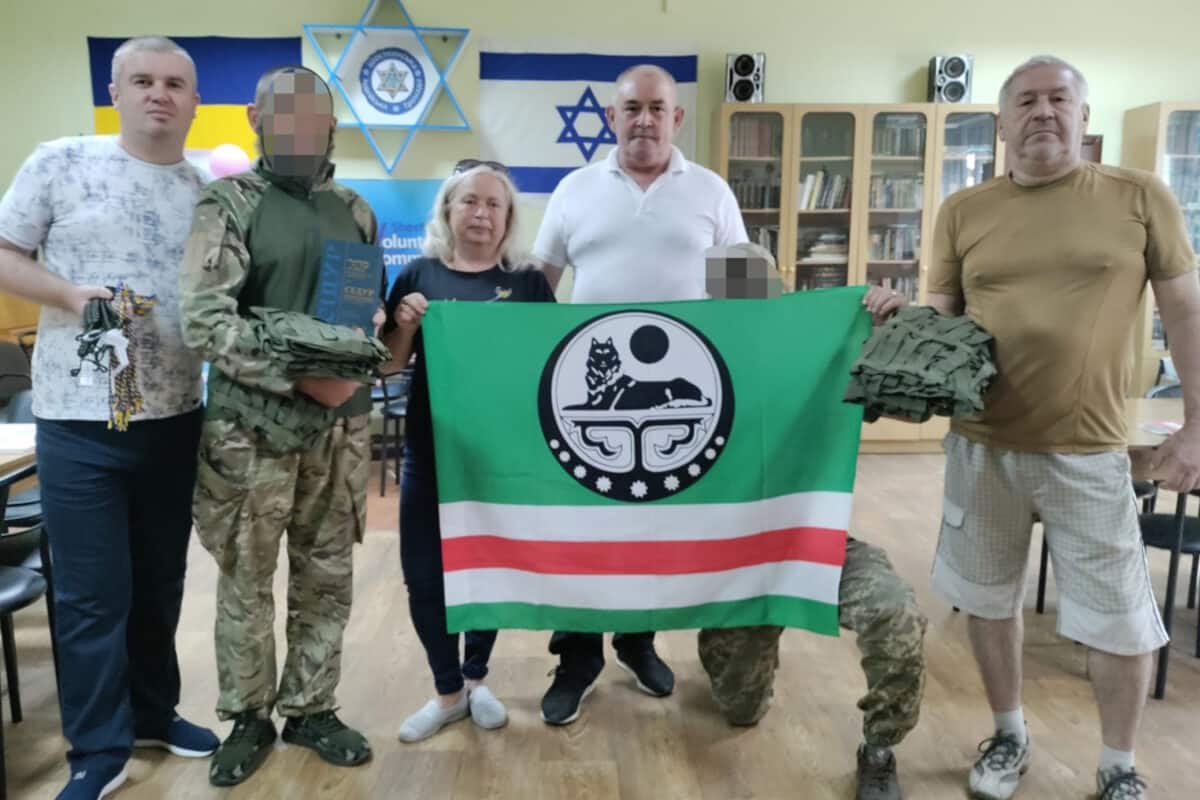
In the photo — Jewish volunteers and representatives of the Chechen battalion hold the flag of the Chechen Republic of Ichkeria — the official symbol of the unrecognized Chechen state, which in 1991–2000 actually existed on the territory of Chechnya and declared independence from Russia. Today it is mainly used in the diaspora and among supporters of Chechen independence, including Chechen volunteers in Ukraine.
The suppression of the Chechen resistance by Russia in the 1990s–2000s was accompanied by mass civilian casualties and large-scale destruction.
In the First Chechen War (1994–1996), Russian troops used carpet bombing, especially in Grozny, which was practically wiped off the face of the earth; thousands of civilians were killed, tens of thousands were wounded.
In the Second Chechen War (since 1999) the scale of violence increased even more: extrajudicial executions, “cleansing” operations with disappearances of people, torture and deportations took place. According to human rights activists, the total number of dead in the two wars ranges from 80 to 150 thousand people, including women and children, and hundreds of thousands became refugees.
These events made the flag of Ichkeria not only a symbol of independence, but also a reminder of the tragedy of a people who experienced ethnic extermination.
How are the Chechen volunteer battalions of the AFU connected to the Jewish communities of Ukraine?
The Jewish community of Shostka handed over humanitarian aid to the Chechen battalion of the AFU
In Shostka, the Jewish community handed over another batch of humanitarian aid to Ukrainian servicemen, including the Chechen battalion, which is heading to one of the most dangerous sections of the front.
This was reported by the Shostka Jewish Community on its account on August 12, 2025.
“The Shostka Jewish Community continues to support our defenders by providing tactical stretchers made using Israeli technology. These stretchers are in great demand among the military, as they are reliable, comfortable, and help save lives.
This time, the aid went to the Sheikh Mansur Chechen Battalion, which will head to the hottest direction to defend our indestructible Ukraine. Along with the stretchers, paracord bracelets, protective gloves, neck pillows, fire starters, and, of course, amulets were handed over to protect our warriors in the hottest spots.
We believe that every contribution brings us closer to victory. Victory is not far away — Ukraine will definitely win!”
Volunteer work of the Shostka Jewish Community
The Shostka Jewish Community is known for producing tactical stretchers using Israeli technology.
The production is organized by volunteers at the community base. Modern materials are used to ensure reliability and convenience. Such stretchers can withstand significant loads and allow transportation of the wounded even in difficult conditions. They can be used not only to evacuate soldiers from the battlefield but also in rescue operations — they can hold up to 200 kg.
In addition to stretchers, the community purchases and sends to the front protective gloves, warm clothing, neck pillows, fire starters, and small amulets.
Sergey Katsman, head of the Jewish community, said that the Shostka Jewish Community is the only one in Ukraine producing such stretchers, but they are ready to share the sewing technology with other cities because all Ukrainians now have one common goal — Victory.
Since February 24, 2022, Shostka, a city in the Sumy region 25 kilometers from the Russian border, has been regularly shelled. Already in the first days of the invasion, the city found itself in the zone of direct threat. In March 2022, as a result of artillery strikes, residential buildings and infrastructure were damaged.
The Shostka Jewish Community, numbering several dozen active members, from the beginning of the war organized volunteer aid together with other residents. They coordinate the collection of food, clothing, medicines, and hygiene products for those affected.
In the summer of 2025, Shostka, Sumy region, was the focus of massive attacks by Russia. Aviation, guided bombs, and Shahed drones were used, with strikes on residential neighborhoods and infrastructure.
Chronology of shelling:
| Date | Event |
|---|---|
| July 19, 2025 | Massive attack using drones and guided aerial bombs. The attack lasted about four hours. No recorded dead or wounded, but local fires occurred. |
| July 25–26, 2025 | Drones, bombs, and missiles struck the city. Three people were injured (two women and a man), suffering burns and shrapnel wounds. Four private houses, apartment buildings, and infrastructure facilities were damaged. |
| August 8, 2025 | Night raid of Shahed drones. Some targets were shot down by air defense, but residential buildings, cars, and infrastructure were damaged; one person was injured. |
| August 10, 2025 | Air strike on the Khlazove area and other parts of Shostka. Civilian infrastructure and private houses were damaged. |
Against the backdrop of constant threat, the Shostka Jewish Community continues to act: organizing collections of food, medicines, and essential items for those affected, and providing assistance to the wounded and to families who have lost their homes.
On July 28, 2025, the Shostka Jewish Community (Sumy region) appealed to city residents to support community members — Serhii and Iryna Starostenko, whose house was completely destroyed as a result of shelling, and all property was destroyed.
Chechen volunteer battalions in the Armed Forces of Ukraine
For more than ten years, Chechen volunteer formations, created from natives of Chechnya who emigrated after the First and Second Chechen Wars, have been fighting as part of the Armed Forces of Ukraine. Their main goal is to continue the struggle against Russia, which they consider their historical enemy. For them, the war in Ukraine is not only support for the Ukrainian people but also part of their own national liberation struggle for the independence of the Chechen Republic of Ichkeria.
Sheikh Mansur Battalion
It was to this battalion that the Shostka Jewish Community has now provided assistance.
Formed in 2014, mainly from Chechens who left Chechnya after the Second Chechen War. Initially part of the Volunteer Ukrainian Corps “Right Sector,” later — of the Ukrainian Volunteer Army. Named after the late 18th-century Caucasian leader Sheikh Mansur, who led the highlanders’ uprising against the Russian Empire. This is one of the largest volunteer battalions in Ukraine, which took part in battles in Donetsk and Luhansk regions, and after 2022 — also in the southern directions.
Dzhokhar Dudayev Battalion
Also created in 2014. Composed mainly of Chechen emigrants who left their homeland after the Second Chechen War. Named after the first president of the Chechen Republic of Ichkeria, Dzhokhar Dudayev, who was killed by Russian troops in 1996. The battalion’s motto is “Freedom or Death!”. The unit is actively fighting on the fronts, seeing Ukraine’s victory as an important step towards the possible liberation of Chechnya.
Khamzat Gelayev Battalion
A formation created in 2022, named after Chechen field commander Ruslan (Khamzat) Gelayev, one of the symbols of resistance to Russia. The battalion quickly became part of the AFU’s combat operations, participating in assault actions and reconnaissance.
Other Chechen formations
In addition to these three main battalions, the following fight on Ukraine’s side:
- Separate Special Purpose Battalion of the Armed Forces of the ChRI;
- Special Operations Group “SOG”;
- Assault Battalion “Shalena Zgraya” (“Mad Pack”);
- Volunteer Battalion “Crimea”;
- Muslim Corps “Caucasus”.
Why Chechen battalions fight for Ukraine
For the fighters of these units, the war in Ukraine is a chance to continue the struggle they began on their native land against Russian occupation. They believe that Russia’s defeat in Ukraine will also bring the liberation of Chechnya closer. Many fighters have combat experience gained in the Caucasus mountains and use it to help Ukrainian troops with reconnaissance, sabotage operations, and urban combat.
As of the end of 2022, the number of Chechen volunteers in the AFU was estimated at about 2,000 people, but there are no exact and up-to-date figures for 2025 — many formations do not disclose their numbers for security reasons.
Historical connection between Mountain Jews and Chechens
The ancestors of the Mountain Jews (Juhuri) arrived in the Caucasus presumably in the 5th century CE from Persia, where their forebears had settled in the 8th century BCE from ancient Israel. Their language — Mountain Jewish (Juhuri) — belongs to the southwestern group of Judeo-Iranian languages. The Mountain Jews practiced Judaism according to the Sephardic rite and had their own writing, literature, and religious books, including the prayer book “Rabbi Yechiel Sevi.”
From the 19th century, during the Caucasian War and the annexation of the region by the Russian Empire, Mountain Jews lived in Chechnya, Dagestan, and neighboring areas, including Grozny, Vedeno, Itum-Kali, and mountain auls. Their neighbors were Chechens — Sunni Muslims — with whom relations of mutual respect and trust were established. Trade routes, crafts, and common enemies (first the tsarist, then the Soviet repressive authorities) brought the two peoples closer.
Chechens valued Jewish blacksmiths, gunsmiths, jewelers, and winemakers, and Mountain Jews used the services of Chechen craftsmen and farmers. In bazaars, the trading rows stood side by side, and deals were often sealed by a spoken word. In case of an external threat, Chechens protected Jewish families, and Jews helped their neighbors with food and craft products.
During the Second World War, the Mountain Jews of Chechnya and Dagestan avoided the mass extermination that befell their communities in Crimea and the Kuban, largely thanks to the resistance of the local population, including the Chechens. In 1944, when the Soviet authorities deported the Chechens to Central Asia, some Mountain Jews of Grozny and the surrounding areas looked after their homes. After the return, the Chechens helped their Jewish neighbors amid the postwar devastation.
The cultural life of the Mountain Jews suffered greatly from Soviet policy: in 1948–1953, schools teaching in the Judeo-Tat language were closed, literature in Juhuri ceased, and communities were pressured. Nevertheless, until the end of the 20th century, several thousand Mountain Jews continued to live in Chechnya.
Cultural revival began only after 1991; however, new problems arose due to instability and religious pressure from the Muslim environment. The period of the Chechen wars of the 1990s–2000s was especially difficult, when almost all Mountain Jews left Grozny and Nalchik.
Today the number of Mountain Jews is estimated at approximately 110,000 people. The largest communities live in Israel (50–70 thousand), Azerbaijan (12–37 thousand), as well as in the USA, Germany, and Austria. In Russia, they remain in Dagestan (3–18 thousand) and partly in other regions. Traditional centers of residence include Derbent, Makhachkala, Buynaksk (Dagestan), Baku and Kuba (Azerbaijan). In Chechnya now only a few elderly representatives of this community remain, and most descendants of the Mountain Jews from Chechnya live in Israel, the USA, and Europe.
Despite the loss of former neighborhood, the memory of peaceful coexistence is preserved. Chechens and Mountain Jews who met in Israel or in the diaspora often recall the times when they were connected by shared courtyards, markets, mutual assistance, and respect — that which allowed two different peoples to live side by side for more than a century.
Relations between Jews and Chechens in Ukraine from 2014 to the present
Since the beginning of Russian aggression in 2014, the interaction between the Jewish community of Ukraine and Chechen volunteers has acquired practical and symbolic significance.
In the autumn of 2014, a volunteer battalion named after Beni Krik was created in Odesa — a Jewish-Chechen humanitarian formation. Commander Dmytro Nudel stated that Odesa Jews would collect aid for fighters in the ATO zone and for the wounded, and that volunteers would be trained with the help of fighters from the Chechen battalion named after Dzhokhar Dudayev. The battalion had a symbolic character and did not participate in battles, but demonstrated the alliance of the two communities: the Chechens shared military experience, and the Jews — resources and a volunteer network. The unit was supported by Amina Okuyeva, the wife of the commander of the Dudayev battalion.
In 2014–2015, a significant part of the assistance to Chechen volunteers was coordinated through the Dnipropetrovsk region, where, with the participation of Governor Ihor Kolomoyskyi and the Jewish community, a powerful volunteer center was created. Private patrons provided fighters with uniforms, transport, and equipment.
In February 2016, commander Adam Osmayev and Amina Okuyeva, at the invitation of city council deputy Asher Cherkassky, visited the central synagogue “Golden Rose” and the “Menorah” center in Dnipro. The guests toured the Museum “Memory of the Jewish People and the Holocaust in Ukraine,” where special attention was paid to the deportation of Chechens in 1944. Cherkassky emphasized the spiritual kinship of peoples united by a common struggle against imperial aggression.
At the state level, Jewish support was also noticeable. In the Verkhovna Rada of the 8th convocation (2014–2019), deputy Heorhii Lohvynskyi, deputy chairman of the Human Rights Committee, repeatedly raised the issue of the deportation of Chechens by the Stalinist regime, drawing parallels with the Holocaust. He welcomed the recognition of the Chechen Republic of Ichkeria and supported pro-Ukrainian Chechen formations. These actions strengthened the moral and political legitimacy of the Chechen presence in Ukraine.
In September 2022, the words of President Volodymyr Zelenskyy, addressed to the peoples of the Caucasus with an appeal not to fight for Russia, received a wide response in the Jewish diaspora and strengthened informational support for Chechen allies.
The Chechen volunteers themselves note the respect and assistance from the Jewish community. Osmayev and Okuyeva emphasized that Ukraine became a home for people of different nationalities united by the desire for freedom. After 2022, the symbols of Ichkeria began to appear at Jewish public events, and some Chechen fighters wear a six-pointed star on their uniforms along with the flag of their republic.
From NAnews
The story of assistance from the Shostka Jewish community to the Sheikh Mansur Chechen Battalion is not a one-off gesture, but part of a long line of mutual support stretching from the days of peaceful neighborhood between Mountain Jews and Chechens in the Caucasus to today’s joint struggle in Ukraine.
Since 2014, Jewish communities across the country — from Odesa to Dnipro — have not only shared resources with Chechen volunteers, but have also publicly recognized them as allies in resisting Russian aggression. The Chechens reciprocate, seeing Ukrainian Jews as partners in arms and fate.
Today, when the flag of the Chechen Republic of Ichkeria is raised alongside the Ukrainian and Israeli flags, it symbolizes not only resistance to a single aggressor, but also the historical solidarity of peoples who survived genocide and refused to give up the right to freedom. For us at NAnews — News of Israel, this is a reminder that brotherhood, forged through blood and mutual aid, can outlast centuries and borders.
