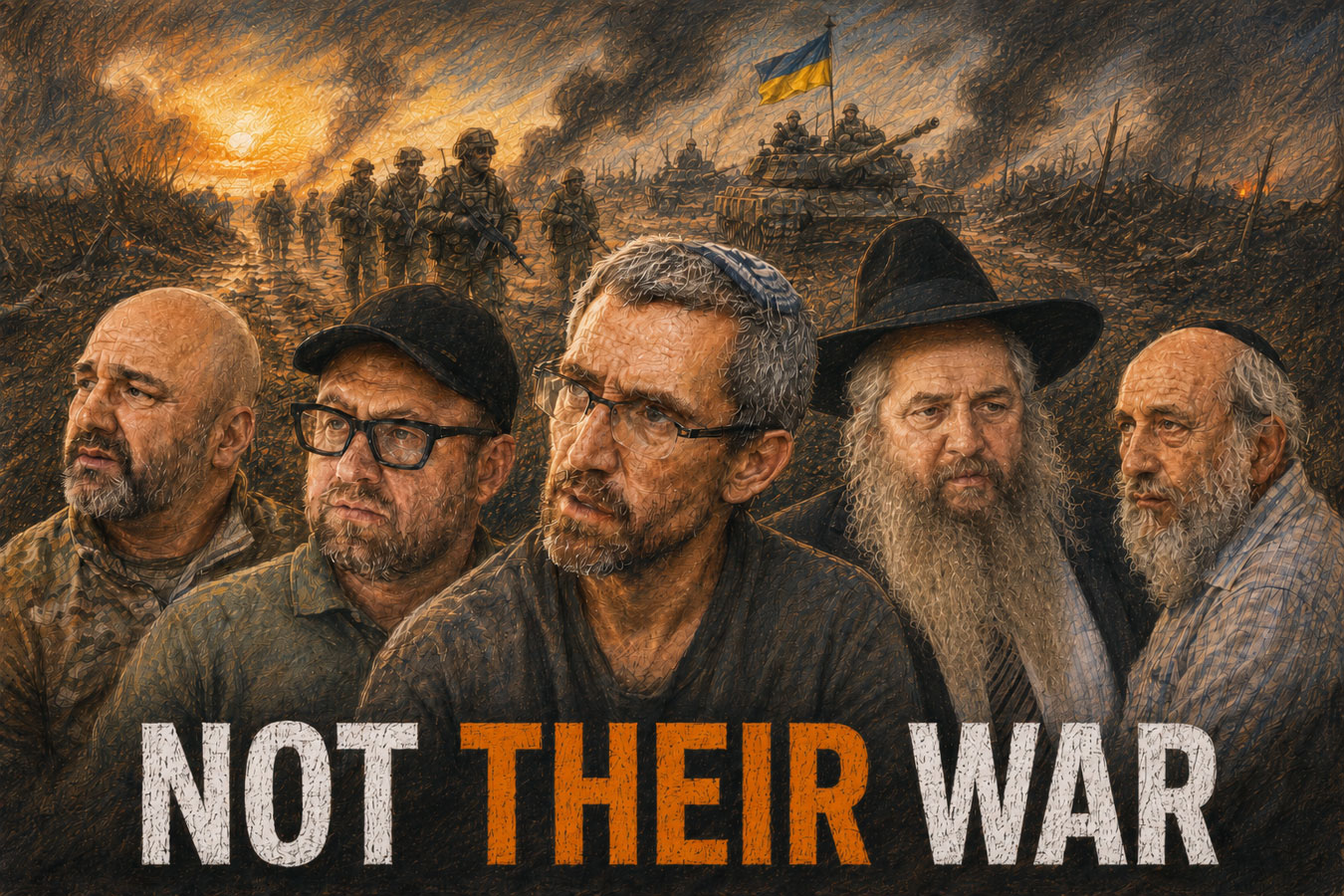
The documentary film “Not Their War“, released on July 26, 2026, tells the story of Israelis and Ukrainian Jews, for whom Russian aggression against Ukraine turned from a distant war into a personal story. Through stories about the army, Uman, Anatevka, Torah scrolls, and community assistance, the main theme of the film gradually unfolds — the price a person pays for a voluntarily made choice.
The video title promises an almost spy story: “How an Israeli instructor was forced to write this confession.” At the beginning, the viewer is indeed told how Israeli Tzvi Arieli ended up in Ukrainian counterintelligence and wrote an absurd paper claiming he was allegedly a Mossad agent.
However, this episode takes only a few minutes. The Russian-language editorial documentary “Vot Tak” “Not Their War” is dedicated to a much deeper question: why Israeli citizens, who had the opportunity to leave and live their own lives, decided to stay close to Ukraine, train its military personnel, join units, save Jews and Ukrainians, build housing for refugees, and help the army.
Vot Tak Editorial https://www.youtube.com/@vot_tak presented the film as a story about Israelis whose lives became closely connected with Ukraine.
“Vot Tak” describes itself as “Free news of Russia, Ukraine, Kazakhstan, Belarus, and the whole world. A project of the International Broadcasting Center of Polish Public Television TVP.”
A specific personal author or director of the film is not named in the open description, so it is more correct to speak of the documentary work of the “Vot Tak” editorial team.
The film’s heroes include Israeli instructor Tzvi Arieli, volunteer of the “Aidar” regiment Grigory Pivovarov, Chief Rabbi of Ukraine Moshe Reuven Asman, historian Chaim Chazin, and scribe Yitzhak Chazin. They talk about Maidan, Donbas, the full-scale Russian invasion, the Jewish community of Ukraine, Uman, Anatevka, service, faith, and personal responsibility.
A dog from under Bucha and a man who does not consider himself its owner
The film does not start with battle or politics, but with a rescued dog.
Tzvi Arieli tells how he found the animal in the village of Lyudvinovka near Bucha, occupied by Ukrainian forces in the early days of the war. The dog was injured and could not step on its paw. Its previous owners left, abandoning the animal.
Arieli emphasizes that he does not consider himself the dog’s owner. They are, in his words, friends. The animal experienced great fear and cried when it thought it might be abandoned again.
This short episode sets the tone for the entire film. Its heroes constantly talk about those who were abandoned and their own decision not to leave: about people on the front, displaced persons, Jewish families, injured animals, and communities caught in the middle of the war.
In archival footage, another story is heard. Representatives of the Jewish community travel to the ATO zone to deliver matzah, grape juice for Kiddush, and everything necessary for observing religious traditions to Jewish servicemen. Then they plan to go to the Svitlodarsk arc, where, according to them, about twenty more Jews were located.
Thus, the war in the film is immediately shown in two dimensions. A person needs help to survive physically, but at the same time, it is important for them to maintain a connection with faith, community, and their own identity.
How Maidan changed Tzvi Arieli’s life
Arieli says he initially came to Ukraine not to fight. He was invited by a friend who had a company working with lawyers. Thanks to his knowledge of several languages, Arieli helped communicate with clients and, according to him, earned about three thousand dollars a month.
Then Maidan began.
According to Arieli, during that period, he noticed a series of attacks and provocations near Jewish sites. He claims that many of them were orchestrated by Russia, which sought to portray Ukraine as an anti-Semitic country. Documentary evidence of this claim is not shown in the film itself, so it should be perceived as the hero’s position.
Arieli recalls that in 2014 he gave interviews in English and tried to explain to a foreign audience that Russian propaganda was using the theme of anti-Semitism to discredit Ukraine.
The film does not create an idealized picture. Later, representatives of the Hasidic community in Uman say they sometimes face ridicule, cold attitudes, and unpleasant words. This is an important distinction: the absence of state anti-Semitic policy does not mean the complete disappearance of everyday prejudices.
Grigory Pivovarov: from the border with Lebanon to Ukrainian “Aidar”
Another hero of the film, Israeli citizen Grigory Pivovarov, says he has been in Ukraine since 2014 and served in “Aidar”.
His childhood was spent in Kiryat Shmona near the border with Lebanon. Pivovarov recalls the constant threat from Hezbollah and says that even then he wanted to join the army. His attitude towards the war was also influenced by his grandfather — a World War II veteran who taught that the enemy must be stopped, not endlessly persuaded.
After Maidan, Pivovarov was going to leave but decided to stay. One of his motives was irritation over Russian manipulation of the theme of Ukrainian anti-Semitism.
He does not try to present himself as a perfect hero. On the contrary, he says he now finds it difficult to perceive military uniforms and does not consider himself a hero. His story lacks the romance of service. There is a firm conviction in the necessity of resistance and the fatigue of a person who has been inside the war for too long.
“They need to be explained how to walk so as not to be killed”
One of the central plots of the film is related to Tzvi Arieli’s work as an instructor.
According to him, Anton Gerashchenko asked him to conduct classes for one of the Ukrainian units. Initially, Arieli thought of teaching the military Israeli anti-terror methods, but quickly realized that people needed much more basic knowledge: how to move, maintain communication, disperse, and not become an easy target.
Arieli says he trained the group for about a week. After that, he went to Thailand with his family and almost forgot about the classes.
Later, one of the trained soldiers asked for a meeting. He said that during the exit from Ilovaisk, the fighters remembered the instructor’s requirement not to gather in tight groups in vehicles in a dangerous area but to move on foot in tactical order. According to Arieli’s interlocutor, this decision helped them survive.
No supporting documents or testimonies from other participants are provided in the film. But it is this conversation, according to Arieli, that became a turning point for him. He saw that even a few days of training could determine whether a person would return home or die.
From 2014 to 2017, Arieli says he was closely involved in training reconnaissance and special forces units. He participated in an experiment to create a brigade according to NATO standards, developed a basic training course, and sought to build a system where soldiers would train from morning to evening.
The paper on “recruiting National Guardsmen for Mossad”
The deep involvement of a foreign instructor aroused suspicion.
Arieli says he was summoned by counterintelligence representatives. According to his version, they asked him to write an explanation that he was not a Mossad agent and would no longer recruit Ukrainian National Guardsmen.
At first, he wrote a denial. When the interlocutors remained dissatisfied, Arieli offered to dictate the desired text and sarcastically wrote that he was allegedly a Mossad agent and promised not to recruit anyone else in the village of Stary, where he conducted classes.
It is from this story that the title of the video grew. But calling it a real confession of working for Israeli intelligence is not possible. In the film, the episode is presented as an ironic reaction to an absurd suspicion, not as the exposure of a spy.
What the Israeli army gave to the Ukrainian instructor
Arieli repeatedly returns to his experience of service in Israel.
He talks about an operation to detain a person whom a Shabak officer called a future suicide bomber. According to Arieli, the detainee was supposed to carry out an attack in Afula. During the arrest, Arieli hit him several times.
The commander did not leave this act without consequences. Instead of the usual detention for such cases, Arieli, according to him, was suspended from operational activities for three weeks. He recalls this as a serious punishment because he wanted to continue participating in operations.
Through this story, the film shows an important principle: even hatred for a terrorist does not cancel the discipline and responsibility of a soldier for their actions.
In Ukraine, Arieli especially sharply saw the difference between the Israeli military system and post-Soviet orders. He recalls dirty toilets, harsh living conditions, poor food for soldiers, and at the same time tables with cognac, caviar, and meat cuts for generals. He claims that because of this, he argued with the command.
“There should be no rot in the army,” he formulates his conclusion.
For NANews — News of Israel this part of the film is also important because it is not about mechanically transferring Israeli methods to Ukraine. Arieli describes primarily a culture of responsibility, discipline, training of the ordinary soldier, and the requirement that the commander does not exist in a separate world from his soldiers.
February 24: family evacuation and return to war
Arieli says he did not intend to fight for Ukraine. He was not its citizen and believed he had already done enough as an instructor.
But shortly before February 24, 2022, he moved his family to a Jewish community camp about thirty kilometers from Kyiv. According to him, many did not believe in the possibility of a full-scale Russian invasion and returned to the capital.
After the attack began, Arieli went to Uman, where he was asked to help organize the city’s defense. For two days, he trained local volunteers who were just beginning to form territorial defense.
Then he took his family to the border. According to him, the route passed through 38 checkpoints and not on main roads.
After that, people he had trained since 2014 and who had become commanders of reconnaissance groups of the 95th brigade approached him. They asked him to stay with them. Arieli says he could not refuse. He also had a heavy sniper rifle weighing about 14 kilograms.
Anatevka: a settlement born from Jewish memory
A large section of the film is dedicated to Anatevka — a settlement for Jewish refugees and displaced persons near Kyiv.
Chief Rabbi of Ukraine Moshe Reuven Asman says that in 2014 he acquired a plot of land, not yet realizing its symbolic significance. Later it turned out that the area is connected with the world described by Sholem Aleichem and made famous by the musical “Fiddler on the Roof.”
The name Anatevka stuck in the American pronunciation. Within a few months, housing for refugees, a school, a kindergarten, and a synagogue were built here.
A separate 27-apartment building was named Matityahu House — in memory of Rabbi Asman’s son Moti Matityahu, who died defending Ukraine. According to Asman, about 300 people lived in the settlement, and in winter there were more.
During Russian strikes on energy infrastructure, the community created mobile points where Kyiv residents could warm up, have hot tea, a snack, and charge phones and computers.
After the war, Asman wants to turn Anatevka into an international center where people from all over the world will come. A Jewish museum, cultural space, and restored shtetl may appear here.
In Anatevka, they cared not only about people. The film shows geese, ducks, chickens, turkeys, fish, and animals evacuated from combat zones. Goats from the Kherson region lived here, and injured dogs and cats from the Bucha area underwent surgery. They were also called refugees.
Jerusalem direction and Torah scrolls
One of the heroes shows the direction to Jerusalem. He says that an invited cartographer drew a line from the local synagogue and found that it is oriented almost exactly towards the holy places of Jerusalem.
Then the film introduces the viewer to the work of scribe Yitzhak Chazin.
He explains that a Torah scroll cannot simply be printed. It is handwritten on parchment with special ink and a pen, following traditional rules for drawing each letter and its crowns.
According to Chazin, a full scroll includes 245 pages, and its creation with verification and correction takes about a year. He says he has been doing this work for 48 years and has written more than twenty scrolls located in France, the USA, and Israel. He passed his craft to his children, who passed it to their children, and now his grandchildren write the Torah.
This part changes the pace of the film. After talks about units, a sniper rifle, and Russian strikes, the viewer is shown the slow work of a person who spends a whole year drawing letter by letter.
This is what the heroes are trying to protect: not only territory and homes but also the continuity of memory.
Faith and the right to self-defense
The film features a well-known Jewish principle: if someone comes to kill you, you must preempt them.
One of the heroes speaks of the high religious status of a warrior defending others. He also recounts statements he associates with Jewish sages and Maimonides.
These words reflect the worldview of the film’s participant, but they should not be automatically perceived as a complete exposition of Halacha. Some religious formulations require additional rabbinical commentary.
The meaning that the heroes invest in them is clear: for them, faith does not mean passivity in the face of someone who comes to kill. Protecting life is seen as a moral obligation.
Uman: why Hasidim continue to come
A separate part of the film is dedicated to the Hasidic community of Uman and the annual pilgrimage to the grave of Rabbi Nachman.
The heroes say that preparation for Rosh Hashanah begins many months in advance. Kitchens and dining rooms prepare food in advance, as tens of thousands of people need to be fed during the holidays. The film mentions an estimate of 60,000 pilgrims, although the hero clarifies that the actual number may be higher.
Even the pandemic and war did not completely stop the pilgrimage. Hasidim sought complex routes to get to Uman, as they perceive Rabbi Nachman’s request to come to him on Rosh Hashanah as a spiritual obligation. Some pilgrims, according to the heroes, do this annually for forty years.
Chaim Chazin compares Uman to Dubai — not in a material, but in a spiritual sense. For a person seeking material rest, the symbol of pleasure becomes an expensive resort. For a Hasid, such a place is Uman and prayer at the grave of the tzadik.
In the city, according to the film’s participants, there are at least twenty large synagogues.
The myth of Hasidim wanting to “take Uman”
The film thoroughly examines the popular myth that Hasidim allegedly want to buy up Uman, displace local residents, or move their permanent life here.
Chaim Chazin responds that pilgrims come primarily to pray. According to him, if Rabbi Nachman’s grave were moved to Israel, the main flow of pilgrims would immediately move there.
He reminds that Hasidism is historically closely connected with Ukraine. Here were born and lived the parents, grandparents, and great-grandparents of many modern Hasidim. This does not mean territorial claims, but it does mean the right to perceive Ukrainian land as part of one’s own family and spiritual history.
Signs in the Hasidic quarter of Uman, as shown in the film, are designed in Ukrainian and Hebrew. Community representatives emphasize that they live in Ukraine legally: some have citizenship, others have permanent or temporary residence permits.
Some local residents treat Hasidim with respect, but others laugh at them or speak coldly. One of the heroes says that his children know how to respond: they were born in Ukraine, are its citizens, and have the same rights as other Ukrainians.
“My choice is to be a Hasid. I love this choice. I am a Ukrainian Hasid,” he essentially formulates his identity.
What the Hasidic community gave to Ukraine
One of the heroes says that after the start of the full-scale war, he gave the army an ambulance and a generator that his business previously used.
In addition, the community collected mattresses, beds, blankets, pillows, and medicines. All this was packed and handed over to the Ukrainian military.
For NANews — News of Israel this story is especially indicative. Russian propaganda has been trying for years to oppose Ukrainians and Jews, using the memory of pogroms, the Holocaust, and Soviet anti-Semitic stereotypes. The film shows the opposite process: Jewish communities did not disappear from Ukrainian life during the trial but became part of the system of mutual assistance and resistance.
Ukraine and Israel: similar feelings, different stories
One of the heroes says that during the war, Ukraine began to better understand Israel.
He compares small Israel, forced to defend itself from surrounding opponents, with Ukraine, which is significantly larger in territory but found itself next to a state denying its right to independent existence.
This is an emotional, not a literal geopolitical parallel. The history, regional environment, and international circumstances of Israel and Ukraine differ.
But the similarity of experience is hard not to notice:
- missile strikes on cities;
- the need to quickly mobilize society;
- evacuation of families;
- life under constant threat;
- the importance of reservists and volunteers;
- attempts by the enemy to portray the victim as the aggressor;
- realizing that international promises alone are not enough.
For the film’s heroes, Israel became a source of military experience, and Ukraine — a place where this experience was necessary.
Tattoos as a map of personal war
In one of the episodes, Arieli shows his tattoos.
Among them is a fennec, a small desert fox, which he turned into the image of a Ukrainian warrior: aggressive, cunning, and capable of a painful bite. There is Anubis — the symbol of the company, an old owl of ‘Aidar’, a talisman from Tel Aviv, and the inscription Tel Aviv Punks — ‘never give up’.
A special place is occupied by the drawing of Maidan. It depicts a Molotov cocktail being lit by a Ukrainian lighter, with cartridges depicted below. Arieli says he asked the artist for permission to transfer the drawing onto his body.
His skin becomes a kind of map of the journey between Israel, Maidan, Donbass, and the Ukrainian army.
Everyday life that the war could not cancel
The documentary does not remain only in the space of great tragedies.
The viewer is shown how strawberries are checked to comply with kashrut, how children help transport products, how the daughter of one of the heroes opened a pedicure studio, and how the younger son is offered to earn money by making key copies for visiting pilgrims.
One of the residents of Uman came from the UK and stayed in Ukraine with a large family. Some think about business, some prepare festive meals, some teach children to earn money.
Such everyday scenes are as important as stories from the front. They show that preserving life is not only about physical survival. It’s the ability to continue raising children, praying, working, joking, and making plans.
One of the heroes dreams that after the war there will be a direct flight between Israel and Uman. Not through Kyiv, Odessa, or Lviv, but directly from Tel Aviv to Uman.
“Ukraine takes second place in my heart”
Towards the end, the film becomes significantly heavier.
Tzvi Arieli says he would like to return to Israel. Ukraine, he says, takes second place in his heart. He feels almost no connection to Latvia, where he was born: there he felt like a person between two worlds — not Russian for Russians and at the same time Russian for Latvians.
In Ukraine, he invested too much effort, but fears that this connection will not allow him to leave.
Behind the external toughness, a person gradually opens up, physically and psychologically destroyed by the war.
Six surgeries, hearing aids, and drug dependency
Arieli says he underwent six surgeries. He had ligament damage, concussion consequences, and hearing aids.
But he calls post-traumatic stress disorder the most severe problem.
He couldn’t sleep for a long time and started constantly taking benzodiazepine tranquilizers. Arieli admits that he developed a dependency and it’s extremely difficult to give up the drugs.
The war changed his relationships with loved ones. The family fell apart, contact was mainly maintained with his son, who is supposed to come from Israel. For a long time, Arieli almost completely lost interest in the surrounding world.
He emphasizes that PTSD does not necessarily look like screaming, aggression, or madness. A person can talk calmly on the outside but lose interest in family, the road, people, and the future.
During a trip to Germany, he started having flashbacks. He was so out of reality that he missed the necessary stops. “The head is the most unpleasant,” says the hero.
Not the battle, but what was seen after Russian attacks
Arieli admits that participation in combat operations was not the main cause of his psychological trauma.
He recalls his service in Israel and says that once he shot an armed enemy at close range in Jenin. At that time, he perceived what happened as eliminating a threat to his comrades.
In Ukraine, he was broken by something else — the attitude of Russian soldiers towards civilians.
He talks about a car that drove out of a danger zone. The driver was the only survivor, while the wife, children, and an elderly woman in the car died.
In the film, this scene is described extremely realistically. For publication, it’s important to convey its meaning without turning human tragedy into a shocking detail: a trained soldier was not ready for the systematic destruction of peaceful families.
It is these images, according to Arieli, that continue to return to him.
A parable about fish and true love
The film ends with an unexpected parable.
Arieli recalls one of the first lessons in yeshiva. The rabbi explained the difference between love and infatuation using the example of a person who says he loves fish.
In fact, he doesn’t love the fish, but himself — the pleasure he gets when he eats it. True love begins when a person does not consume another but invests strength, time, and himself in them.
Arieli applies this thought to Ukraine.
At first, he was asked to conduct a few classes. Then one of the soldiers said that the knowledge gained saved people. After that, Arieli continued to train units, help friends, evacuate family, and return to where he was needed.
He didn’t ‘eat this fish’, but invested too much in it.
The last line of the film sounds not like a victorious slogan and not like a promise of a heroic future. Arieli says he continues to cling to life, although he no longer knows what exactly for.
Why ‘not my war’ became his own
The title of the film is built on a paradox.
Most of its heroes had an Israeli passport, an Israeli home, or the opportunity to leave. The Russian war against Ukraine could formally remain foreign to them.
But the war became their own through people.
Through the fighters they trained. Through the Jewish families they evacuated. Through a son who died defending Ukraine. Through refugees for whom they built a home. Through matzo brought to the front line. Through animals picked up near Bucha. Through Torah scrolls that continue to be written during Russian shelling. Through a child left without a father and a soldier who can no longer return to his former life after the war.
“Not my war” does not claim that all Israelis should repeat the heroes’ choice. The film shows something else: sometimes responsibility for what is happening arises not from citizenship and not from a state order.
It arises at the moment when a person realizes they can help, and after that, they can no longer pretend that what is happening does not concern them.