
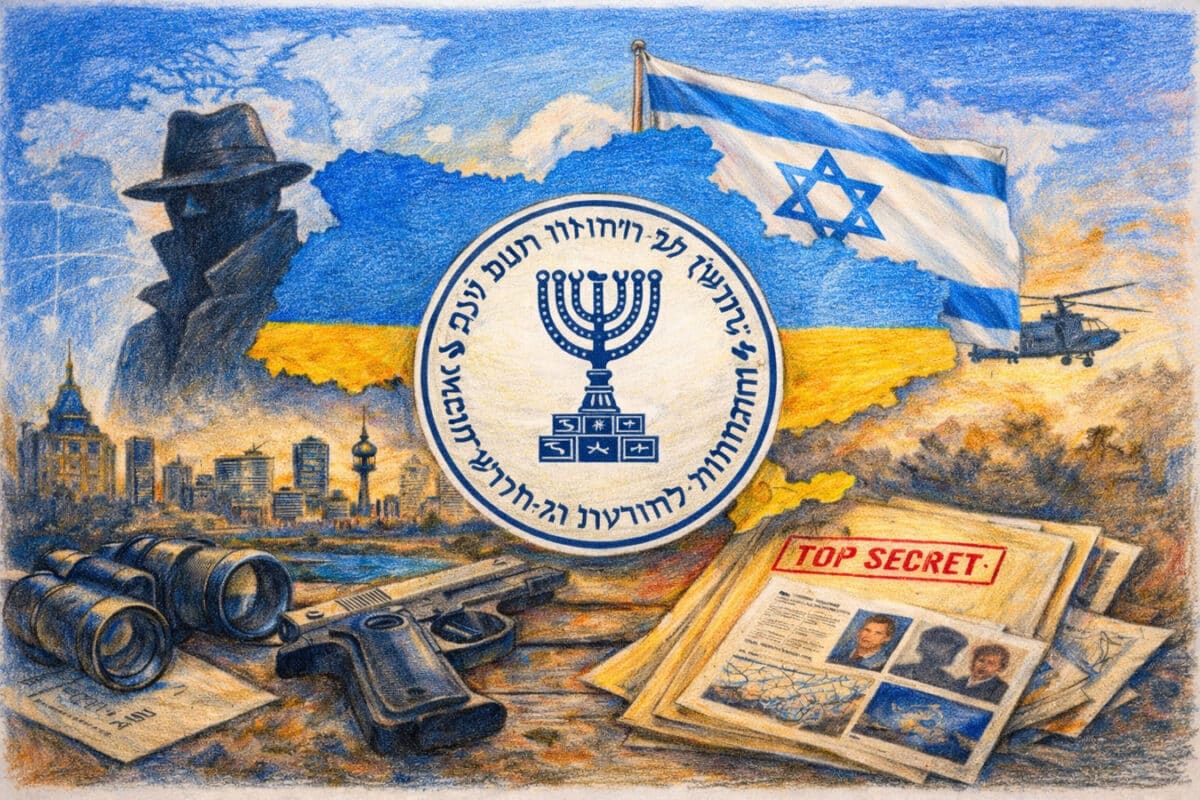
Israeli intelligence has long become part of a global political myth. Mossad is spoken of as an almost abstract force — without faces, without biographies, without a past. However, any institution has a human dimension. If you look closely at the history of Mossad’s leadership, especially in the second half of the 20th — early 21st century, it becomes clear: the key stages of the formation and strengthening of Israeli intelligence are connected with people whose roots go back to Ukraine.
This is not about the influence of states or external control. It’s about people shaped by the experience of Jewish life in Odessa, Kharkiv, Kherson — cities where security was never guaranteed, and the ability to survive became part of everyday culture. This experience was in demand at a time when the young state of Israel needed not just intelligence, but a survival system. This was noted by Valery Boyanju in “Odessa Life”.
Ukrainian Jewish Reality as a Factor of Thinking
Jewish Ukraine at the end of the 19th and the first half of the 20th century was a space of constant risk. Pogroms, revolutions, changes of empires, the Civil War, Stalinist repressions, Nazi occupation — all these are not abstract chapters of textbooks, but personal memories of thousands of families. For these people, the state was rarely a source of protection. More often — a source of threat or, at best, indifference.
It was in such an environment that a type of thinking was formed, based on three principles: not trusting declarations, verifying reality, and acting in advance. This approach later became one of the unspoken foundations of the Israeli security system.
Mossad as a Product Not Only of the State but Also of the Diaspora
Officially, Mossad was created in 1949, after the declaration of Israel’s independence. At an early stage, it was a compact structure with limited resources. However, it quickly began to rely on people with experience in underground struggle, military intelligence, and living under constant threat.
Immigrants from Eastern Europe, including Ukraine, fit organically into this logic. They did not perceive security as something given. For them, it was always a process, not a state.
Meir Amit (1963–1968): Kharkiv Roots and Systemic Transformation
Meir Amit (Hebrew: מאיר עמית, born Meir Haimovich Slutsky) led Mossad from 1963–1968, during a period when Israeli intelligence was transitioning from the stage of formation to the stage of institutional maturity. Although Amit was born in Israel, his parents came from Kharkiv — one of the largest Jewish intellectual centers in Eastern Europe.
Article in the Ukrainian Wikipedia – Meir Amit.
In English biographies, it is consistently mentioned that he was a cousin of the poet Boris Slutsky, and Slutsky himself grew up/was formed in Kharkiv (this is about the poet).
This background was reflected in his management style. Amit was opposed to improvisation for the sake of heroism. He insisted on analytics, data structuring, and strategic planning. It was under him that Mossad became not just a set of operations, but part of a unified architecture of national security.
During his leadership, intelligence played a key role in preparing for the Six-Day War. After leaving his post, Amit did not disappear from public life: he became a member of the Knesset, participated in economic and technological projects, including telecommunications and the defense industry. This highlights an important detail: for this generation, intelligence was not an isolated profession, but part of the general state thinking.
Yitzhak Hofi (1974–1982): Odessa Pragmatism in an Era of Crisis
Yitzhak Hofi (Hebrew: יצחק חופי, born Yitzhak Poberesky) led Mossad from 1974–1982 — one of the most challenging periods in Israel’s history. His leadership came after the Yom Kippur War, the rise of international terrorism, and the strengthening of threats beyond the Middle East.
Article in the Ukrainian Wikipedia – Іцхак Хофі.
Hofi was born in Mandatory Palestine, but his parents emigrated from Odessa. The Odessa Jewish environment always combined irony, caution, and harsh realism. This cultural code was reflected in his management style.
Hofi avoided publicity and believed that the best operation is the one that neither journalists nor politicians know about. Under him, Mossad significantly expanded its international agent networks and strengthened its ability to operate beyond the region, including in Europe and other continents.
Meir Dagan (2002–2011): Kherson, the Holocaust, and the Rejection of Illusions
The most famous figure with Ukrainian roots was Meir Dagan (born Huberman, in another transcription Huberman), who led Mossad from 2002–2011. He was born in Kherson in 1945 to a family that survived the Nazi occupation. (in some sources, 1947 is indicated; Odessa is also named as Dagan’s place of birth).
His grandfather was killed during the Holocaust, and this family tragedy became part of his worldview.
Article in the Ukrainian Wikipedia – Meir Dagan.
Dagan came to intelligence from the army, went through key Israeli wars, and formed a reputation as a person who does not believe in the “goodwill” of the enemy. In his office, a photograph of a deceased relative was kept for many years — not as a symbol of revenge, but as a reminder of the price of strategic mistakes.
Under Dagan, Mossad focused on preventive actions against strategic threats, including the nuclear programs of Israel’s adversaries. He consistently opposed the illusions of diplomatic appeasement and believed that intelligence must prevent threats before they become the subject of public discussions.
Behind the tough image was a person with unexpected interests. Dagan was fond of painting and sculpture, was a vegetarian, and valued unconventional thinking. This combination of internal reflection and strategic toughness made him one of the most controversial figures in the history of Israeli intelligence.
Common Denominator: Experience of Instability
What unites these people is not geography per se, but the experience of living in conditions of instability, characteristic of Jewish Ukraine. This experience formed several key principles that later became the foundation of Israeli intelligence culture:
absolute distrust of declarations without confirmation;
willingness to act in conditions of uncertainty;
understanding that the weakness of the state is always perceived as an invitation to aggression;
orientation towards long-term survival, not short-term political comfort.
Myths Around the “Ukrainian Trace”
In recent years, the topic of the Ukrainian roots of Mossad leaders is often used for propaganda purposes. This is a distortion of reality. Mossad has always been and remains an instrument of the Israeli state, subject to its laws and political leadership.
The Ukrainian roots of its leaders are part of the history of the Jewish diaspora, just like the Polish, Lithuanian, German, or Iraqi. Attempts to turn this fact into a political sensation only simplify the complex and tragic history of the 20th century.
Why This Matters Today
Against the backdrop of the ongoing war in Ukraine and the protracted conflict around Israel, the historical context takes on new significance. Ukrainian Jews are not a “bridge of influence” or a political tool. They are part of the common historical fabric, in which the destinies of Ukraine, Israel, and the Jewish people are intertwined.
Understanding this allows for a better view of the logic of Israeli security — a logic formed not by abstract doctrines, but by real experiences of loss, flight, and survival.
Instead of a Final Point
The history of Mossad is the history of specific people who brought not only professional skills but also personal memories of what happens when security is underestimated. The Ukrainian Jewish trace in this history is not a sensation and not an argument in political disputes.
It is a reminder that from Odessa, Kharkiv, and Kherson, the path sometimes led not only to emigration but also to the very heart of the system responsible for the survival of the state.
Category: “Jews from Ukraine” | NANews – news of Israel
