
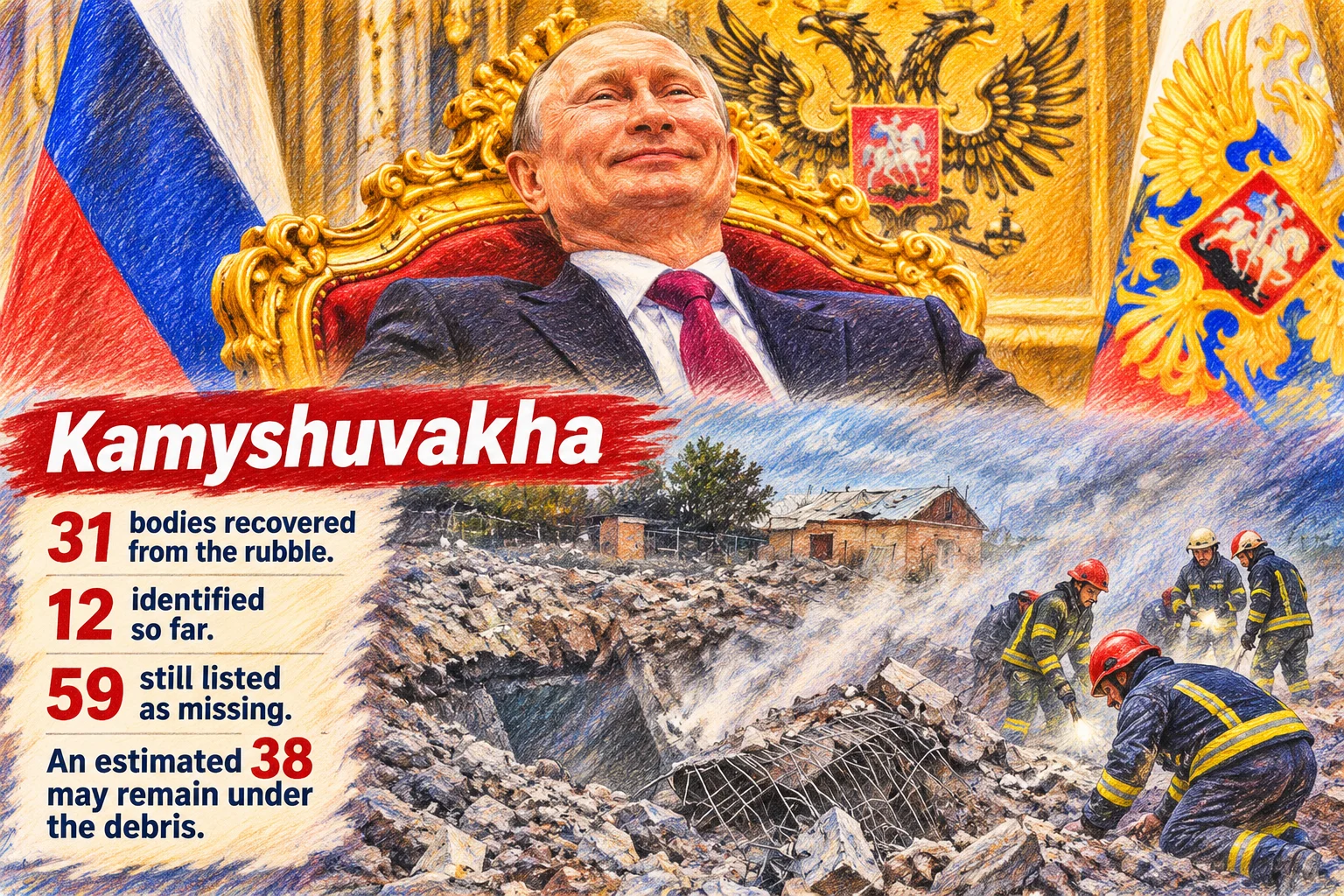
Russian aviation carried out a series of strikes on the place where residents of the Zaporizhzhia region were receiving humanitarian aid. When people hid underground, a FAB-3000 bomb hit the shelter. By the morning of November 4, the bodies of 31 deceased were extracted from the ruins. Only 12 people have been identified. Another 59 are listed as missing. Preliminary estimates suggest that 38 people may remain under the rubble. Rescuers and police officers are among the victims. Ukrainian intelligence considers the attack deliberate.
On the morning of November 2, 2026, about a hundred people gathered near the ‘Dzherelo’ gymnasium in the village of Kamyshevakha, Zaporizhzhia region – here is the village on the map https://maps.app.goo.gl/mCGLyKrWW1qHZVrv8. People came for humanitarian aid — food, medicine, the essentials for life.
A FAB-3000 was dropped on them — a heavy aerial bomb weighing about 3 tons, containing more than 1.4 tons of explosives. Such munitions are capable of destroying major structures, including fortified and underground facilities.
Author: Elena Gunko | NANews
Kamyshevakha: underground gymnasium, war, and humanitarian aid
Kamyshevakha is a frontline village between the regional center of Zaporizhzhia and the city of Orikhiv. After the start of the full-scale Russian invasion in February 2022, life here changed dramatically. Constant shelling destroyed residential buildings and infrastructure, and many families left. Some residents remained, including elderly people who found it difficult to leave their homes. The village continued to live under the threat of Russian airstrikes and drone attacks.
Before the full-scale war, Kamyshevakha itself had a population of 5,251 people — these figures were provided as of January 1, 2022. As of November 4, 2026, about 200 residents remained in the village. The population decreased by more than 96%. The Kamyshevakha community, which unites 30 settlements, had about 13,000 people before the war. By September 2026, about 5,000 residents remained in its territory. Thus, even after mass evacuation, thousands of people continued to live in neighboring villages, requiring food, medical assistance, and other services.
The ‘Dzherelo’ gymnasium had its own military history.
On July 2, 2023, a Russian missile strike destroyed its former building, after which children were forced to switch to distance learning. In September 2024, construction of an underground school began on the territory of the destroyed gymnasium — educational premises that also served as a protected shelter. Construction was temporarily halted due to disputes over the safety of such a facility near the front line. On October 17, 2025, the school was officially opened with financial support from the European Union. It became the thirteenth underground school in the Zaporizhzhia region and one of the closest to the front. The educational premises were designed for a thousand children in two shifts. Classrooms, a medical office, a sports area, and recreation rooms were equipped here. The underground complex was also intended to protect local residents during shelling and prolonged power outages. By November 2026, it was also used for the community’s humanitarian needs.
The capacity for a thousand children was explained by the fact that the ‘Dzherelo’ gymnasium was a core educational institution for several settlements. Even in 2021, more than 800 schoolchildren could study here. In January 2025, there were 821 schoolchildren and 172 preschool children in the entire Kamyshevakha community. The new underground facility was intended for students from four gymnasiums at once — ‘Dzherelo’, Yasnopolyanskaya, Zarechnenskaya, and Novotavriyskaya. Children from neighboring settlements were planned to be transported by school buses.
At the same time, a thousand children was the design capacity for two shifts, 500 students at a time, not the actual number attending the school. About 300 children attended the opening on October 17, 2025. The construction was calculated for the educational needs of the entire community and the possibility of students returning to face-to-face classes. However, the military situation continued to deteriorate, and already two months after the opening, underground education had to be stopped.
The school was located at a depth of about seven meters. However, face-to-face education lasted only about two months. Due to the worsening security situation, children were again transferred to distance learning. Since the beginning of 2026, the underground complex has been used as a shelter, a population support center, and a place for regular distribution of humanitarian aid. The Center for Administrative Services Provision also operated here — a municipal institution where residents could process documents and receive state and local services. Thus, the school built for children became one of the few protected public spaces in the village.
In June 2026, the last 11 children remaining in Kamyshevakha were forcibly evacuated. By the time of the Russian strike on November 2, the underground gymnasium was no longer used for classes. Instead of schoolchildren, mainly adult residents of the frontline community, including pensioners in need of humanitarian support, came here.
After the evacuation of children, the underground gymnasium began to be used as a humanitarian aid center for the remaining residents of the frontline village, where food and other necessary items were distributed every Monday.
Why were free products distributed here at all? It’s not that trade completely disappeared in Kamyshevakha. Even in April 2026, the market and individual stores continued to operate here. But buying products became increasingly difficult: constant shelling, destroyed homes, work problems, and limited incomes made many residents dependent on humanitarian support. Pensioners had a particularly hard time. In an April report from Kamyshevakha, one local resident said she received a pension of only about three thousand hryvnias a month. Meanwhile, access to stores and ordinary services was even more difficult in neighboring villages.
Therefore, local authorities organized regular distribution of free bread and food packages. The aid was primarily intended for families who continued to actually live in Kamyshevakha and the neighboring villages of Odarivka and Hryhorivske. According to published rules, products were distributed based on one household. One family representative with documents came for them. For residents served by social services, home delivery of aid was provided. This was not a one-time action, but a constant system of support for people remaining in the frontline zone.
The distribution was handled by employees of the Kamyshevakha community — the local municipality. Among them was the head of the Center for Administrative Services Provision, Olga Tverdenko, who came on Mondays to sort and distribute bread and food packages. The head of the humanitarian headquarters, Tatyana Ivanovna, also participated in this work. Both women died during the Russian strike on November 2.
On that Monday, residents were supposed to receive primarily free bread. Local authorities announced in advance that the distribution would take place from 10:00 to 12:00 in the underground school premises. The announcement was published on social networks, so residents of Kamyshevakha and nearby villages knew where and when to come. About a hundred people gathered there at that time.
Strike
A few minutes later, between 10:00 and 11:00 local time, Russian aerial bombs began to fall on the gymnasium territory.
People rushed into the underground shelter. They hoped to wait out the shelling behind reinforced concrete walls, specially built to protect against explosions.
But the next bomb hit directly into the shelter.
Underground, the ceilings collapsed. A fire started. People were trapped by concrete slabs. Russian aviation continued to strike.
By the morning of November 4, the bodies of 31 deceased were extracted from the ruins. Only 12 people have been identified. Another 59 are listed as missing. Preliminary estimates suggest that 38 people may remain under the rubble.
Some of the missing are likely among the already discovered but not yet identified deceased. The final number of victims is unknown.
This is one of the largest tragedies in the Zaporizhzhia region during the full-scale Russian invasion.
First, they struck the school. Then — those who hid
On November 3, the Main Intelligence Directorate of the Ministry of Defense of Ukraine published the sequence of the attack.
First, two Russian aerial bombs hit the gymnasium territory. Then a FAB-3000 strike followed directly on the underground shelter. After that, Ukrainian intelligence recorded six more airstrikes.
In total, according to this sequence, there were nine strikes.
FAB-3000 was developed in the Soviet Union in the 1950s to hit large ground targets and fortified structures. The explosion of such a bomb creates a powerful shock wave capable of collapsing concrete ceilings and destroying buildings. Since 2024, Russian aviation has been using modernized FAB-3000s in Ukraine, with planning and correction modules allowing them to be dropped from a distance from the target. The impact of such a munition on an underground shelter poses a deadly threat to the people inside.
Why did the Russian military use such a weapon against a building where civilians were receiving food?
Ukrainian intelligence claims that the Russian army was monitoring Kamyshevakha and knew that every Monday, humanitarian aid was distributed to local residents at the resilience center.
If this information is confirmed, the question will arise not only about the choice of the building but also about the choice of the time of the strike — when especially many civilians were nearby.
The GUR considers the attack a deliberate assault on the civilian population. An independent judicial assessment of the circumstances and intentions of the attackers is still absent.
The school was built to save lives. It became a mass grave
After the tragedy, Ivan Fedorov, co-chairman of the Zaporizhzhia Regional Defense Council, explained that the building was constructed according to existing building standards. However, such structures are not designed for a direct hit by a FAB-3000.
Russia had already destroyed the original school. Now its aviation destroyed the shelter built in its place, where people tried to save themselves.
Two hours under concrete slabs
Raisa, one of the survivors, was working near the place where humanitarian aid was distributed.
Shortly before the explosion, the woman took out the trash and returned inside. What happened next, she almost doesn’t remember.
When Raisa regained consciousness, her head and right arm were pinned by concrete slabs. It was impossible to get out on her own.
Rescuers lifted the debris with jacks. The woman was freed after about two hours.
Next to her was her colleague Irina Fokina. She died immediately.
Raisa told journalists that eight women from her team died. They were preparing food and helping people who came for humanitarian aid.
Another victim, Galina, was in the garden during the shelling. She suffered a fracture and shrapnel wounds. Her neighbor was in the underground school. The woman knew nothing about her fate.
In a Zaporizhzhia hospital, doctors are fighting for the life of a 22-year-old girl extracted from the rubble. She suffered an explosive injury, severe fractures, and burns on 81% of her body surface.
According to doctors as of November 3, the girl was on artificial lung ventilation. Her condition was assessed as extremely serious.
Behind the numbers of the dead are people who were doing ordinary things in the morning: cooking lunch, distributing products, working, talking to neighbors.
Now their relatives have to wait for the results of body identification.
Russian bombs killed those who helped to shelter
The Ministry of Internal Affairs of Ukraine confirmed the death of six emergency service and police officers during the repeated Russian strike.
Rescuers Denis Konovalenko and Alexey Suschevsky, as well as police officers Nikolay Balanda, Mikhail Romanov, Dmitry Besedin, and Mikhail Buzhenko, died.
Konovalenko served in the State Emergency Service for almost 12 years, Suschevsky for more than 13 years. Balanda served in the police for 23 years, Buzhenko for 21 years.
When the explosions began, they were helping civilians reach the underground shelter.
The repeated strike killed people who were trying to save others.
And after that, the rescue operation remained dangerous. Russian drones and ongoing shelling hindered the delivery of necessary equipment to the ruins. There was heavy smoke in the destroyed premises.
Every hour of delay reduced the chances of people remaining underground.
Why did the Russian army need to bomb a humanitarian center?
There is no military explanation confirmed by independent evidence at the time of publication. Nor are there verifiable reports that a legitimate military target was in the shelter.
However, the sequence of strikes allows for several possible motives.
First — terror against the remaining population. A strike on a place where people come for bread shows civilians that danger can reach them even while receiving aid. Such fear can force residents to leave frontline settlements.
Second — destruction of humanitarian infrastructure. If the center for distributing food, medicine, and other aid is destroyed, the lives of people who cannot or do not want to evacuate become significantly harder. The death of the center’s staff amplifies the consequences of the attack.
Third — targeting people who took shelter after the initial explosions. This version requires especially thorough investigation. If the attackers knew that after the initial strike civilians went underground, the subsequent hit by a FAB-3000 takes on a completely different meaning than the accidental destruction of a building.
These are possible explanations, not established motives of specific Russian commanders. The investigation needs to determine what information the pilots and command had, what targets were specified in the assignments, and why the strikes continued.
But the absence of final answers does not negate the already known circumstances: Russian bombs hit a civilian aid center, destroyed the shelter, and killed dozens of people.
Such use of military force against civilians has the hallmarks of a terrorist method of warfare.
A war crime that cannot be attributed to the proximity of the front
The Zaporizhzhia Regional Prosecutor’s Office has launched an investigation under part two of Article 438 of the Criminal Code of Ukraine — violation of the laws and customs of war, resulting in the death of people. The pre-trial investigation is conducted by the SBU.
International humanitarian law prohibits deliberate attacks on civilians and civilian objects. Humanitarian personnel and objects used for providing aid are also protected.
Even the presence of a presumed military target nearby does not give the army the right to indiscriminately destroy surrounding buildings and people.
Therefore, the investigation must establish whether the humanitarian function of the object was known to the attackers, whether there was a military necessity, what precautions were taken, and who gave the orders.
In Kamyshevakha, Russian aviation used a munition capable of destroying an underground structure in a place of mass civilian gathering. The consequences of this decision can no longer be changed.
Why the tragedy in Kamyshevakha concerns Israel
Israelis do not need an explanation of why people run to shelters after an alarm signal. Protected rooms, public shelters, rescuers working after rocket hits are part of the country’s familiar reality.
But the events in Kamyshevakha show another, especially dangerous side of war: what happens when a place intended to protect civilians itself becomes a target.
Where people should receive help and the opportunity to survive, the use of heavy aerial bombs can turn salvation into a trap.
For Israel and Ukraine, the principle of civilian protection has immediate significance. The rules of war must apply regardless of who strikes and on whose territory the victims are located.
If attacks on shelters and humanitarian centers remain uninvestigated and unaccountable, the consequences extend far beyond a single settlement.
People came for bread. Their families await identification
The head of the Kamyshevakha community, Yuriy Karapetyan, lost his wife Natalia during the Russian attack.
Relatives continue to wait for information about those who were inside on November 2 near the destroyed school.
In the Zaporizhzhia region, mourning was declared from November 3 to 5. Rescuers continue to clear the rubble. The number of dead may increase.
On the morning of November 2, people came to Kamyshevakha for food. When Russian planes appeared and explosions began, they did what civilians are taught to do during war: they hid in a protected room.
Russia struck this shelter as well.
Now some families are burying the dead. Others do not yet know whom they will have to bury.
They came for bread. The Russian army left them under concrete slabs.