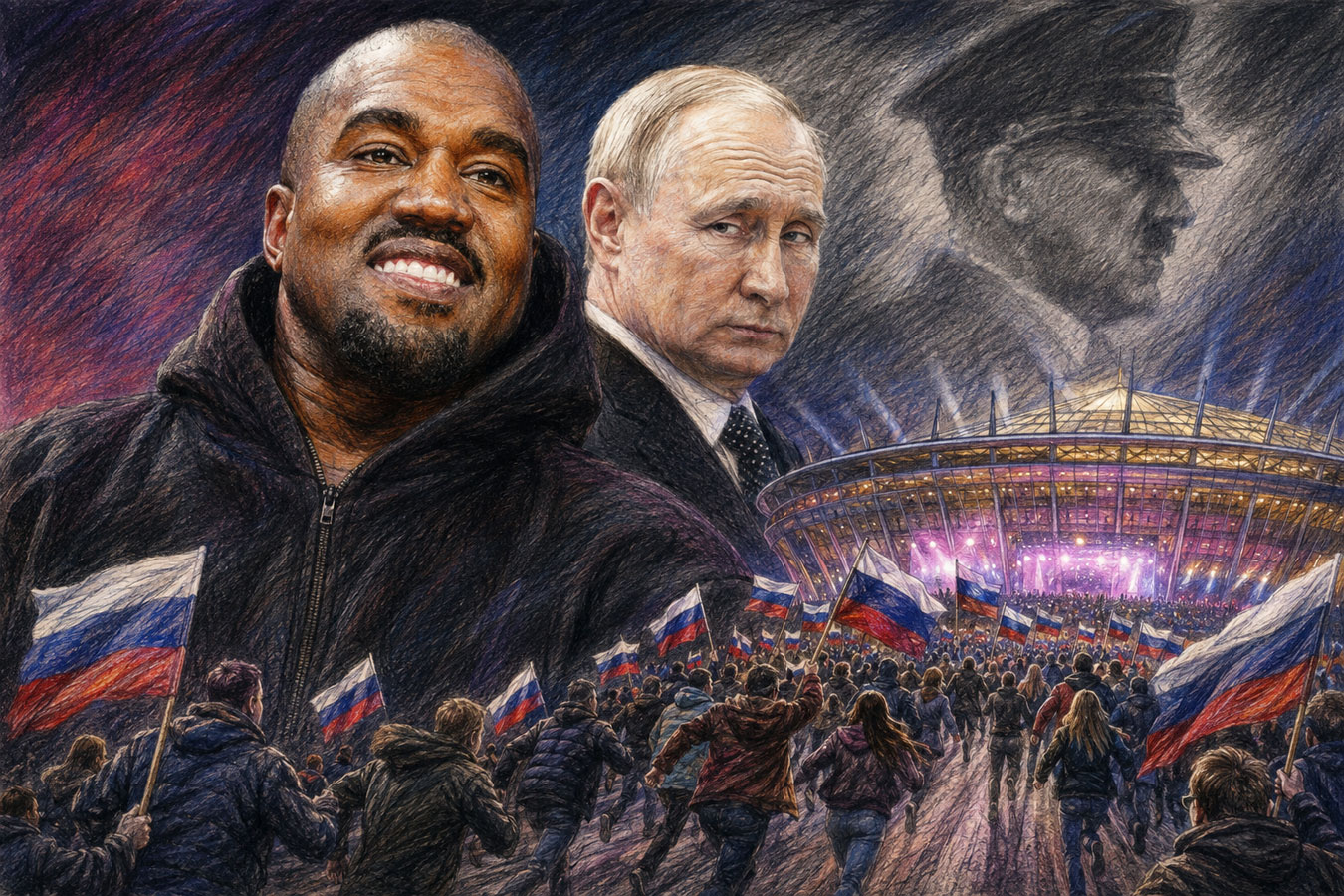
After the announcement of two Kanye West concerts in St. Petersburg, train ticket orders for these dates increased 41 times. But the story has long gone beyond music: Ye publicly praised Hitler and used Nazi symbols, faced bans in Europe, tried to organize a performance in Israel, and now his Russian promoter talks about the artist’s ‘long-standing dream’ to meet Putin.
On the morning of August 18, 2026, a figure emerged around Kanye West’s two upcoming concerts in St. Petersburg that turned an ordinary showbiz news into a rather uncomfortable question about modern Russia. According to the travel service ‘Tutu’, only on August 17, the number of train ticket orders to St. Petersburg for October 9-11 increased 41 times. Airline tickets for the same dates were searched 16 times more often, and the same increase was recorded for hotel searches.
The reason for the excitement is known: Ye, whom the world still more often calls Kanye West, is supposed to perform at the ‘Gazprom Arena’ on October 10 and 11, 2026. Tickets were sold from 9 to 160 thousand rubles (approximately from 316 to 5,614 shekels), the cheapest seats disappeared in about an hour. Reuters notes that if the concerts take place, West will become one of the largest international music stars to visit Russia after the start of the full-scale invasion of Ukraine in February 2022. Russian dates are now also present in Ye’s official tour schedule.
This is where the simple story about a rapper and tickets ends for the author of NAnovosti Anton Pshedynsky. His materials are usually at the intersection of Israel, Ukraine, and Russian politics, and in the case of Ye, these lines literally converged on one stage.
The question is not about the musical tastes of tens of thousands of people and not about trying to declare every ticket buyer a supporter of the artist’s views.
Much more interesting is another: why public admiration for the real Adolf Hitler turned out to be quite compatible with huge demand in a state that has been justifying the war against Ukraine for the fifth year by the need for its ‘denazification’?
NAnovosti — News of Israel | Nikk.Agency monitors how Russian rhetoric about ‘Nazism’ is used far beyond the conversation about history. In the case of Kanye West, the dispute unexpectedly ceased to be theoretical: a man who truly glorified Hitler is coming not to a Russian TV studio for condemnation, but to one of the largest concert venues in the country.
From ‘death con 3’ to ‘Heil Hitler’: what exactly did Ye do
In the fall of 2022, Kanye West’s story with anti-Semitism became an international scandal. In October, he wrote that he was going to go ‘death con 3’ on Jews — intentionally or mistakenly playing on the American term DEFCON. After that, major partners began to abandon him; Adidas severed a highly profitable collaboration with Yeezy, and the CAA agency left him. Less than two months later, Ye was already publicly talking about seeing ‘good things’ in Hitler.
It is important to remind this now because the expression ‘praised Hitler’ in relation to West is not a political characterization by a journalist and not an exaggeration in a headline. His own statements led to the topic of Nazism becoming part of his public image for years.
Even the first noticeable apology did not close the problem. In December 2023, Ye posted an address to the Jewish community in Hebrew, expressing regret for the pain caused. The Anti-Defamation League then said that words could be the first step but reminded: actions are more important. The warning turned out to be not superfluous.
In 2025, West again crossed an almost demonstrative line. A T-shirt with a swastika appeared on his website, and in May he released the song Heil Hitler with Nazi imagery. Australian authorities later annulled his visa precisely after the release of this composition. Reuters and AP in 2026 materials directly characterize the song as a work promoting Nazism.
There is another date that cannot be hidden for the sake of a convenient journalistic construction. On January 26, 2026, Ye bought a full page in The Wall Street Journal for a new apology. He stated that he had lost touch with reality, talked about bipolar disorder and the consequences of a long-standing head injury, admitted previous admiration for Hitler and the use of the swastika, and separately wrote that he does not consider himself a Nazi or anti-Semite. The ADL called the apology long overdue but emphasized that it does not automatically erase years of anti-Semitic statements, hundreds of publications, swastikas, mentions of the Holocaust, and Heil Hitler.
One can believe in the sincerity of this repentance, one can doubt it. But its presence must be taken into account as honestly as what exactly Ye apologized for.
Europe closed doors, but fans did not disappear
In the spring of 2026, the price of previous statements became especially noticeable. On April 7, British authorities denied Ye entry, considering his presence not in the public interest. Because of this, the London Wireless Festival, where the rapper was supposed to perform for three evenings in front of an audience of about 150,000 people, was completely canceled. Sponsors, including Pepsi and Diageo, began to leave even before the final cancellation.
On April 15, Ye postponed a concert at the Marseille Stade Vélodrome. Before that, the French Minister of the Interior was looking for ways to prevent the show, and the mayor of Marseille, Benoît Payan, publicly said that he did not want to turn the city arena into a platform for a person promoting hatred and Nazism. Poland and Switzerland also lost planned performances, and later the concert was canceled in Italy.
But from this chronology, one cannot draw a convenient conclusion that the West rejected Ye, and the Russians alone were indifferent to his past. Reality is against such a scheme.
On May 30, 2026, at the Atatürk Olympic Stadium in Istanbul, Ye gathered about 118,000 people. Among the spectators, according to Anadolu, were fans from the UK, Germany, France, the Netherlands, Italy, Poland, Russia, and the Middle East. His commercial appeal survived both anti-Semitic scandals and European cancellations.
Another example appeared literally ten days before the Russian announcement. On August 7, Ye performed at the Algarve Stadium in Portugal. Israeli Ambassador Oren Rosenblat asked to cancel the concert and reminded that the artist glorified Hitler, promoted anti-Semitism, and called himself a Nazi. The diplomat posed a rather simple question: if society is not ready to calmly accept hatred towards other groups, why should Jews be an exception?
The Portuguese organizer did not agree with this. The concert took place, and on August 8, Euronews reported about 34,000 spectators. Ye did not make scandalous political speeches from the stage that evening.
Therefore, the problem is not reduced to the national character of the Russians. A huge celebrity still has fans in many countries who can separate the music from the performer’s personality, accept his apologies, or not consider political statements a sufficient reason to refuse a concert.
However, Russia has one detail that neither Portugal nor Turkey has.
The country of ‘denazification’ gets a fan of Hitler
On February 24, 2022, Putin, announcing the start of a full-scale invasion of Ukraine, named among Russia’s goals the ‘demilitarization and denazification of Ukraine’. This formula did not disappear after the first months of the war: the Russian authorities continued to use accusations of ‘Nazism’ as one of the central explanations for aggression.
NAnovosti recently analyzed in detail how Moscow continues to revive this construction even after four and a half years of war — now through Russian court decisions on Bandera, OUN, and UPA and a new round of conversation about Russian ‘denazification of Ukraine’. In another material, Ukrainian President Volodymyr Zelensky responded to the same propaganda scheme through his own Jewish family and the history of the family of Ukraine’s Chief Rabbi Moshe Asman: ‘Jews do not fight for Nazi regimes’.
Against this background, Ye’s October concerts create an almost laboratory test of the meaning of the word itself.
If ‘Nazism’ is such a fundamental threat to the Russian authorities that they justify the invasion, occupation of foreign territory, and years-long war with it, the reaction to a person who truly admired Adolf Hitler should have been at least painful.
Reality so far looks different.
In Russia, they discuss prices, stadium seats, the road to St. Petersburg, hotels, and possible guests. State Duma deputy Vitaly Milonov did not demand to ban Ye at all. He suggested that the rapper get acquainted with Russian chanson and learn ‘Kupola’ or ‘What are you, fraer, backed down?’, to find a response among Russian listeners. At the same time, Milonov said that the concert should not be canceled.
There is also outrage within Russia, and it would be dishonest to erase it. Russian publications remind of Hitler and Ye’s anti-Semitism, calls to cancel performances are heard. So, it cannot be written that ‘Russians do not know’ or ‘all Russians do not care’.
Available figures allow us to say only what they really show: for a very large number of people wanting to attend the concert, these facts did not become a stop signal.
On August 17, cheap tickets were gone in about an hour. On the same day, a surge in transport orders began. For October 9-11, the average price of a one-way train ticket, according to ‘Tutu’, is 6.2 thousand rubles (about 218 shekels), from Moscow — 5.5 thousand rubles (about 193 shekels). The average plane ticket is 15.9 thousand rubles (about 558 shekels), and a night in a hotel is about 3.7 thousand rubles (approximately 130 shekels). People did not just click ‘interested’ on social media: part of the audience began planning the trip a month and a half before the show.
This is where Russian ‘denazification’ already faces not a historical dispute about Bandera, but a very much alive American rapper.
Israel Ye already tried to return — and received a completely different reaction
The Russian story looks even more noticeable if we recall the events of May 2026.
On May 12, i24NEWS, citing Mako, reported that Ye had agreed in principle to consider a concert in Israel and that the parties were discussing financial terms. The version looked especially symbolic: after Heil Hitler, the American rapper wanted to perform specifically in front of the Israeli audience and thus, according to assumptions from people in the music industry, confirm the seriousness of his repentance.
For Ye himself, Israel was not an unfamiliar territory. He had already performed there in September 2015 at the stadium in Ramat Gan. In November 2025, the musician met with Israeli Rabbi Yoshiyahu Pinto and expressed regret over his anti-Semitic statements.
However, the idea of returning did not cause delight in the Israeli music industry. Producer Gadi Oron told Walla that he received an offer to bring Ye about two months before the publication, studied the technical requirements, and refused. The show assumed a 360-degree stage configuration; the stadium in Ramat Gan was almost suitable for it, but there were no available dates, and other logistical problems arose. At the same time, Oron directly linked Ye’s interest in Israel with difficulties in the European part of the tour.
The owner of the Tel Aviv club Barbie, Shaul Mizrahi, spoke much more harshly: he considered a possible concert to be in bad taste and promised to call for a boycott of the producer who would undertake to organize it. In the end, no confirmed Israeli date appeared.
For the Israeli reader, this detail changes the perception of St. Petersburg. A few months ago, there was a debate here about whether it was even possible to return an artist to the stage after Heil Hitler. Now in Russia, the debate is mainly already about how two big shows will take place.