
The collections of the museum “Memory of the Jewish People and the Holocaust in Ukraine” in Dnipro have been enriched with rare scientific and measuring instruments, which usually remain in private collections or specialized laboratories. The new acquisitions were announced in January 2026 by the Federation of Jewish Communities of Ukraine: the exhibits were donated by a member of the Dnipro Jewish community, Eliezer (Alexander) Goshkovich, and a friend of the museum, the secretary of the rabbinical court, Rabbi Avraham Yosef Itzhak Karshenbaum.
In museum stories, the word “unique” is often used, but here it is justified specifically: these are items that show not only the era but also how science looked “in hands” — precise, heavy, sometimes almost jewelry-like in execution.
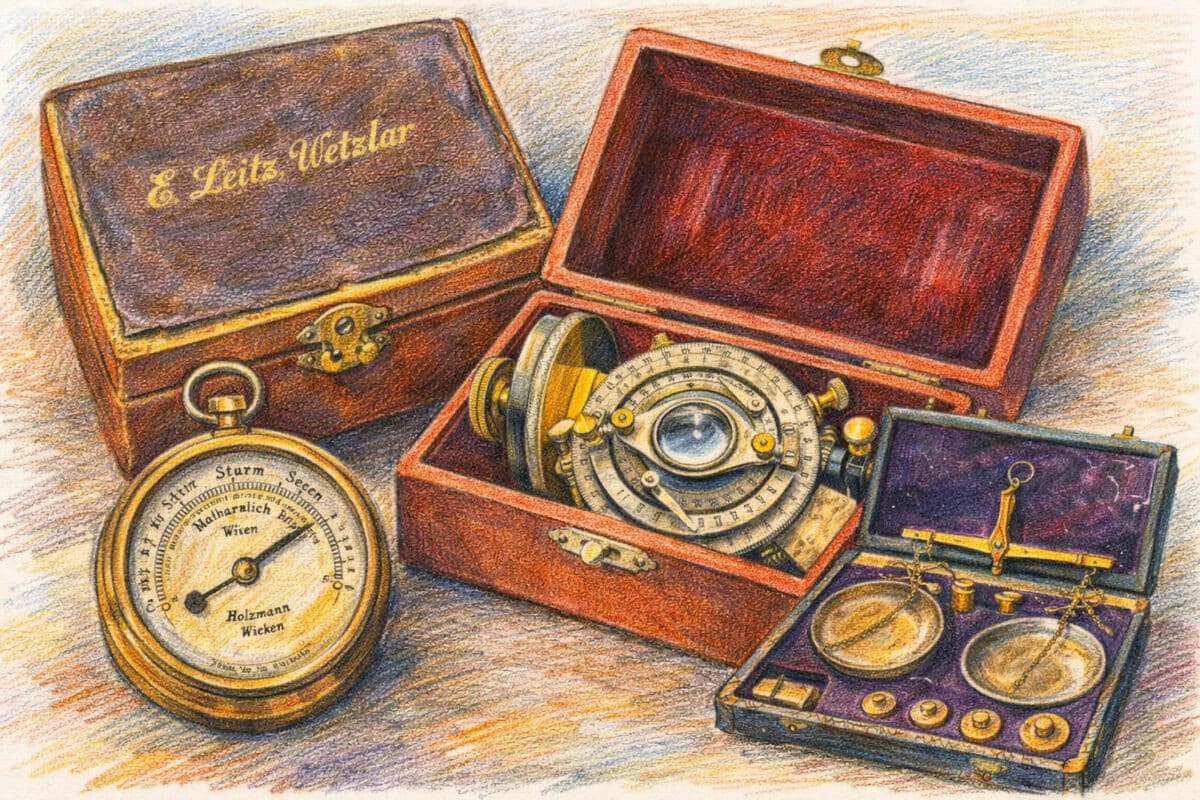
The most notable detail among the new acquisitions is a case with the golden inscription “E. Leitz, Wetzlar”. Inside is an original eyepiece for a microscope, associated with the legendary German optical school. The company E. Leitz (Wetzlar) grew out of the optical production of the XIX century and later became world-famous under the Leica brand — a symbol of precise optics, microscopes, and photographic equipment. A showcase with such an item is not about “beautiful antiquity,” but about the industrial and scientific culture of Europe, which largely defined the appearance of laboratories in the XX century.
The history of Leitz is important for the museum’s context: technological brands of this level are usually associated with industrial centers and universities, but the fate of instruments often leads them into private hands, through family archives, migration, wars, and border changes. And when such an item ends up in museum collections in Ukraine, it becomes a marker not only of technical history but also of the biography of an entire region.
The second exhibit, which specialists call a rarity, is the universal Fedorov table. This is a rotating device for a polarizing microscope: it allows changing the position of a crystal in a thin section and measuring optical constants. The instrument was named after the scientist Yevgraf Fedorov, who created the first model in 1891. Later, the design was improved: by 1896, a version with four axes was described, and in 1929, American researcher Richard Conrad Emmons added a fifth axis. Until the 1960s, the “table” was actively used in scientific research, but then it was replaced by more modern technologies — along with them, the skills of working with such equipment disappeared. Today, according to experts, only a few can confidently work with it.
In the museum’s presentation, this is an important line: the exhibit is valuable not only for its metal and mechanism but because it preserves the “language” of the past laboratory — the way to see the crystal, measure light and angles, understand the material with hands, not just buttons.
An equally expressive acquisition was an antique pocket barometer, made by the Viennese firm of Austrian watchmaker Johann Holtzmann (1763–1827). This is an aneroid barometer — an instrument that measures atmospheric pressure without liquid: the needle moves due to the deformation of the case. Such things are often perceived as “romantic travel,” but in essence, it is a tool of precise time when measuring weather and pressure was part of real logistics and science, not an app on a phone.
Of particular interest are laboratory, practically jewelry-like scales, made at the end of the XIX century in the workshop of K. Novikov, specializing in scales and weights. The uniqueness lies in the preserved factory packaging and the complete set of weights. For museum workers, this is almost an ideal situation: completeness allows not just to display the item, but to show how it was used and what standards of accuracy were considered the norm in its era.
Such acquisitions for the museum are always more than just “filling showcases.” It is an expansion of the story: about how people lived and worked, what items accompanied scientific thought, and how material culture survives catastrophes and wars, maintaining the connection of generations.
The museum thanked the donors and noted that the exhibits will soon take their place in the exhibition halls and become available to a wide audience. For Dnipro, where the memory of the Jewish history of Ukraine today intertwines with the experience of a new war, such exhibits resonate especially accurately: they restore the sense of cultural continuity — even where history constantly tries to break it.
It is precisely such stories — about people, communities, and preserving memory through specific items — that NAnews — News of Israel | Nikk.Agency collects and explains daily, so that the connection between Ukraine, Israel, and Jewish heritage remains alive and understandable.
