
On January 27, 2026, on International Holocaust Remembrance Day, a ceremony was held in Babyn Yar (Kyiv, Ukraine) to honor the memory of the victims of the Nazi genocide. The event was attended by the President of Ukraine Volodymyr Zelensky, representatives of the Ukrainian government, rabbis from Ukrainian cities, the Israeli ambassador to Ukraine Michael Brodsky, diplomats, and representatives of international organizations.
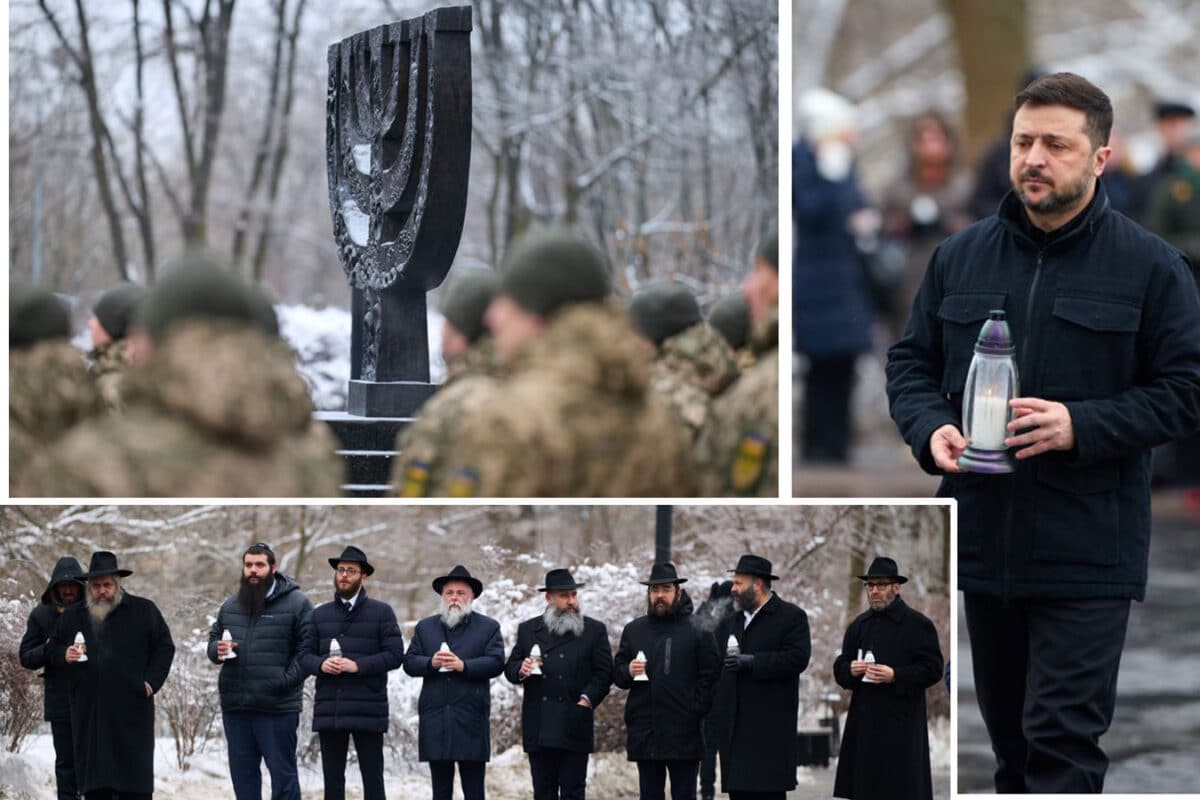
A Memory That Should Not Become a Formality
The Chief Rabbi of Ukraine Moshe Azman published a written address after the ceremony, in which he spoke about the events of this day at Babyn Yar.
“Today, January 27, on International Holocaust Remembrance Day, we, together with the President of Ukraine Volodymyr Zelensky, Head of the President’s Office Kyrylo Budanov, Minister of Foreign Affairs of Ukraine Andriy Sybiha, rabbis from Ukrainian cities, diplomats, and other state representatives, honored the memory of the Holocaust victims at Babyn Yar.”
According to him, Babyn Yar remains one of the most tragic symbols of the Holocaust:
“This place has become a symbol of incredible, inhumane cruelty and a great tragedy for the entire Jewish people.”
Words of the President of Ukraine Spoken at Babyn Yar
Moshe Azman separately emphasized the key thought expressed by the President of Ukraine during the ceremony:
“In his speech, the President of Ukraine emphasized that indifference and impunity towards evil are literally ‘fertilizer’ for its spread.”
This thought, as highlighted in the text, is directly related to today’s reality:
“In our days — in the conditions of a severe war in Ukraine and terrible events in Israel — this is especially relevant.”
A Historical Lesson Addressed to the Present
On the official resource of the President of Ukraine, it is emphasized that the memory of the Holocaust is not only a tribute to the past but also a warning to the future:
“If we do not remember the victims of the Holocaust, fascism has the opportunity to be reborn and fight against humanity.”
The President of Ukraine separately noted:
“This is a clear lesson of history: when hatred against one nation is not stopped, others cannot remain indifferent and stand aside.”
According to him, aggression and contempt for human life cannot become the norm:
“Aggression and disregard for the lives of people and entire nations should never prevail.”
Babyn Yar and Responsibility to Future Generations
The President of Ukraine reminded that Babyn Yar is a place of mass extermination of people, where more than one hundred thousand people were killed and tortured, and millions became victims of the Nazi regime worldwide.
“If we do not gather, do not remember the victims, especially the victims of the Jewish people during the Holocaust, the victims of Babyn Yar — if we do not do this, then fascism has the opportunity to be born again, to be reborn in one state or another and fight against humanity. Against the most important — against life.”
The head of state emphasized that the memory of the deceased is a signal to the next generations so that the tragedy does not repeat.
Personal and Religious Address
In conclusion of his address, Moshe Azman wrote:
“May the memory of more than six million Jewish hearts destroyed in the Holocaust be blessed and eternal.”
“I pray for the souls of the deceased and know — light always overcomes darkness.”
International Context
More than fifty representatives of foreign diplomatic missions and international organizations participated in the ceremony. Volodymyr Zelensky thanked the diplomats and their countries for supporting Ukraine and for jointly preserving historical memory.
On January 27, 1945, the last prisoners of the Nazi concentration camp Auschwitz-Birkenau were liberated. In 2005, the UN General Assembly established this date as International Holocaust Remembrance Day — as a reminder of a tragedy that should not be repeated.
Editorial of NANovosti: Are We Doing Enough to Prevent History from Repeating?
January 27 — International Holocaust Remembrance Day.
A date that every year brings us back to the words “Never again.” But is it enough today to just say them out loud?
In a world where wars are happening again — in Europe and the Middle East — we bow our heads in memory of millions of people killed just for the right to be themselves. This memory has long gone beyond history textbooks. It is again with us — in the news, in photographs of destroyed cities, in the fates of families whose lives have been crossed out by violence.
And again, systems, Nazi in their essence, speak of the “right” to destroy people just for who they are — Jews or Ukrainians.
On January 27, 1945, the Nazi death camp Auschwitz-Birkenau was liberated by soldiers of the 60th Army of the 1st Ukrainian Front of the Red Army. Then the world saw for the first time on a full scale what cannot be justified, explained, or “put into context.”
The conveyor of human destruction — systematic, cold-blooded, industrial.
This date was established by the UN as International Holocaust Remembrance Day.
Six million Jews were killed by the Nazi regime.
Almost a third of them — on the territory of modern Ukraine.
They were shot in Babyn Yar, Drobytsky Yar, Kamianets-Podilskyi. They were destroyed in ghettos, camps, on death marches. This is not abstract statistics. These are specific places. Specific families. Specific lives.
The history of the Holocaust is not only a history of pain.
It is also a history of choice.
More than four thousand Ukrainians are recognized as Righteous Among the Nations. People who, risking their own lives, saved Jews. Even in the darkest times, a person is capable of choosing humanity. And this choice is always specific.
On the eve of this date, the UN High Commissioner for Human Rights Volker Türk spoke the right words — about hatred, dehumanization, about the lessons of the past. He reminded that the Nazi regime destroyed Jews with terrifying “conveyor efficiency” — openly and practically without consequences.
The words are correct.
The problem is that we hear them from international officials, as a rule, once a year.
Passive memory has not become a protection against new genocides.
This is a fact.
Today, during the Russian war against Ukraine, the world is once again witnessing war crimes: mass killings of civilians, deportations, destruction of cities, attempts to deny the right of an entire nation to exist.
Against this evil, Ukraine is on the front line of defending fundamental human values — life, freedom, and dignity. Not in theory. At the cost of real sacrifices.
Israel, in turn, is forced to defend itself under constant pressure from terrorist organizations and regimes of hatred, which openly declare that they do not recognize its right to exist. It is not about disputes or political disagreements, but about a systematic attempt to destroy the state and its citizens — just for who they are. Israel is fighting not for territory, but for the right to live and not allow hatred to turn into a conveyor of death again.
Yesterday, the last hostage held by terrorists Hamas “returned.” Behind this “return” is not a joyful point, but a long chain of tragedies: those killed in captivity, women and children who experienced violence, civilians who became targets only because they were civilians.
Memory makes sense only when it becomes action.
Only then do the bitter pages of history not repeat, but become a warning that the world is capable of hearing.
Today we bow our heads before the millions killed.
And today this question sounds especially acute:
Are we doing enough to prevent history from repeating?
NANovosti — News of Israel | Nikk.Agency
