The material is prepared based on the interview with “Hromadske Radio” (published on January 15, 2026 (Ukr.)). Interviewees: journalist Yelyzaveta Tsaregradska and the president of the Ukrainian Association of Judaic Studies, senior research fellow of the Judaic Foundation of the Vernadsky National Library of Ukraine, Vitaliy Chernoivanenko.
Qumran and the Dead Sea Scrolls are one of those topics where a successful name immediately sets both geography and intrigue. On one hand, it is a real point on the map near the Dead Sea in the Judean Desert, not far from Jerusalem. On the other hand, it is a huge corpus of texts found in caves and surroundings that changes the understanding of the religious and intellectual life of Judea at the turn of our era. That is why the question “what is Qumran” almost always leads to the next: “who wrote these scrolls and why did they end up in the caves.”
Why they are called “Dead Sea Scrolls”
In the interview, Chernoivanenko begins with a mundane but illustrative story: when he defended his dissertation on this topic (2012), one of the council members was surprised by the very phrase “manuscripts of the sea” — like, “how can there be manuscripts of some sea.” But the name “Dead Sea Scrolls” (as well as “Qumran Scrolls”) is an established term in different languages, including Ukrainian, English, French, and Hebrew.
The term is also important because it fixes the difference between “Dead Sea Scrolls” in a broad sense and “Qumran Scrolls” in a narrow sense. The Dead Sea Scrolls are finds from various locations near the Dead Sea, while “Qumran” refers to those found specifically in the Qumran area. At the same time, the largest array of finds is indeed associated with Qumran, so in the public consciousness, everything often “collapses” into one point.
Where is Qumran and what is this place
Qumran is not a city in the usual sense. Chernoivanenko emphasizes: debates about what exactly Qumran was (a settlement, the center of some group, an economic object, something else) continue to this day. But as a geographical location, it is described quite clearly.
We are talking about a territory that today belongs to the State of Israel. In ancient times, these lands were called differently in different eras: the Kingdom of Israel, the Kingdom of Judah, and in Roman times — Palestine (at the same time, the term “Palestine,” as the expert reminds, was not the original name of these lands but was fixed later and “stretched” to modern political lexicon).
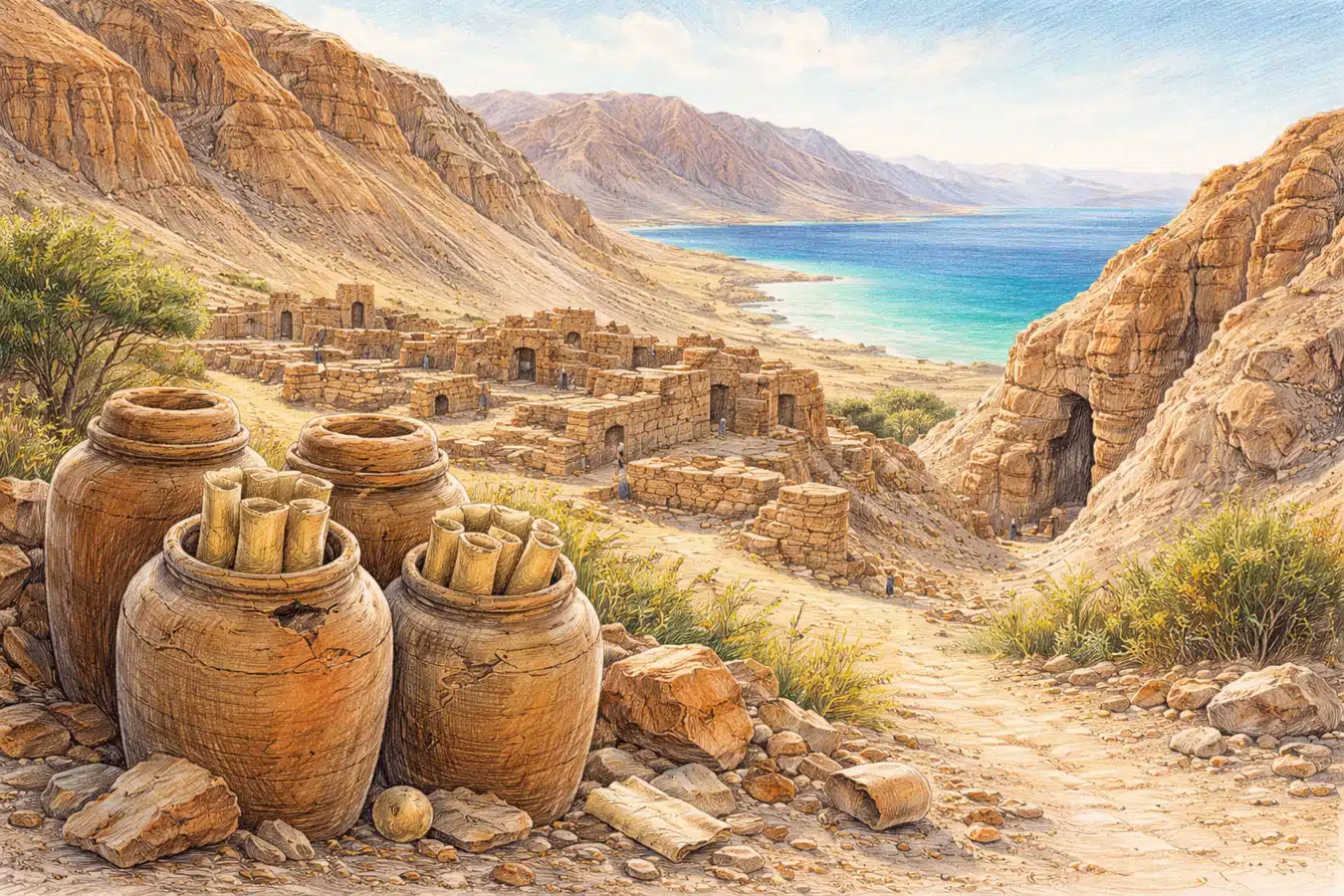
Geographically, Qumran is located on the northwest of the Dead Sea, in the Judean Desert, near Jerusalem. In literature, the names Khirbet Qumran and Wadi Qumran are encountered. “Wadi” is an Arabic word for a dry riverbed of a seasonal desert river: in the region, rains occur mainly in winter, water appears, but then quickly disappears, the land dries up and cracks. “Khirbet” means “ruins” — that is, the name itself refers to something destroyed, to the remnants of a former structure.
What dates are associated with the scrolls and why is it important
If we “reduce” the finds to a historical range, Chernoivanenko names the period from the 2nd century BCE to the 1st century CE. At the same time, according to him, there are relatively few finds from the 2nd century BCE, the main array relates to the 1st century BCE and the 1st century CE.
This is a key point for explaining why the Dead Sea Scrolls became a global scientific “magnet.” We are talking about a time when different religious and political movements existed in Judea, complex internal processes were taking place, and in a broader context, an environment was forming from which early Christianity later emerged. The scrolls become an additional source, not reducible only to the texts of the New Testament or later retellings.
What languages are the scrolls written in
According to Chernoivanenko, three languages are recorded among the finds: ancient Hebrew, Aramaic, and a little ancient Greek. The appearance of Greek is associated with the post-Hellenistic era when Greek culture spread to the Middle East and became part of the regional reality.
This is not just a “detail for reference.” Multilingualism helps explain how heterogeneous the intellectual environment was and how different audiences could be involved in the production, reading, and copying of texts.
How and when were the scrolls discovered
The first discovery of the scrolls Chernoivanenko dates to 1947. He mentions the “legendary” story of a Bedouin who supposedly stumbled upon jars and found the first scrolls. Further interest in the finds grew: in the 1950s-60s, archaeologists and researchers became active, excavations and research continued then with interruptions, not only in Qumran but also in other points around the Dead Sea — finds “accumulated” over time.
Another important point: access to the scrolls was long restricted — almost until the 1990s. At the same time, the volume of scientific reaction was colossal. The expert says that in the first decade of Qumran studies, research on this topic in scale was second only to biblical studies (Bible research): it was about thousands of works, and he provides a benchmark — about six thousand studies in the first decade.
How many scrolls exist and in what form have they survived
Speaking of manuscript material, not everything has survived intact. Many texts have been preserved in fragments, sometimes very small. But in general, according to Chernoivanenko, more than a thousand “manuscript units” have been found.
This immediately affects how a researcher’s work looks: reconstruction, comparison of handwriting, materials, text variants, attempts to understand which fragments relate to what, and what exactly was in the hands of people two thousand years ago.
What’s inside: it’s not a “chronicle,” but a motley library
One of the most common mistakes is to expect that the Dead Sea Scrolls will be something like a coherent chronicle of events, a “diary of the era,” or systematic annals. Chernoivanenko speaks directly: there are no chronicles in this corpus. Yes, in the biblical tradition there are chronicle books or books of kings, where reigns and events are described, but there is almost none of this in the Dead Sea Scrolls.
But there is something else: extraordinary genre diversity and multilayeredness. The expert emphasizes that the corpus is heterogeneous not only in languages. There are many different handwritings — that is, a significant number of people were involved in the creation/copying of texts. There are also texts of an eschatological, apocalyptic, messianic nature, which, in his assessment, shows how society of that time lived with expectations of “end times.” This, in particular, helps to better understand the context in which early Christianity emerged: initially, it looked like one of the movements within Judaism of that era, and the scrolls demonstrate the diversity of such movements.
In addition, among the scrolls, there are very different types of documents: from actual biblical books (for example, prophetic) to texts that can be called non-canonical, as well as commentaries on biblical books (exegesis). Chernoivanenko mentions unexpected genres — for example, horoscopes. And another important feature: many texts work through allusions, so researchers sometimes tried to “read” historical events and characters of the era indirectly, through hints and images.
What editions are available and why translations are a separate problem
Chernoivanenko notes that today there are several editions of the entire corpus of the Dead Sea Scrolls. There are practically no Ukrainian translations (he says he translated a small volume in an appendix to his own book). In Russian, there were separate attempts back in Soviet times and later — in the post-Soviet period, publications with the most famous texts were released, but not the entire corpus.
The full corpus is published, according to him, in English and Hebrew, there are also bilingual versions, where the original and translation are side by side. He separately mentions the digital format: when high-quality scans of the scrolls are available, and the user can hover over a word and see a hint with reading, meaning, and translation. Importantly, this changes the accessibility of the material compared to the era when the scrolls were “closed” to most researchers.
Main debates: who are the authors and what is Qumran
The interview outlines the basic framework of the discussion, with which, according to Chernoivanenko, almost any serious conversation about the scrolls begins: there are two big questions.
The first is what Qumran was as a place.
The second is who wrote the Dead Sea Scrolls (and, in particular, the Qumran Scrolls).
Chernoivanenko explains that he systematically analyzed these questions in his book “Qumran and the Dead Sea Scrolls: Authorship, Identification, Historiography,” where he collected and analyzed different theories and hypotheses.
The most famous version: the “Qumran-Essene” theory and its logic
The first, most popular in mass perception version arose very early — almost immediately after the 1947 finds. A group of researchers formed, and then an international team, where not everyone was admitted. Chernoivanenko separately emphasizes a characteristic detail: among this team, there was not a single Jew; key roles were played by Christians, including Catholic monks. The central figure of this early wave was the priest and researcher Roland de Vaux.
Their picture looked like this: Qumran was presented as something like an “ancient monastery” with a scriptorium — a place where scribes sat and copied/wrote scrolls. The image is clear: an ascetic group, discipline, text production, storage.
At the same time, Qumran as an archaeological point was known since the 19th century — Chernoivanenko mentions the French archaeologist Clermont-Ganneau, who paid attention to the place long before the discovery of the scrolls. And the “attachment” to a specific group early researchers tried to support with ancient authors: Josephus Flavius, Philo of Alexandria, and Pliny the Elder. In their texts, a group of Essenes is described — mysterious, marginal, ascetic, living in anticipation of the end times.
And then a logical “glue” occurs: ancient sources talk about Essenes in the area of the northwest Dead Sea; in this area, there is Qumran; therefore, Qumran is the place of the Essenes; therefore, they could be the authors/keepers of the scrolls.
Chernoivanenko, however, shows why this version raises questions. One of the sharp points: in ancient descriptions, it is said that the Essenes did not marry, which for Judaism looks marginal against the backdrop of the biblical commandment “be fruitful and multiply.” It can be assumed that a small ascetic group existed — but it can also be argued how accurate and “non-mythological” this image is.
Alternative: “Jerusalem theory” and arguments against the idea of a “small community of scribes”
Then Chernoivanenko moves to a position he considers an important alternative and without which the conversation would be incomplete. He associates it with the works of his scientific mentor — University of Chicago professor Norman Golb. Golb published a key article in 1980, and then developed ideas in subsequent works and in the book “Who Wrote the Dead Sea Scrolls?” in the 1990s.
The essence of the “Jerusalem theory” is that many features of the corpus point not to a small isolated community in Qumran, but to a large urban center — Jerusalem.
The arguments in the interview are presented step by step.
First, different content and different genre: within the corpus, there are texts that are sometimes simply incompatible with each other in spirit and ideas. This poorly fits the image of a “single community” with a single charter and uniform practice.
Second, the number of different handwritings and the scale of manuscript work. Chernoivanenko explains in detail who a professional scribe is in the Jewish tradition. This is not “a person who sat down and copied.” This is a trained specialist, a calligrapher, a profession with discipline and training. In Judaism, this practice has been preserved for centuries, and the profession of sofer — a scribe of sacred texts — still exists. He provides understandable examples from modern life: Torah scrolls in a synagogue, mezuzahs on doors, where inside lies a handwritten text — all this must be written professionally and according to the rules.
From here, the conclusion: it is hard to imagine a small community where there would be “incredibly many” qualified scribes — this would look like a statistically and socially unrealistic model. But in Jerusalem, the capital of Judea at that time, the existence of many groups, schools, traditions, and scribes looks much more plausible.
Then the next question arises: if “all roads lead to Jerusalem,” how did the scrolls end up in the caves near the Dead Sea, including the Qumran area?
The answer in the interview is tied to the historical context of the Jewish War of 66–73 CE. In 70, the Romans took Jerusalem. In Golb’s logic, this triggers a scenario of saving values: people flee the city, take out what they consider important, including scrolls. Chernoivanenko mentions that Josephus Flavius describes the directions of the movement of refugees from Jerusalem, and one of the directions was the area of the Dead Sea.
Then a simple human mechanism comes into play: life is more important than things. If a person understands that they may not escape pursuit, they may hide valuable things “for better times.” The caves near the Dead Sea could become such hiding places. In this model, the scrolls lay for almost two thousand years and “returned” in the 20th century as an archaeological sensation.
Why the topic is important today, including the Ukrainian context
Chernoivanenko emphasizes several times that the Dead Sea Scrolls are not “exotic for narrow specialists,” but a source that expands knowledge about what Jewish society of that time was like, what ideas circulated, what expectations and disputes looked like within the religious environment. This corpus provides material “from the side” of the New Testament and allows us to see that era differently, when messianic and apocalyptic motifs were part of everyday intellectual life.
A separate line in the original source states that the project (within which the conversation took place) was prepared with the support of the Canadian non-governmental organization “Ukrainian-Jewish Encounter” (UJE). This emphasizes that the conversation about Qumran and the scrolls is not only an “Israeli” topic: it exists in both the academic and cultural agenda of Ukraine, where Judaic studies are developing as an independent direction, connected with libraries, universities, translations, and scientific discussions.
In a practical sense, the main outcome of the interview is this: Qumran is geography, and the Dead Sea Scrolls are a corpus that is too diverse to be “closed” forever with one convenient version. The more texts, technologies, and parallel studies are opened, the more noticeable it becomes that the answers here will be refined for a long time. That is why Qumran studies remain a living discipline — not museum-like, but working, arguing, and reassembling details anew.
And for the Israeli audience, it is also a reminder: the Judean Desert, Jerusalem, and the Dead Sea are not only tourist spots but also places where texts literally lay that defined the language of conversations about the Bible, Judaism, and early Christianity for two thousand years ahead — and these texts continue to influence how the world reads the region today. NAnovosti — News of Israel | Nikk.Agency