Russian propaganda media are actively spread theories about a new “world Zionist conspiracy,” accusing Israel and the United States of trying to “undermine” the Suez Canal.
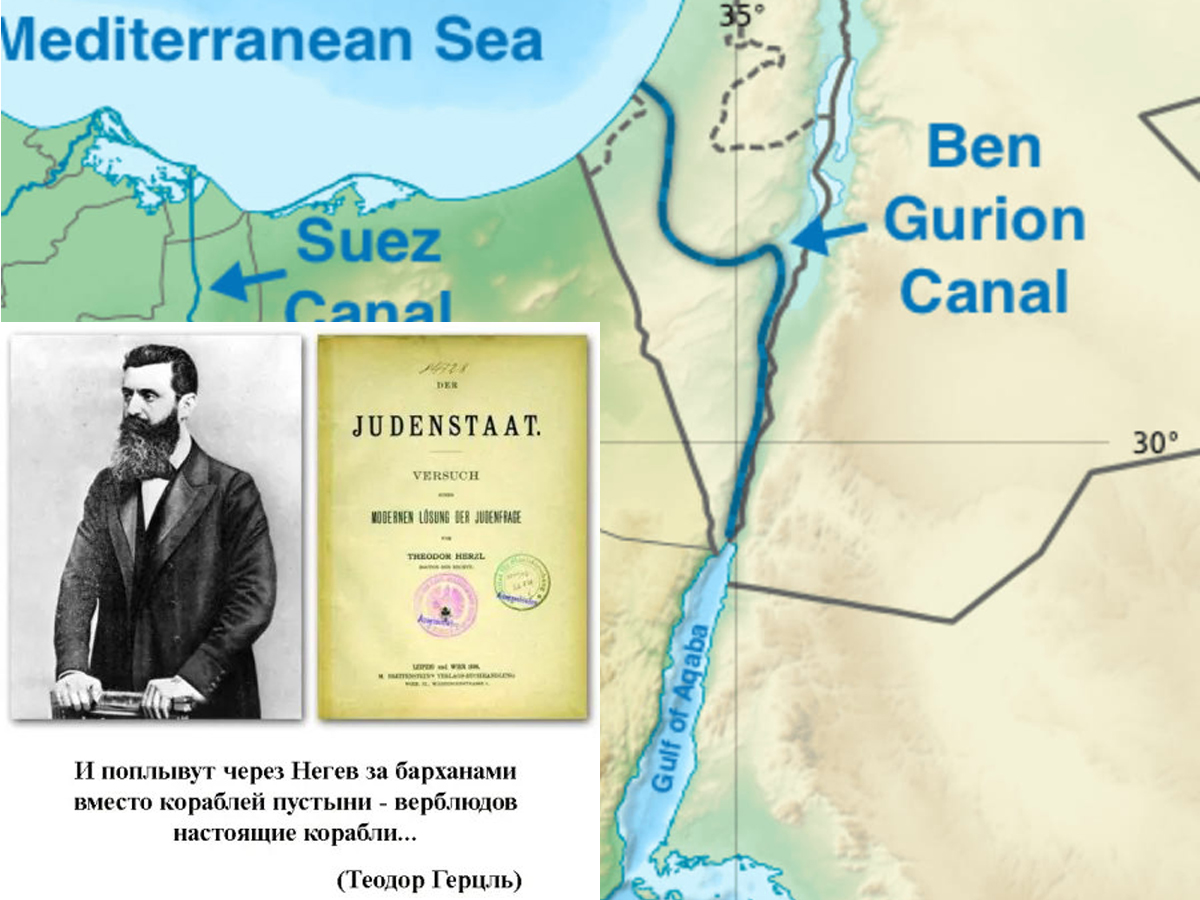
At the center of this new wave of disinformation is the Ben Gurion Channel project that “Israel is planning (there is such a project – ed.) to build as an alternative to the Suez Canal.”
“After newly elected US President Donald Trump said he would return the Panama Canal to US control due to its importance to American trade and national security, it is clear that “Trump is entering a fight for control of global trade communications” and that “ The next move should be expected regarding the Suez Canal, which is controlled by China, Russia and Iran.”
This is how it happens. In Israel, attention has been intensified to the construction project of the Ben-Gurion canal with a length of about 258 km
According to Russian media, the channel project is part of the global strategy of Israel and the United States to change the geopolitical balance in the region. This narrative is actively supported by various propaganda platforms, including state-controlled television channels and Internet resources.
“The moment is coming to expose the true goals of US and Israeli policy in the Middle East.
The battle is not for territories or even countries, but for the routes of new logistics, which in turn will predetermine inevitable military conflicts in the future. According to experts, the Ben-Gurion channel could even provoke the outbreak of World War III. And now all the foundations of the previous security system are collapsing in the region, which does not bode well for the future.
So there are big events ahead in the Middle East.”
What do Russian media say?
- “Zionist conspiracy”
Propaganda focuses on the fact that the channel project is supposedly aimed at weakening the positions of Egypt, Russia and China.
- “Suez Canal Bombing”
There are accusations in the Russian media that the new Israeli project threatens a key trade route – the Suez Canal.
- “Control of world trade”
Accusations of an attempt by Israel and the United States to monopolize logistics in the region, cutting off other countries from key routes.
Why is Russia spreading these theories?
Russian propaganda uses “conspiracies” as a tool of influence to:
- Maintain influence in the region. Russia fears losing its position in the Middle East, where it actively cooperates with Iran and Syria.
- Undermine trust in Israel and the United States. By demonizing the canal project, Russia is trying to discredit its geopolitical opponents.
- Strengthen internal propaganda. Conspiracy theories help distract attention from Russia's internal problems.
“Russia is ready to create any fake narratives in order to protect its interests in the region and maintain influence,” – notes the Israeli analyst NAnews.
What is the Ben Gurion Channel Project?
The Ben Gurion Canal project is a massive proposal to build an artificial waterway that would connect the Mediterranean and Red Seas through Israeli territory. It is seen as an alternative to the Suez Canal, offering a new trade route that could potentially change the logistics landscape of the Middle East and the world.
Key features of the project:
- Channel length: The channel should stretch for about 258 kmstarting from Eilat (Gulf of Aqaba on the Red Sea) to the Mediterranean coast.
- Specifications:
- Depth: near 50 meterswhich makes it deeper than the Suez Canal (40 m).
- Width: near 200 metersallowing the passage of the largest ships in the world up to 300 meters long and 110 meters wide.
- The canal will have two separate routes for traffic in both directions, which is different from the single-lane Suez Canal.
- Infrastructure along the canal: Israel plans to create new cities, hotels, tourist areas and industrial infrastructure along the canal route, which should stimulate economic development in the region.
- Expected cost and terms:
- Construction costs are estimated from 16 to 55 billion dollarsdepending on the final project.
- It is expected that the work will take 5-7 years.
- Economic effect:
- The canal is expected to bring about $6 billion in annual revenue.
- The new route will become an important element for global logistics, connecting Europe, Asia and Africa.
Project history:
- 19th century ideas: The first plans to build a canal through Israeli territory appeared in the 19th century. In 1855, British Admiral William Allen proposed digging a canal through the Dead Sea, not taking into account that it was below sea level.
- Cold War: In 1963, at the height of the Cold War, the United States considered digging a canal as an alternative to the Suez Canal after it was nationalized by Egypt. This project involved the use nuclear explosions to create a route, but was never implemented.
- Current plans: The idea was revived after the signing Abraham Accords in 2020, as Israel began to strengthen ties with Arab countries. The canal became part of a broader strategy that included the creation of a transport corridor from South Asia to the Mediterranean Sea.
Political significance:
The Ben-Gurion Canal could change the balance of power in the Middle East, affecting the following aspects:
- Competition with the Suez Canal: The Israeli route threatens the economic interests of Egypt, which receives about 5 billion dollars a year from the Suez Canal.
- Geopolitical strengthening of Israel: Israel is emerging as a key logistics hub between Europe and Asia, strengthening its position on the international stage.
- Opposition to China: The project is seen as an alternative to China's Belt and Road Initiative, threatening China's economic interests in the region.
- Reaction of Iran and Arab countries: Iran, Egypt and some other states see the project as a threat to their economic and strategic interests.
Main challenges and criticism:
- High cost and complexity of construction:
The project requires significant investment and technology, including work in desert conditions and rough terrain.
- Geopolitical resistance:
Egypt, Iran and China oppose the implementation of the canal, fearing the loss of their influence in the region.
- Environmental risks:
Construction of the canal could damage the ecosystems of the Negev Desert, Red Sea and Mediterranean Sea.
Prospects:
If the project comes to fruition, it could become the largest infrastructure achievement in Israeli history. This will ensure economic growth, strengthen the country's logistics position and turn Israel into a key element of world trade.
The Ben Gurion Canal project is not only an economic initiative, but also part of a larger geopolitical game in which Israel seeks to take a leading position in a changing world.
How Russian propaganda distorts facts
This is not the first time Russian media have used disinformation tactics against Israel. Typical methods include:
- Taking it out of context. Quotes from Israeli and American politicians are used to support “conspiracies”.
- Data distortion. The canal project is presented as ready for implementation, although it is still at the discussion stage.
- Creating fake threats. Russia claims the project could trigger “World War III.”
| Russian fake | Reality |
|---|---|
| Canal project threatens Suez | The channel is still under development |
| This is part of a “conspiracy” between the US and Israel | The project aims to improve trade |
| Israel and the US are provoking conflict | Israel seeks stability in the region |
Conclusion
Fake theories about a “Zionist conspiracy” are another example of Russian propaganda aimed at undermining stability in the region. Despite this, the Ben Gurion Canal project has the potential to radically change global logistics and strengthen Israel's position on the international stage.
Read more analytical materials on geopolitics and Russia's influence on the Middle East on the website NAnews – Israel News. We talk about what is important to know!
…
Read on WhatsApp – channel NAnews ↓ — Israel News
Read on Telegram – channel NAnews ↓ — Israel News