
On the night of October 23, Russian drones attacked Kyiv. One of them hit the Podil district — the historic center of Jewish life in the capital. The “Beit Menachem” synagogue on Shchekavytska Street suffered serious damage: windows were shattered, the facade was destroyed, miraculously no one was killed. Ukraine’s Chief Rabbi Moshe Asman called the incident “a blow to faith and memory.” Mayor Klitschko confirmed: residential buildings, a kindergarten, and at least seven people were affected. Foreign Minister Andriy Sybiha emphasized: during the war, Russia has already destroyed more than 640 religious sites and killed 67 religious leaders.
Strike on Podil: The Night Faith Faced Terror
On the night of October 22-23, 2025, Kyiv once again experienced one of the most powerful attacks since the beginning of autumn. Russia launched dozens of Shahed-136 drones and missiles at the Ukrainian capital. The air defense system shot down most of them, but some drones penetrated deep into the city.
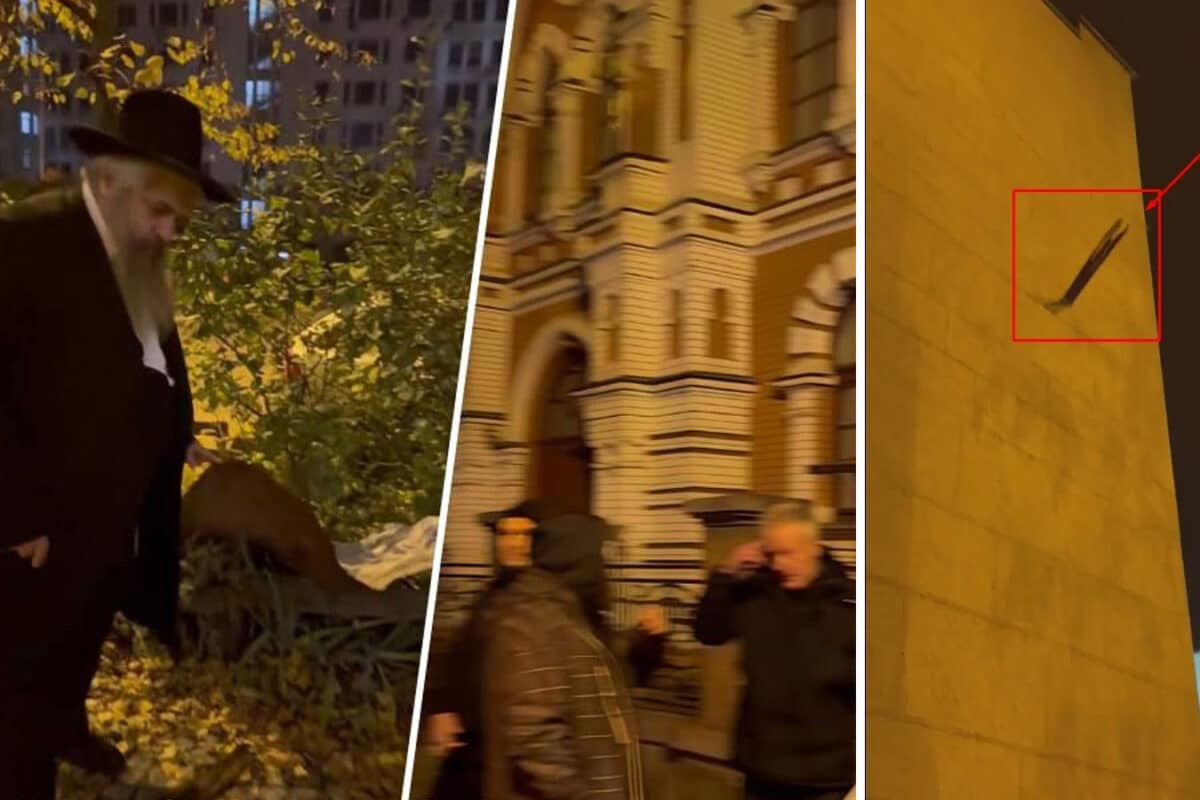
The strongest blow was dealt to the Podil district — the historical center of old Kyiv and the heart of Jewish life. Here, on Shchekavytska Street 29, the blast wave damaged residential buildings, a kindergarten, and the Chabad-Lubavitch synagogue, where congregants gather daily for prayer.
“This is a place where people pray every day. Today, it was only a miracle that no one died,” said Ukraine’s Chief Rabbi Moshe Reuven Asman, showing the destroyed facades and drone fragments stuck in the wall.
Destruction and Casualties
According to the Kyiv City Military Administration, five impact points were recorded in the Podil district.
- Seven people were injured, five of whom were hospitalized.
- Windows were shattered, facades and roofs were destroyed in residential buildings.
- In the synagogue’s courtyard, cars were damaged, and fragments of the explosive device were scattered.
- A kindergarten was affected, where there were no children at the time of the explosion.
Kyiv Mayor Vitaliy Klitschko confirmed:
“This is one of the heaviest blows to the city in recent weeks. Podil has suffered greatly, but the people of Kyiv are not broken.”
“Beit Menachem” Synagogue: A Place of Faith and Memory
The synagogue on Shchekavytska 29 is one of the oldest Jewish buildings in Kyiv. It was built in 1894–1895 according to the project of architect Nikolai Gordenin in the Moorish Revival style. During the Russian Empire, it served as a center of prayer and the community of Podil craftsmen.
After the revolution and the advent of Soviet power, the building was closed. During World War II, the synagogue was looted, and in the post-war years, it was used as a warehouse for a long time. Only in the 1990s, with the revival of Jewish life, was the synagogue restored and transferred to the Chabad-Lubavitch community.
A prayer hall, a Torah school, and a humanitarian center were opened here. Hebrew was heard again in Podil, and the light of Hanukkah candles became a symbol of the return of faith to the city.
Moshe Asman: “An Iranian-Russian drone hit the synagogue!”
The first report of the hit appeared on social media at 3:20 a.m. Rabbi Moshe Asman wrote:
“Just now, an Iranian-Russian drone hit the synagogue in Podil!!! Everything shook, the noise was terrible.”
Later, he arrived at the scene and recorded a video:
“The hit occurred near the place where people usually gather for prayer. The noise was such that the whole building shook. Drone debris damaged the yeshiva and the nearby hotel, windows were shattered, part of the roof was blown off.”
The footage shows broken stained glass, metal fragments, glass on the floor, and smoke inside the prayer hall. According to Asman, services in the synagogue will resume immediately after cleaning.
“We thank the Almighty that no one was hurt. But what happened is an act of terror against faith and life. Russia strikes at the soul of Ukraine,” he said.
Chabad in Kyiv: A Living Network of Help and Faith
The Chabad-Lubavitch movement is one of the most influential Jewish directions in the world, founded in the 18th century in Eastern Europe, in the town of Lubavitch (now in Russia). Its philosophy is based on a combination of deep Torah study and practical kindness — helping others regardless of their origin, language, or faith.
After the Holocaust and decades of Soviet persecution, Chabad became a symbol of the revival of Jewish life in Eastern Europe. Rabbis of this school opened prayer houses, kindergartens, schools, and humanitarian centers where faith seemed forgotten.
Rabbi Moshe Reuven Asman
Moshe Reuven Asman is the Chief Rabbi of Ukraine, a representative of the Chabad-Lubavitch movement, born in Leningrad in 1966, repatriated to Israel, and then moved to Kyiv in the 1990s. He led the revival of the Central Brodsky Synagogue, turning it into a spiritual center of Ukrainian Jewry.
Asman is not only a religious figure but also a public one. After 2014, he actively participated in helping Ukrainian refugees and the military, organized humanitarian aid collections, opened shelters for displaced persons, and launched a volunteer network project delivering food and medicine to the war zone.
Since the beginning of the full-scale invasion, Asman has become one of the most recognizable religious leaders in Ukraine. He constantly speaks in international media, visits frontline cities, and leads prayers for Ukraine’s protection.
“When walls collapse, people remain. Faith is not walls, but what we do for others,” the rabbi said in an interview.
Chabad in Kyiv: Centers of Life and Help
Today, several active Chabad centers operate in Kyiv:
- 🕍 Central Brodsky Synagogue (Shota Rustaveli St. 13) — the main temple and residence of Rabbi Asman. Daily prayers, Torah courses, and meetings with representatives of other religions are held here.
- 🕍 “Beit Menachem” on Shchekavytska 29 — the synagogue and community center affected during the attack, where a kitchen, humanitarian warehouse, and children’s classes operate.
- 🕍 Center on Saksahanskoho 67 — an educational house with a library, Hebrew language courses, and youth programs.
- 🕍 Chabad House in Darnytsia — a branch on the left bank, where Shabbat dinners and family programs are held on Saturdays.
After February 24, 2022, all these centers turned into shelters and rescue points. Refugees stayed overnight here, kitchens operated, and volunteers packed food for the front. Asman and his students personally evacuated hundreds of families, helping not only Jews but everyone in need.
“We do not divide people into ours and others. Everyone who came is our brother,” he said in March 2022.
Why This Matters Now
The strike on the “Beit Menachem” synagogue was not just an act of building destruction — it was a blow to a movement that embodies restoration, mercy, and faith.
For thousands of people in Kyiv, Chabad is not only a religion but also real help, food, shelter, medicine, and moral support.
Podil: A Place of Memory and Trials
Podil is not just a district on the map. It is the heart of old Kyiv, where in the 18th–19th centuries Jewish shopkeepers, craftsmen, and rabbis lived. On the streets of Shchekavytska, Khoreva, and Yaroslavska, dozens of prayer houses stood, and Jewish families made up a third of Podil’s population.
During the Holocaust, the community almost disappeared, but after Ukraine’s independence, its revival began. The “Beit Menachem” synagogue became its symbol — a place where faith returned home.
Now history repeats itself: explosions are heard again in the heart of Podil, but the candle of faith burns again.
“We will pray even under the rubble. Because faith is stronger than fear,” said one of the congregants in a morning report.
International Reaction and Assessment
The Embassy of Israel in Kyiv expressed solidarity with the Jewish community and readiness to help restore the building. Israeli diplomats called the attack “a blow to the conscience of the world.” Representatives of European missions in Kyiv spoke in the same spirit, emphasizing that strikes on religious sites violate all norms of international law.
Statement from the Ministry of Foreign Affairs of Ukraine
Ministry of Foreign Affairs of Ukraine / MFA of Ukraine
💬 Minister of Foreign Affairs of Ukraine Andriy Sybiha:
“The Russian attack on Kyiv at night damaged the synagogue. Russian terror spares no one, including religious communities.
Since the beginning of the full-scale invasion, 640 religious sites have been damaged in Ukraine, and 67 religious leaders have been killed.
During the night shelling of Kyiv, residential buildings were hit, at least 7 civilians were injured. In Sumy, Russians again attacked our railway infrastructure and workers.Putin rejects any peace proposals, wants to continue the war he started, and refuses to end it. We must deprive him of the opportunity to continue terror and aggression: leave his military budget unfunded and weaken his military capabilities.”
The Synagogue Stands, Faith Lives
On the morning of October 23, Chabad volunteers began clearing debris, boarding up windows, and bringing life back to the building. Services are decided to be held the next day.
“Let them see that we are alive. That we pray. That we are not broken,” says Rabbi Asman.
In his video from the synagogue — people in gloves and jackets collecting glass shards and candles lit on a broken window. In those frames — everything: pain, fatigue, and resilience.
Russia — A Terrorist State
The rabbi’s words sound not only as an appeal to God but also as a moral verdict:
“What happened is terror against faith and life. We will restore the synagogue and continue to pray.”
The “Beit Menachem” synagogue survived, as did the Jewish community of Kyiv. Podil once again became a place of trials — and once again a place of resilience.
Russia tries to destroy history — but history survives.
