
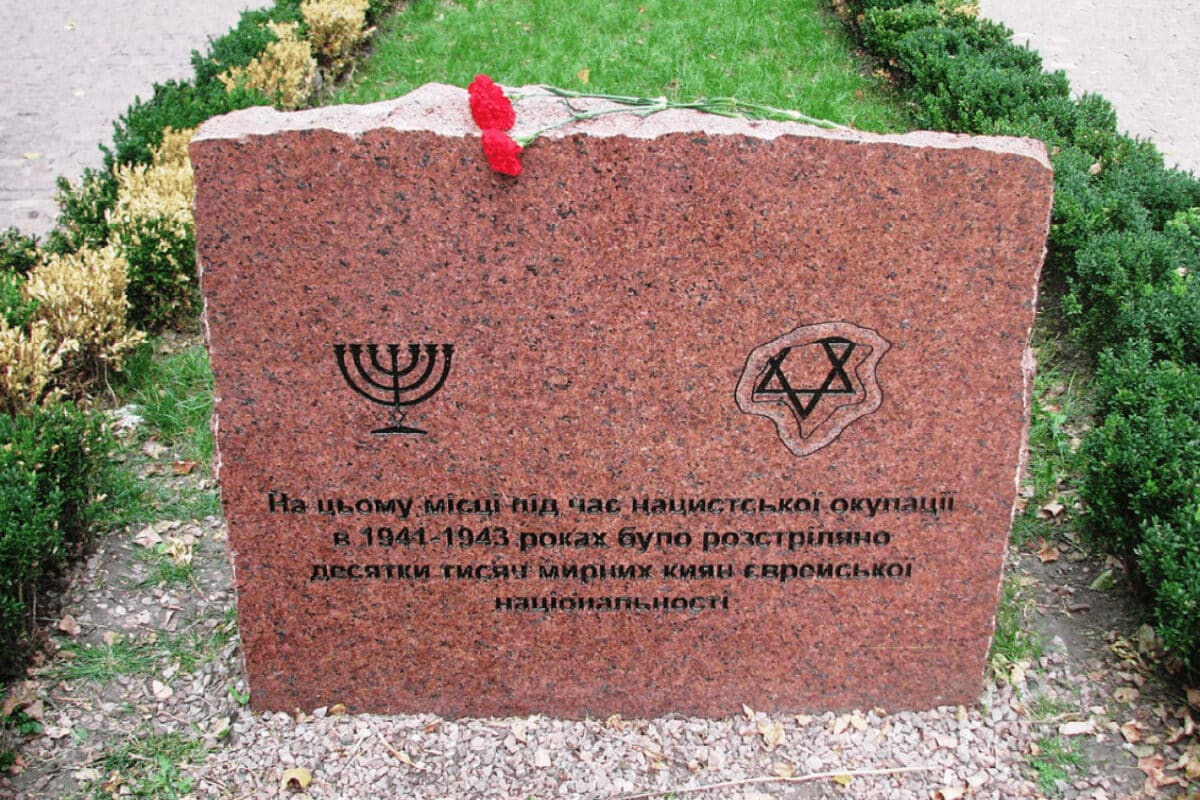
Every year on September 29, Ukrainians mournfully remember the tragic pages of their history. Over two days — September 29 and 30, 1941 — the Nazis shot more than 30,000 Jews in Kyiv. What is important to understand is that this was one of the largest punitive actions of World War II.
Babi Yar: Memory of Tragedy
Babi Yar is a place of memory, a necropolis where about 100,000 civilians and prisoners of war, destroyed by the Nazis in 1941–1943, are buried. Among the victims of the Third Reich: Jews and Roma, Red Army soldiers, communists, underground members of the Organization of Ukrainian Nationalists, prisoners in the Syrets concentration camp, “saboteurs,” curfew violators, patients of the Pavlov Psychiatric Hospital.
After the end of World War II, the Soviet authorities remained silent about the tragedy of Babi Yar for a long time, distorting the memory of its victims. The Soviets even tried to destroy Babi Yar itself and the surrounding cemeteries.
One totalitarian regime concealed the atrocities of another, diminishing the scale of the tragedy and depriving the victims of due respect.
Today, Ukraine is once again facing a regime of hatred, this time a direct heir of totalitarianism — under the rule of Russian dictator Putin. There are regular attacks on the civilian population, torture, and illegal arrests of citizens in the occupied territories, and the abduction of Ukrainian children continues.
The Ukrainian authorities are collecting evidence of Russia’s war crimes and submitting them to national and international human rights mechanisms. Everyone who committed a war crime must answer for their actions. Eternal memory to all Holocaust victims, as well as to all who perished in Babi Yar at the hands of the Nazis.
Kyiv followed the same route that led people to execution
In the capital of Ukraine, the tenth annual March of Memory for the victims of Babi Yar took place. The column followed the historical route — the same one that 84 years ago the Nazis drove Kyiv’s Jews to executions.
At the “Menorah,” the memorial prayer “El Male Rachamim” was recited by Rabbi Moti Levenhartz. Among the participants were representatives of foreign diplomatic missions and schoolchildren from Uman; the organizers of the march were Yevhen Horodetsky and Dmytro Yurinov.
Israeli Ambassador Michael Brodsky laid flowers on the anniversary of the tragedy
On the morning of September 29, the Ambassador of the State of Israel to Ukraine, Michael Brodsky, honored the memory of the victims at the Babi Yar memorial.
The diplomat emphasized the universal meaning of the memory of the Holocaust and the “Holocaust by bullets,” reminding that on September 29–30, 1941, 33,771 Jews were shot in Babi Yar in two days, and later the killings continued, with the total number of victims in the ravine reaching about 100,000 people of different nationalities, including Roma and Soviet prisoners of war.
Why this is important for Ukrainian-Israeli dialogue
For the Ukrainian-Israeli agenda, Babi Yar is not only a historical episode but also a point of contact between communities, memory, and modern diplomacy. Joint ceremonies, the participation of the Israeli ambassador and foreign delegations in Kyiv show that the topic of the Holocaust remains a foundation on which mutual understanding, educational programs, and the fight against modern anti-Semitism and racism are built.
The presence of schoolchildren is a signal of passing memory to the next generations, which is especially important against the backdrop of wars and attempts to rewrite history.
Memory that works here and now
In the year of the 84th anniversary of the tragedy, Ukrainian and Jewish organizations once again brought people to the March to follow the same path, recite a prayer, and call things by their names. This is about respect for the victims, an honest conversation about the past, and a lesson for the present: intolerance, incitement to hatred, and dehumanization always start with words and end with real blood.
And that is why Ukraine and Israel consistently make memory a “work of hands” — through living rituals, education, public diplomacy, and international solidarity.
