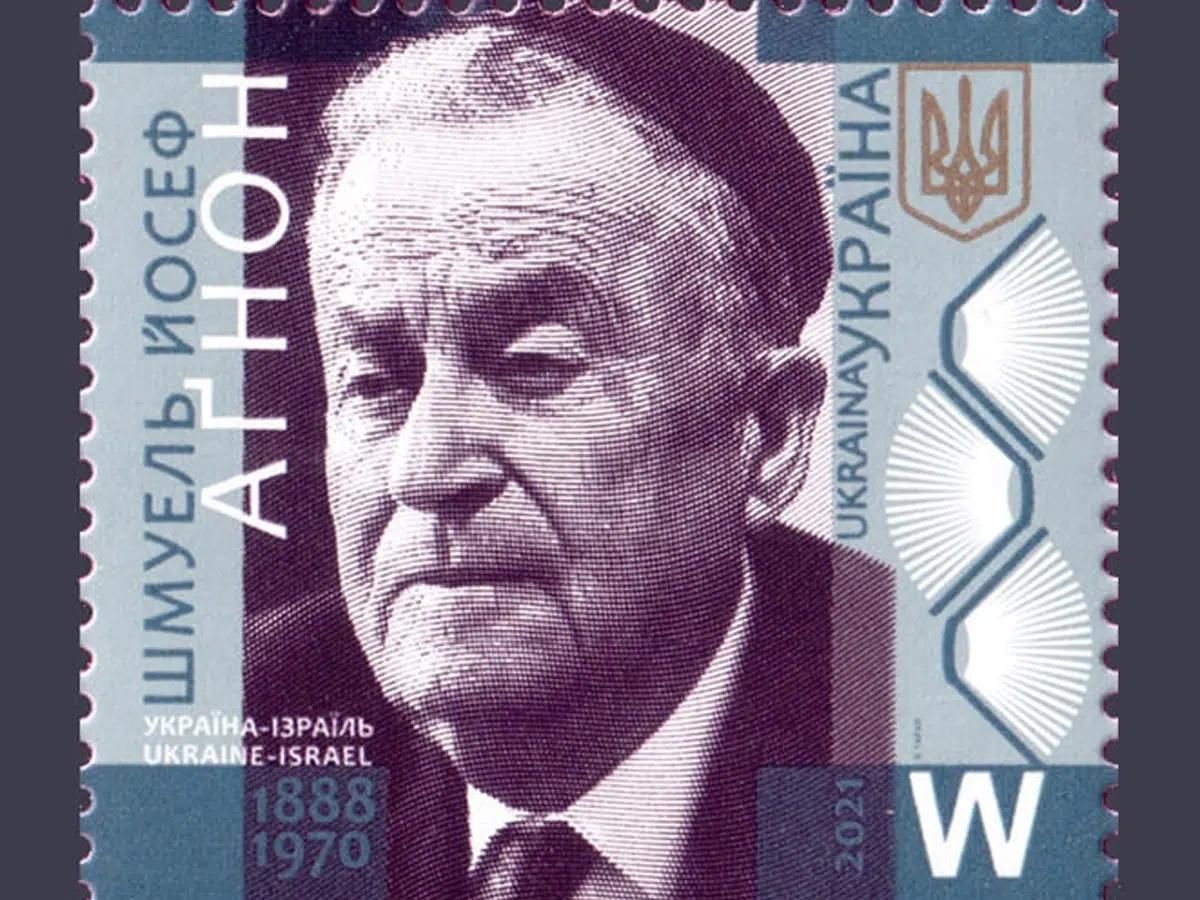
In his native Buchach, a monument was erected in his honor, one of the city’s streets is named after him, and a bas-relief of the writer is at the entrance to the local “ART-Court.”
Shmuel Agnon (born July 17, 1888, Buchach, Ukraine) is a famous Jewish writer whose life and work are closely connected with Ukraine. The events of his most famous novels, “The Bridal Canopy” and “A Guest for the Night,” for which he received the Nobel Prize in Literature, take place in his native Buchach and its surroundings.
In Ukrainian Buchach
To date, not many of Agnon’s works have been translated into Ukrainian, but interest in them is growing in Ukraine, which means that Ukrainian readers are in for an acquaintance with his books.
The Nobel Prize in Literature laureate of 1966 “For his profoundly original narrative art with motifs from Jewish folk tales.” He became the first laureate of one of the Nobel Prizes representing Israel. He wrote in Hebrew and Yiddish.
The influence of the Talmud on Shmuel Agnon’s work was significant. He was born as Shmuel Yosef Halevi Czaczkes in July 1887 in Buchach, now Chortkiv district of Ternopil region. His father, Shalom Mordechai Halevi Czaczkes, was a rabbi and fur trader, knowledgeable in the Torah and Talmud, and often explained them to the local Jewish community.
Shmuel’s mother, Esther Farb, and grandfather, Yehuda Farb, were also educated people. Shmuel attended a cheder and received a good home education, studying Yiddish, Hebrew, German, and Ukrainian languages, as well as the Talmud under his father’s guidance.
Starting to write early, at the age of 8, Shmuel published stories in local newspapers. At 19, he moved to Lviv and worked in a Jewish newspaper. In 1907, his first novella “Forsaken Wives” was published, which in Hebrew sounds like “Agnon,” becoming his pseudonym and official surname since 1924.
Palestine and Berlin
In the same year, Agnon went to Palestine, and then to Berlin, where he wrote, lectured, gave private Hebrew lessons, and published works in the newspaper Jude.
He was supported by patron Zalman Schocken, who provided a five-year scholarship for organizing an anthology of Jewish literature and writing new works. Agnon’s works were published in German at Schocken’s publishing house in Berlin.
Love Against All Odds
In Berlin, Shmuel Agnon found true love — Esther Marks, or “dear Esterlein,” as he called her. The girl’s father was against their marriage, but they married anyway, and the ceremony was conducted by Rabbi Yechiel Yaakov Weinberg.
They had a daughter, Emuna (“faith”), and a son, Shalom Mordechai, whom they called Hemdat (“soul’s desire”) at home.
Three Destroyed Homes
In 1924, the family moved to Jerusalem. The move was preceded by tragedy: the writer’s house in Hamburg burned down, destroying the library and manuscripts, including the novel “The Community of the Ever-Living.”
Agnon decided to return to the Promised Land. He moved to Jerusalem first, and a year later called for Esther and the children. In 1927, an earthquake occurred in Jerusalem.
“The disaster did not destroy our souls,” Agnon wrote, “only the house we lived in.”
Two years later, in 1929, the new Agnon home in Jerusalem was looted during Arab riots. “Esterlein,” he wrote to his wife, “we need to start everything anew: the house is ruined, things are stolen or broken. But… do not grieve and do not think about it.”
World Fame and the Nobel Prize
Agnon gained world fame in the late 1940s when his works began to be published in English. In 1966, Agnon became the first writer writing in Hebrew and Yiddish to receive the Nobel Prize for the novels “The Bridal Canopy” and “A Guest for the Night.”
In his speech, he noted that he draws inspiration from spiritual literature.
“Keep Quiet! Agnon is Working!”
Israel is proud of its Nobel laureate. When a construction site was opened in the Talpiot area, Mayor Teddy Kollek installed a sign saying: “Keep quiet! Agnon is working!” European critics compared him to Marcel Proust, James Joyce, and William Faulkner.
Agnon wrote in various genres but was wounded by the fact that many of his readers became victims of the Holocaust. His last novel, “Just Recently,” set in Palestine during the Second Aliyah, is dedicated to the catastrophe of European Jewry.
Memory of the Writer
Shmuel Agnon died of a heart attack on February 17, 1970, in Jerusalem at the age of 82. He was buried on the Mount of Olives, and his apartment became a memorial museum.
In his native Buchach, which he last visited in 1930, a monument was erected in his honor, a street is named after him, and a bas-relief of the writer adorns the entrance to the local “ART-Court.”