
On the western map of Ukraine, there is a city whose name has become a symbol of cultural memory — Buchach. It was here that the future Nobel laureate Shmuel Yosef Agnon was born, a writer who combined Jewish spirituality and European philosophy. A century later, this city resonates again — now as the site of a literary residency and the book “Islands of Memory”, where Ukrainian authors reflect on time, identity, and Agnon’s legacy. The publication has become a cultural bridge between Ukraine, Israel, and the diaspora, uniting texts in three languages — Ukrainian, English, and Hebrew.
Return to the origins: the city where it all began
Buchach is a small town in the Ternopil region, once the center of Galicia, where Ukrainian, Jewish, and Polish traditions intertwined. It was here in 1888 that Shmuel Yosef Agnon was born — a future classic who became one of the creators of modern Israeli literature.
His childhood was spent among ancient synagogues, baroque churches, and river slopes, where every place held traces of prayers and songs in Hebrew and Yiddish. Later, these motifs came to life in his books, and Buchach itself became a kind of archetype — a city of memory where the past breathes through words.
After emigrating to Palestine and living in Germany, Agnon gained worldwide fame, but the thread connecting him to Buchach was never broken. That is why, years later, this city once again became a center of cultural dialogue — now in a new century.
Agnon Literary Residency: a city that teaches listening
In 2016, the organization Ukrainian-Jewish Encounter (UJE) together with the Agnon Literary Center created a project capable of returning Buchach its voice.
This is how the Shmuel Yosef Agnon Literary Residency appeared — a space for writers, artists, and translators seeking their own stories in the city.
Here, literature becomes not a genre but a way of dialogue: with memory, with place, with people. Participants — contemporary Ukrainian authors — live in Buchach, explore archives, meet residents, and record their stories. Each new residency is like the city’s breath, a new layer of understanding its multilingual past.
2021: the birth of the book “Islands of Memory”
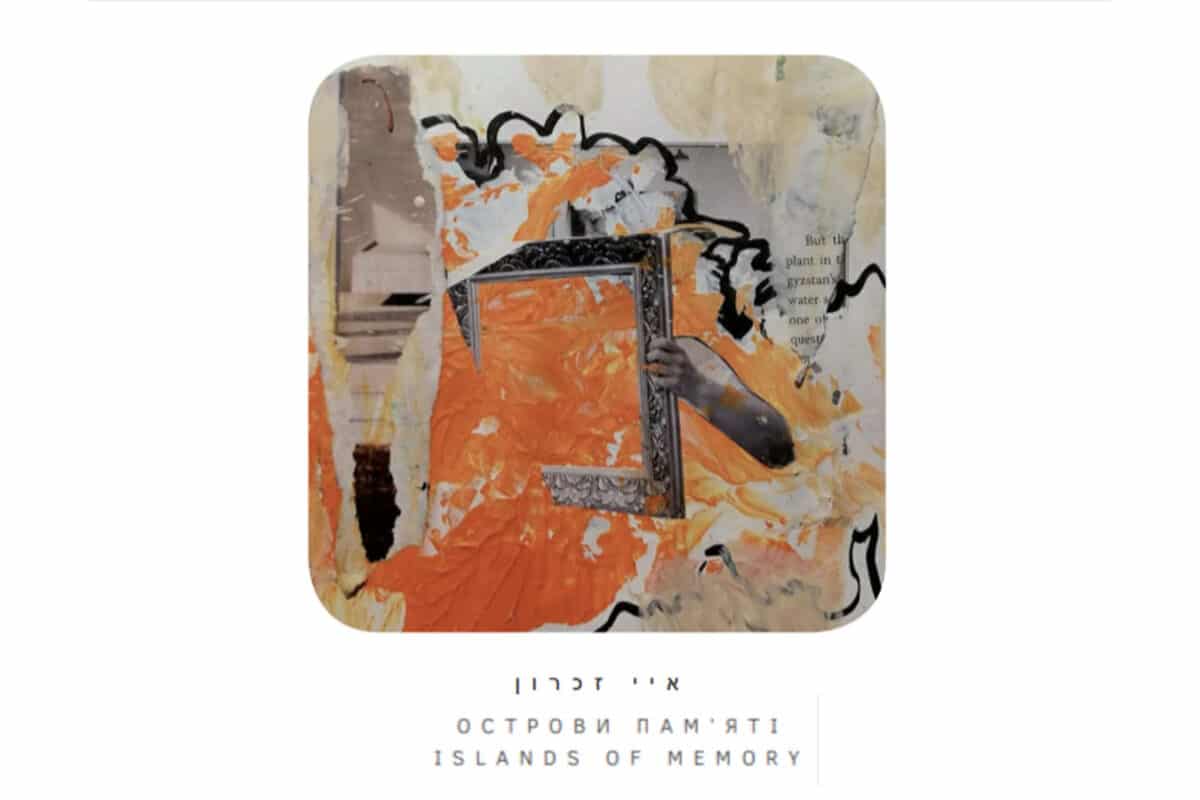
The third season of the residency, held in 2021, was pivotal. At that time, Borys Khersonsky, Diana Klochko, and Markiyan Prokhasko came to Buchach. Three authors from different generations — a doctor and poet, an art critic, a young essayist — wrote texts inspired by time, place, and silence.
The result was the book “Islands of Memory”, published in three language versions.
This project is not just a collection of essays but a living structure of memory, where each text becomes an island, and together they form an archipelago of human experience.
Borys Khersonsky: memory as breath
A psychiatrist and poet, Khersonsky writes that memory is not chronology but a way to remain human. His essays are about the silence of Buchach, where every street becomes a metaphor for the inner world. He sees the city as a living organism, pulsating with traces of prayers and conversations.
Diana Klochko: the city as text
An art critic and philosopher, Klochko speaks of Buchach in the language of architecture. For her, walls are pages, and stones are letters with which history is written. She sees the city as a manuscript inscribed with three alphabets — Cyrillic, Latin, and Hebrew, where everything — from baroque facades to old bridges — carries meaning.
Markiyan Prokhasko: a look at the present
The youngest participant in the project looks at Buchach through the eyes of an observer. His essays are a quiet diary of walks: the smell of coffee, the creak of doors, conversations at the market. Through details, he connects the past and the present day, proving that memory lives not in archives but in everyday life.
Three languages — three mirrors of memory
The main feature of the publication is its trilingualism.
Ukrainian language — as the voice of modernity.
English — as a window to the world.
Hebrew — as a return to Agnon’s roots and Jewish spirituality.
Each language reflects its own perspective, but together they create a complete picture.
Editors and translators — including Anna Nekrasova and Tatyana Nepipenko — made translations not mechanically but intonationally: so that each text sounds natural in its cultural environment.
Thus, “Islands of Memory” became not just a book but a model of how Ukraine sounds when it speaks in several languages at once.
The dialogue of cultures continues: Lviv Forum 2025
Four years later, the theme of Buchach resonated again at the 32nd Lviv Book Forum.
At the discussion “Listen, Read, Understand” Diana Klochko, together with translators Anna Nekrasova (Hebrew) and Tatyana Nepipenko (Yiddish), discussed how Ukrainian literature learns to sound alongside Hebrew and Yiddish without losing its melody.
The conversation became a natural continuation of the book — a new bridge between eras and languages.
Buchach today: a city where memory is alive
Modern Buchach is not an open-air museum but a living organism. Here, the old synagogue is being restored, cemeteries are being explored, tours and thematic festivals are held. The city learns to speak about its multinational past — without nostalgia, but with respect.
Travelers can see the Agnon monument, a bas-relief in the ART-yard, his family home, and ancient streets where time seems to have stopped. Every detail is part of a new cultural map where Ukrainians and Jews meet again.
UJE — an organization that connects stories
The project Ukrainian-Jewish Encounter (UJE) has been operating since 2008 and has already become a platform for open dialogue. Its mission is to restore mutual understanding, to show that Ukrainian and Jewish histories are not parallel lines but intertwined threads of one fabric.
Thanks to UJE, dozens of projects, exhibitions, films, and books have appeared, in which memory is not a requiem but life.
“Islands of Memory” is one of the most significant examples of this approach.
Literature as a form of healing
The book “Islands of Memory” shows that culture can heal.
It connects eras, turns silence into words, and gives a voice to those who were forgotten.
Through three languages and three authorial perspectives, it restores respect for the past and hope for the future.
There is no pathos here — there is breath.
Buchach resonates again.
And this sound is heard in Kyiv, Jerusalem, Paris, and Toronto.
Shmuel Agnon — a symbol that lives again in the Ukrainian context
His books are not only the heritage of Israel but also part of Ukrainian cultural memory.
Buchach gave the world a writer, and Ukraine — a space where this heritage can be understood anew.
Agnon reminds us that literature is a bridge by which one can return home, even after a century.
“Islands of Memory” can be read here .
Sources:
The material is based on the publication of the Ukrainian-Jewish Encounter (UJE) website — https://ukrainianjewishencounter.org/uk/ostrovi-pamyati/,
as well as a reference article Nikk.Agency — Shmuel Agnon.
