
The events in Venezuela became the first test of how far the US is willing to go in returning to the logic of “geopolitical zones.” The overthrow of Nicolás Maduro’s regime and Donald Trump’s subsequent statements about a “revived and strengthened” Monroe Doctrine (now the “Donro Doctrine”) were perceived globally not as a local operation but as a signal: Washington is once again speaking the language of hemispheres.
This is where the chain begins, linking Caracas with Kyiv, Taipei, Greenland, and — in the most vulnerable position — Israel.
Hemispheres as a Convenient Language for Great Powers
The classic Monroe Doctrine was geographically honest. It did not claim universality. The US declared: the Western Hemisphere is our security zone. Everything else is outside of it. This approach worked for decades because it was limited.
The modern version, dubbed the “Donro Doctrine,” is fundamentally different. The US no longer offers symmetry. They simply state:
America is closed to competitors.
For China and Russia, this is not a threat but an invitation. Because the language of geography is the most convenient language for authoritarian and semi-authoritarian regimes. It allows them not to discuss values, the right of peoples to choose, and international norms. It allows them to say: “This is how the map is arranged.”
What China and Russia Will Demand
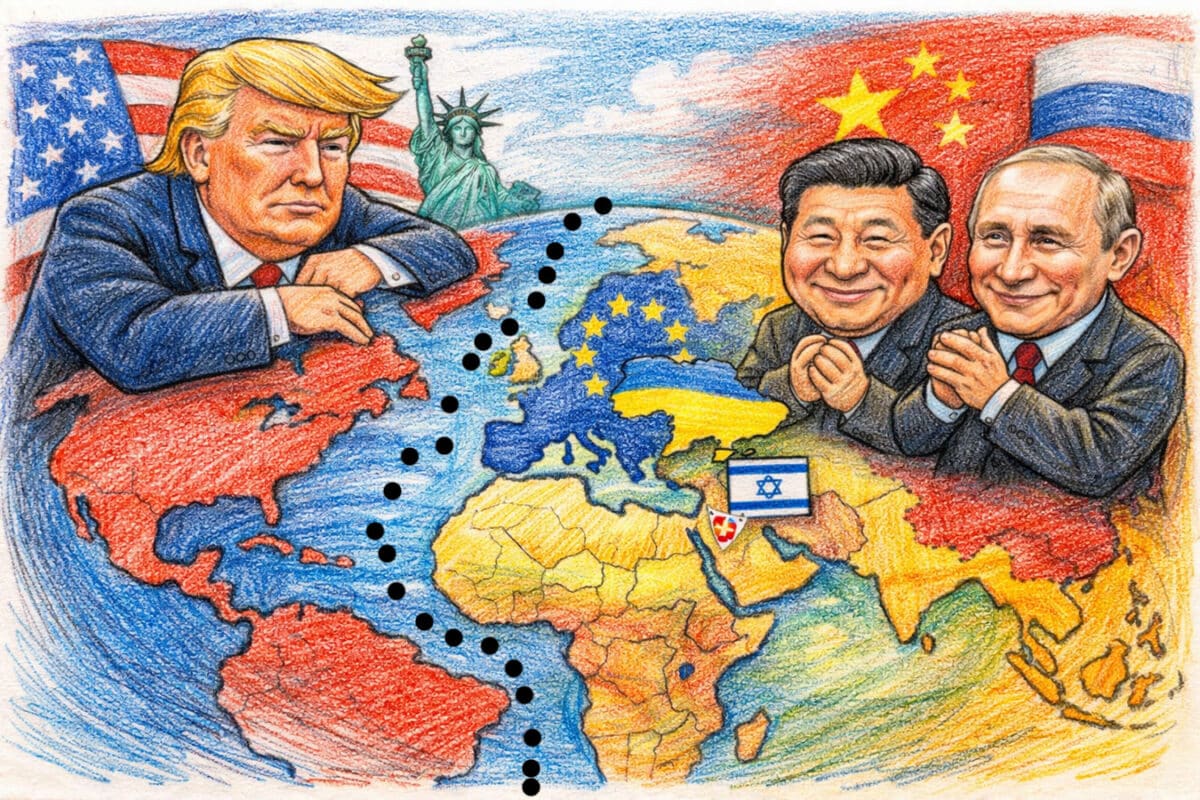
It is important to understand: neither Moscow nor Beijing will demand formal recognition of the “Eastern Hemisphere” in the form of a treaty or declaration. That is not their style.
Their strategy will be softer and more dangerous:
to impose a practice where the US stops automatically intervening in everything that happens outside the Western Hemisphere.
The formula will look something like this:
– The US ensures stability at home
– Russia and China take “responsibility” for their regions
– all disputed territories are considered in the logic of balance, not principles
More importantly: the “Eastern Hemisphere” in their presentation is not school geography and not a dispute about meridians. It is a label for all the space that does not fall under the American doctrine of “America for Americans.” That is, in fact: Europe, the Middle East, Africa, Asia — everything where the US, according to their version, should act not as a “guarantor” but as one of the players.
How will this look in reality? Not as a beautiful declaration, but as a package of conditions that will surface every time Washington wants to “close the question” somewhere quickly: from energy prices and logistics to sanctions and war.
Moscow will push this roughly and briefly: “If you fix your hemisphere, then you recognize that Russia has the right to a decisive word in its ‘near abroad’.” Then the bargaining begins: less support for Ukraine, more “stability,” freezing some supplies, lifting some restrictions, concessions in diplomatic formats. All this is not the “deal of the century,” but a series of small retreats that together turn into recognition of a zone of influence.
China will approach differently: not as military bargaining, but as bargaining for rules. It will demand not the “surrender of Taiwan” on paper, but the removal of automatism: so that any actions by Beijing in East Asia are no longer automatically considered a reason for a harsh American reaction. Simultaneously, China will push the thesis: “If the US itself has returned the world to hemispheres, then what claim is there that Asia is a zone of priority for China?”
And at this moment, the most unpleasant point appears: Israel. Because Israel is physically located where Moscow and Beijing will call the “eastern balance space.” And they will press not on the “transfer of Israel,” but on the blurring of its exclusivity: they say, this is no longer a sphere of automatic guarantees, but a region where the “interests of all major players” must be considered.
This means that the Eastern Hemisphere will gradually be presented as a space where American exclusivity does not apply.
Why Israel Automatically Falls Under This Approach
Israel is one of the few countries for which geography becomes a trap.
It:
- is located in the Eastern Hemisphere;
- is surrounded by regions that Moscow and Beijing consider a zone of “natural influence”;
- depends on external security guarantees;
- and at the same time cannot change its location.
In the logic of China and Russia, this makes Israel not a US ally, but an anomaly that exists only because the West has long refused to think in terms of zones.
As soon as the US itself returns to this logic, the anomaly turns into a question.
Israel as a “Discussable Territory”
Here the distinction is important. It is not about transferring Israel under someone’s influence. That would be too crude and would cause a direct confrontation.
It is about something else:
depriving Israel of the status of a territory that cannot be negotiated.
In practical terms, it looks like this:
- any Israeli operation is interpreted as “regional escalation”;
- any increase in pressure on Iran is presented as “destabilization”;
- the US is increasingly called upon to “restrain the ally”;
- mediators are involved in the process — Russia, China, the “global South.”
Israel formally remains an ally but ceases to be an exception.
Why Israel Cannot “Choose the Western Hemisphere”
Here arises a key metaphor that is actually literal.
Israel is not a ship.
It cannot detach from the shore and sail across the Atlantic.
It cannot geographically enter the Western Hemisphere.
Any doctrine built on geography automatically leaves Israel on the other side of the line.
This is a fundamental difference from Japan, South Korea, or Australia, which, although located in the Eastern Hemisphere, are not part of the zone of constant bargaining between great powers. Israel is.
Ukraine and Taiwan as Tests of the Scheme’s Viability
Ukraine and Taiwan in this logic are not exceptions but trial balloons.
To put it simply, Ukraine and Taiwan are two tests of the same question: is it possible in 2026 to forcibly rewrite the status of a territory and achieve that the world gets used to it. Not immediately, not officially, but de facto.
Russia will try to show: if you press long enough, the West will tire and start looking for a “rational compromise.” China will observe and draw conclusions: where is the threshold of patience for the US and Europe, how much does “stability” cost, and when do principles turn into negotiation material.
The danger is that after Venezuela, the US may start thinking like this: “We have proven that we control our hemisphere — so we can afford flexibility in foreign zones.” And here arises the ground for the most cynical scenario: concessions are not announced as concessions. They are framed as “refocus,” “realism,” “reassessment of priorities.”
In this logic, Ukraine risks becoming what is called in diplomacy a “distant road”: not because it is not important, but because it is not in the American hemisphere. And Taiwan — what China will squeeze step by step, testing where the US’s willingness to pay the price for containment ends.
For Russia, Ukraine is proof that Eastern Europe can be “returned” to the sphere of influence if the US is not ready to go all the way.
For China, Taiwan is a similar test in Asia: how far can you go if Washington is busy defending its hemisphere.
If in at least one of these cases the US demonstrates a willingness to compromise for the sake of “greater stability,” the scheme is cemented. And then the question of Israel becomes not theoretical but practical.
Greenland as a Dangerous Precedent
The story with Greenland shows that even allied obligations can be reconsidered if the territory does not fit into a rigid doctrine.
If pressure on a NATO ally is allowed for strategic control over territory, it means:
geography begins to outweigh alliances.
For Israel, this is an especially alarming signal because its geography is its most vulnerable spot.
Why Europe for Israel Is Not a Choice but a Necessity
If Israel cannot change hemispheres geographically, it can change its contour of belonging strategically.
And here Europe is not just a convenient market and not a direction “for trips.” It is the only space in the Eastern Hemisphere where security and influence are still built not only on force but also on rules, institutions, and public accountability.
Integration with Europe in this logic is not about occasionally selling technology there, signing a couple of contracts, opening new flights, and considering the task solved. It is about constant dialogue and inclusion in the European system of decisions: economic, political, legal, technological. About joint standards, regulatory alignment, long negotiations, compromises, common mechanisms of control and responsibility. The more such “nodes,” the harder it is for any external center of power to present Israel as a single variable that can be moved on the map.
That is why integration is not “we sell technology to Europe” and not “we fly there as tourists.” It is participation in European decision-making chains: joint defense and technological programs, cybersecurity and critical infrastructure standards alignment, joint regimes of financial control and sanctions circumvention, rules on data and dual-use technologies, a common language on rights and freedoms. All this seems boring until you realize that such “boring” mechanisms make a country not a single point on the map but part of a large system that is difficult to “rewrite” with one deal.
The most important thing is that it is not only about trade and security. It is about European values as a system, without which the economic link remains fragile.
The European model is based on principles that, in a world of spheres of influence, become a strategic shield: the rule of law, independence of the courts, competition and transparency of institutions, human rights, protection of minorities, freedom of speech, legitimate change of power, public investigations, and political accountability. These things often seem like “moral words” until a real alternative appears: living in a zone where norms are replaced by “expediency,” and security is bought with silence.
Because the gray zone always has a price.
If Israel is not integrated into the European contour — not by declarations, but by actual compatibility of institutions and practices — it will begin to be gently pushed towards another integration: into the Eurasian, China-oriented, or Russian-imperial logics, where manageability, loyalty, “stability,” and the right of the strong become key.
There, dissenters are usually not engaged in long negotiations and do not spend time on subtle procedures — the methods are well-known: media pressure, censorship expansion, criminal cases against the opposition, “foreign agents,” protest restrictions, fear as a management tool. This is not a question of sympathies.
It is a question of in which coordinate system the country of Israel will live if the world is finally divided into hemispheres.
That is why the European vector in this construction is not cosmetics and not a showcase. It is an attempt to ensure that Israel is not an “eastern territory with special status,” but part of a space where status is ensured by institutions, norms, and long-term interdependence — and where bargaining for the fate of allies becomes politically too expensive.
The Role of Ukraine in This Construction
Ukraine is the eastern border of Europe.
Israel is the southern.
Both countries are located where great powers try to draw lines.
Both resist the logic of “someone’s zone.”
Both pay the price for it.
In a world of hemispheres, it is precisely such countries that determine whether the new order will be stable or explosive.
Final Conclusion
The “Donro Doctrine” is not about the US.
It is about the fact that geography becomes an argument again.
China and Russia will not demand Israel.
They will demand recognition of the Eastern Hemisphere as a space without American exclusivity.
Israel cannot sail across the ocean.
But it can choose whether it will be a gray zone or part of a sustainable contour of power.
Today, that contour remains Europe.
That is why for Israel, the question of the geopolitical vector ceases to be foreign policy and becomes a question of survival in a world that is once again being drawn on the map.
NAnews — Israel News | Nikk.Agency
Question–Answer
What is the Monroe Doctrine?
It is a 19th-century American idea: the Western Hemisphere (North and South America) is a zone where external powers should not meddle. In its classic form, it is about geography and “red lines,” not about universal rules for the whole world.
Why does the “Donro Doctrine” change the logic of alliances?
Because it sounds like an updated priority: “we close our hemisphere to competitors.” And then everything outside this zone automatically looks like a territory where the US can negotiate, reduce involvement, or seek compromises for the sake of a “big deal.”
Where does the “Eastern Hemisphere” pass in a political sense?
Not according to a geography textbook and not along a single straight line. In a political sense, it is all the space outside the American “closed backyard”: Europe, the Middle East, Africa, Asia — what Moscow and Beijing will call a zone of balance, where there is no automatic American exclusivity.
Why is Israel vulnerable precisely because of geography?
Because Israel is physically located in the Eastern Hemisphere and cannot “sail” under the Western doctrine. In a world where zones of influence are being drawn again, geography turns Israel into a point of pressure: its status begins not to be canceled but discussed — and that is already dangerous.
Why is Europe the only way out of the gray zone?
Because “exit” can be achieved not by sea, but by institutions: economy, political formats, standards, norms, and values. The more tightly Israel is integrated into the European contour of decisions and rules, the harder it is to present it as a single regional bargaining object — and the higher the price for those who want to rewrite its status under the “eastern” logic.
