
On January 23, 2026, the Federation of Jewish Communities of Ukraine reported on the continuation of systematic assistance to Ukrainian military personnel from the Shostka Jewish community. This is not a one-time action, but a continuous, structured effort that continues regardless of the news agenda and weather conditions.
Shostka Jewish Community
Shostka Jewish Community continuously meets the needs of Ukrainian servicemen. In response to increased requests from the front, volunteers organized the sewing of warm mittens — one of the most in-demand items during the winter period.
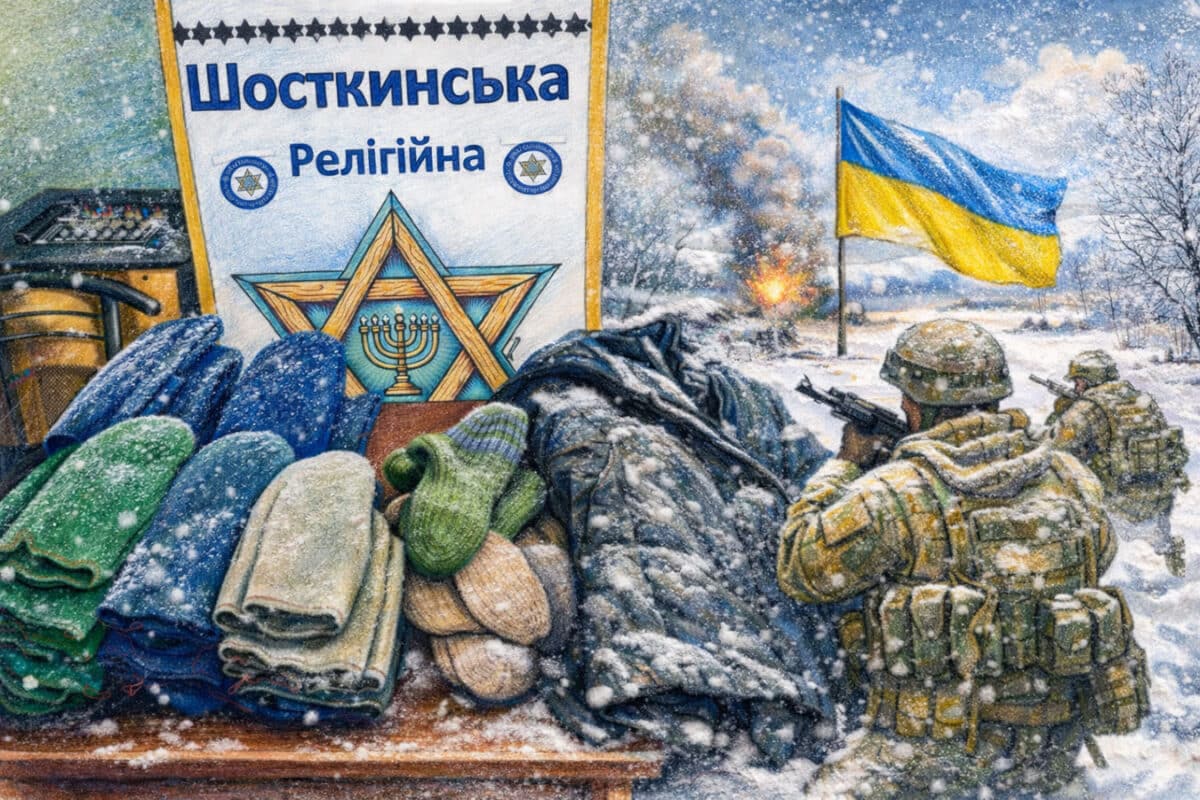
This time, the military received warm mittens, socks, disposable fire starters, and other necessary items. In freezing conditions, Ukrainian fighters perform tasks outdoors, often without the opportunity to warm up, making such assistance critically important.
All items are handmade. Materials and items are brought by community members and city residents. The work is carried out without loud statements — as part of everyday responsibility to those on the front line.
Under the Federation’s publication, users left dozens of words of support. The comments are short but telling: gratitude to the craftswomen, wishes for strength and health, a simple human “thank you.” This reflects society’s attitude towards such initiatives — without pomp, but with an understanding of their real value.
What NAnovosti has already written about the community’s assistance
Support for the Ukrainian army from the Shostka Jewish community is not a new story. Previously, NAnovosti has already detailed other initiatives of this community that complement the current volunteer work.
Assistance to the Sheikh Mansur Chechen Battalion
Previously, the Shostka Jewish community provided humanitarian aid to the Sheikh Mansur Battalion — a Chechen volunteer unit within the Armed Forces of Ukraine, which performs combat tasks in some of the most challenging areas of the front.
The aid included tactical and household items: stretchers, protective gloves, paracord bracelets, neck pillows, as well as other items needed in the field. This transfer emphasized that the community does not differentiate defenders by origin or units — assistance is provided to those fighting for Ukraine.
Systematic assistance to the Armed Forces as a constant practice
Separately, NAnovosti previously noted that assistance to the Armed Forces of Ukraine from the region’s Jewish communities is sustainable. It involves not only warm clothes or humanitarian kits but also regular coordination, resource collection, volunteer participation, and support for fighters at various stages of service.
This activity is not built around individual news events but as a continuous process. That is why new messages from the Federation appear as a logical continuation of an already known line of work, rather than an exception to it.
Communities as part of the country’s defense
The story of the Shostka Jewish community is an example of how local communities in Ukraine have become part of the overall system of resistance and support for the army. Without political slogans, but with concrete actions: sewing, collecting, transferring, helping where it is truly needed.
This work remains largely unnoticed by the general audience, but it is precisely what forms a stable rear — at the level of cities, communities, and specific people. And it is such stories of consistent, unpretentious solidarity that NAnovosti — News of Israel | Nikk.Agency continues to document.
Reference: What is Shostka and where is it located
Shostka is a city in northern Ukraine, in the Sumy region, the administrative center of the Shostka district. It is located about 45 kilometers from the Russian border, which directly affected its security and daily life after 2022.
As of the pre-war period, the population of Shostka was about 70,000 people. The city developed as an industrial center back in the 18th century and was long known primarily for its chemical production. During the Soviet period, Shostka was one of the key industrial cities in the region, with developed infrastructure, large enterprises, and a scientific and technical base.
Historically, Shostka developed as a working city. At different times, Ukrainians, Jews, Russians, and representatives of other nationalities lived here. Before World War II, there was a significant Jewish community in the city, which, like in many cities in northeastern Ukraine, suffered heavy losses during the Nazi occupation. After the war, Jewish life in Shostka did not disappear completely but became less visible and more intimate.
After the collapse of the USSR, the city experienced economic difficulties associated with the decline of industry but retained its status as an important regional center. With the start of Russia’s war against Ukraine in 2014, and especially after the full-scale invasion in 2022, Shostka found itself in a zone of constant threat due to its proximity to the border. The city was regularly subjected to shelling and drone attacks while continuing to live and function.
The Jewish community of Shostka today is small in number but active and structured. It unites local residents and volunteers, engages in humanitarian activities, and supports social and charitable initiatives. After the start of the full-scale war, the community, like many others in Ukraine, became involved in helping the army and the rear, becoming part of a broad volunteer network.
It is important to consider the context: this is a city that itself lives under conditions of increased risk and instability. That is why the participation of the Shostka Jewish community in supporting Ukrainian military personnel is seen not as a symbolic gesture, but as a conscious action by people who are inside the war, not observing it from afar.
