
A Polish court has deemed the extradition of Russian archaeologist Alexander Butyagin to Ukraine permissible. Full story: Myrmekion, excavations in annexed Crimea, Article 298 of the Criminal Code of Ukraine, damage exceeding 200 million UAH, the debate over sanctions, and why this case is significant far beyond archaeology.
The story of Alexander Butyagin is already being reduced to a convenient formula: “a scientist is being persecuted for science.” But if you trace the entire chain from the beginning, a completely different picture emerges. Before 2014, the Russian archaeologist worked in Ukrainian Crimea under one legal framework, after 2014 — under another. It is precisely on this rupture that both the Ukrainian accusation and the Polish extradition procedure are built today, as well as the broader debate about whether it is possible to continue excavating, publishing findings, and pretending that politics has nothing to do with it under occupation.
On March 18, 2026, the Warsaw District Court deemed the extradition of Russian archaeologist Alexander Butyagin to Ukraine legally permissible. This does not mean immediate transfer: the defense has already announced an appeal, and after the court decision comes into force, the final decision on the Polish procedure is made by the Minister of Justice. But the meaning of the step itself is already clear: the Polish court did not see insurmountable obstacles to extradition at this stage.
Butyagin is not a random figure. He is an employee of the Russian State Hermitage Museum, head of the sector of ancient archaeology of the Northern Black Sea region, and since 1999 has led the Myrmekion archaeological expedition in Kerch. The settlement of Myrmekion itself is an ancient Greek colony founded in the first half of the 6th century BC, one of the significant archaeological sites of eastern Crimea.
Myrmekion (Greek Μυρμήκιον) — founded by Ionian Greeks in the mid-6th century BC on the shore of the Kerch Strait, an ancient city that was part of the Bosporan Kingdom. It was located east of Panticapaeum (modern Quarantine Cape within Kerch). It is a cultural heritage monument of Ukraine of national significance (protection No. 010015-N).The area of the settlement is over 6 hectares.
What exactly happened and why this case did not start in Poland
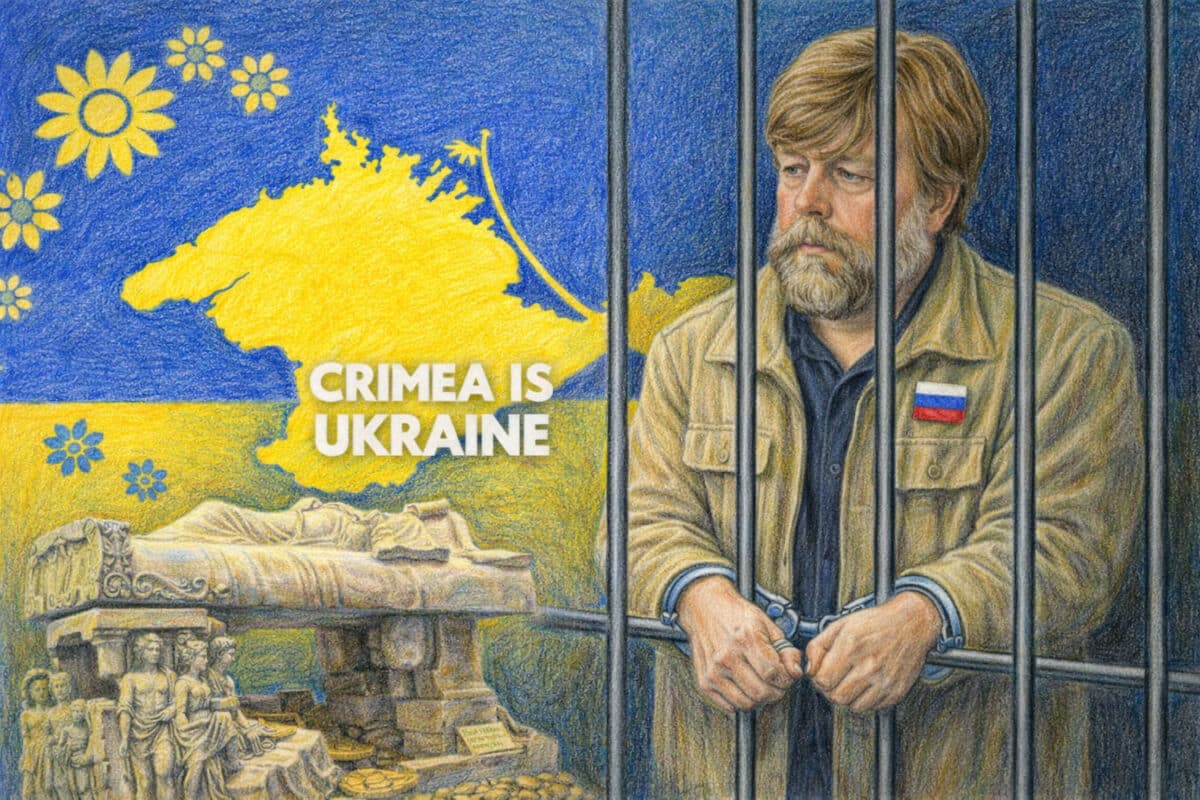
Butyagin’s story did not begin with his arrest in Warsaw, but with excavations in Crimea. And here it is important to immediately remove the confusion often used in polemics. The fact that he is a Russian archaeologist and an employee of the Hermitage did not automatically make his work in Crimea illegal until 2014. Ukrainian legislation allowed archaeological research with Ukrainian permits and an “open sheet,” and Butyagin himself claimed in interviews that before the annexation, permits for the expedition were obtained in Kyiv through the museum’s management. So, at the starting point, it was not about a “self-willed outsider,” but about a Russian expedition operating within the Ukrainian legal framework.
After the annexation of Crimea in 2014, this logic broke down.
For Russia, the peninsula became “its territory,” for Ukraine, the EU, and international organizations — an occupied Ukrainian territory. Excavations continued, but Ukrainian permits were no longer available. This is where the main legal knot of the case arose: not in the mere fact that a Russian archaeologist works in Crimea, but in the fact that after 2014, according to Kyiv, he continued to do so without the consent of the state, which international law continues to consider the sovereign of the peninsula.
Ukrainian law enforcement officials informed Butyagin of suspicion in absentia in 2024. According to materials cited by human rights and media sources, he is accused of illegal work at the archaeological heritage site Myrmekion and partial damage to the monument. The Ukrainian side estimates the damage at more than 200 million UAH. In November 2024, he was put on the wanted list, and then the case reached the international level.
In early December 2025, Butyagin was detained in Poland while traveling through Warsaw during a European lecture tour; different publications mention the date December 4, and the detention was widely reported publicly on December 11. Ukraine officially sent an extradition request on December 23. On January 13, the Polish prosecutor’s office supported the Ukrainian position, in January the court extended his detention, and on March 3, the arrest was extended until June 1. On March 18, the court deemed the extradition permissible.
This entire path is important: it is not a one-time political statement, but an already formalized European procedure.
A separate episode that amplified the case in the public space is related to a 2022 discovery. According to Ukrainian sources cited by human rights activists, Butyagin’s expedition discovered 30 gold coins, 26 of which bore the name of Alexander the Great, and 4 from the time of Philip III Arrhidaeus. For the Russian museum and archaeological community, this was presented as a major scientific discovery. For Kyiv, it was yet another proof that excavations are being conducted on occupied territory and valuable artifacts are being removed outside the Ukrainian permit regime.
Under which articles he is accused and what is wrong with the formula “up to 10 years”
According to publicly available materials that can now be verified, Butyagin is charged in Ukraine under part 4 of Article 298 of the Criminal Code of Ukraine. This provision is related to illegal actions concerning cultural heritage objects if they are committed with the aim of searching for movable items of archaeological origin. The current public version of the article specifies a punishment of 2 to 5 years of imprisonment with a possible prohibition on holding certain positions or engaging in certain activities.
If you break down the provision a bit more precisely, Article 298 is structured as follows: part 1 concerns illegal archaeological and other earthworks at an archaeological heritage site; parts 2 and 3 — intentional destruction, damage, or harm to cultural heritage objects, including monuments of national significance; and part 4 increases responsibility if actions under parts 2 or 3 were committed specifically for the purpose of searching for movable items from archaeological heritage. This construction explains why Butyagin’s case is presented not as a dispute over paperwork, but as a criminal plot about damaging the object and searching for artifacts.
At the same time, some publications indeed featured the formula that Butyagin faces “up to 10 years.”
Such a figure appeared in some early media retellings and Russian publications. But later, both Polish prosecutorial spokesman Piotr Skiba and Ukrainian human rights sources spoke specifically about the risk of up to five years, which coincides with the open text of part 4 of Article 298 of the Criminal Code of Ukraine.
The same applies to the word “plundering.” In journalism, it sounds strong, but legally it is more accurate to write this way: Ukraine accuses Butyagin of illegal excavations, damage to the monument, and illegal handling of finds discovered during these works. Reuters in December 2025 wrote about Ukrainian accusations of unauthorized excavation and plundering historical artifacts.
There is also another important nuance.
The Russian side and some of Butyagin’s colleagues insist that the finds were not taken from Crimea to St. Petersburg but remained on the balance of the Eastern Crimean Museum-Reserve. This does not negate the Ukrainian accusation because for Kyiv the problem begins earlier — already in the very fact of excavations on occupied territory without its permission. But as a defense argument, this thesis will clearly continue to be used.
It is at this point that it becomes clear why the plot ceased to be narrowly specialized. For NAnovosti — News of Israel | Nikk.Agency, the importance here is not only the fate of one scientist but the precedent itself: Europe is showing for the first time so specifically that cultural heritage in Crimea is not a “gray area outside politics,” but part of the big question of sovereignty, occupation, and future responsibility.
Why this case is more than the case of one archaeologist
The most convenient version for Moscow is the formula “a scientist is being persecuted for science.” It is emotional and therefore catchy. But from the perspective of the international framework, the problem looks different. The EU in 2025 officially extended restrictive measures related to the illegal annexation of Crimea, directly calling it illegal annexation. And UNESCO’s recommendation on international principles of archaeological excavations speaks even more harshly: a state occupying the territory of another state must refrain from conducting archaeological excavations on occupied territory.
This does not mean that Butyagin’s guilt has already been proven on the merits. But it directly follows another: the thesis “we were just doing science” does not automatically remove the legal problem. If the territory is considered occupied, archaeology there ceases to be just science. It becomes an action within the regime of control over someone else’s heritage, and sometimes — an instrument of its reformation. That is why Butyagin’s case is so painful for the museum and academic community: it undermines the familiar formula “we are outside politics.”
And here the important question we have already discussed arises: how could a Russian archaeologist even dig in Ukrainian Crimea?
The answer shows where the boundary between the old and new reality lies. Before 2014, he could work there within the framework of Ukrainian law. After 2014 — no longer, if there was no permission from Kyiv. Therefore, the criminal conflict did not begin with Butyagin’s biography itself and not with his nationality, but with the continuation of work under occupation conditions.
If the appeal in Poland does not change the situation, the case will move further along the Polish extradition procedure to the Minister of Justice. If extradition fails for some reason, some human rights lawyers allow for another scenario: transferring materials to the Polish side for possible prosecution already in Poland. This is not yet the main path and not a decision made, but as a legal option, it is being discussed.
A small man within a large occupation — but this does not negate responsibility
On a personal level, Butyagin may not look like the architect of war or an official of the occupation administration, but as a narrow specialist who has been engaged in one monument for many years. There is human drama in this. He indeed excavated Myrmekion for decades, lived with this object, and, judging by his own explanations, considered continuing work after 2014 “necessary and right” in relation to the monument itself. That is why the case is so easily sold to the public as a story about a “small man” caught in the gears of geopolitics.
But here lies an unpleasant boundary.
Occupation is sustained not only by generals, tanks, and flags. It is also sustained by people who make it everyday: administrators, museum workers, teachers, restorers, archaeologists. Not all of them are equal in the scale of guilt. Not all of them are the main ones.
But this does not mean that they do not bear responsibility. If a person continues to work on occupied territory as if international law has already been abolished, they sooner or later face the fact that the legal bill still comes. This framework is confirmed by both the EU’s position on Crimea and UNESCO’s norm on excavations on occupied territory.
Therefore, the most accurate formula here is probably this. Yes, Butyagin is not the main figure of the Russian occupation of Crimea. Yes, on a human level, he may be a “small man” within a large state machine. But the illegality of the occupation itself does not disappear because of this. And those who continued to work there after 2014 should have understood: the immunity of the word “science” is not eternal. This is perhaps the main meaning of the whole story.
That is why Ukraine, in general principle, looks stronger here.
Not because any Russian scientist is automatically guilty, but because you cannot first seize territory, then declare it yours, and then conduct excavations, formalize findings, and say that it is just academic routine. But now it is important for Kyiv not to fall into propaganda and to bring the case purely legally: with proven episodes, a clear causal link, and a careful procedural basis. Only then will Butyagin’s story become a real international precedent, not just a loud headline for a few days.
Why the argument “what about the Golan?” does not save Butyagin
One of the most predictable comments under such an article will sound like this: if Russian excavations in Crimea are a violation, then why are “Israeli works on the Golan supposedly permissible”? It is better to answer this question honestly, not with a slogan.
According to the UN and EU position, the Golan Heights are not recognized as Israeli territory: the UN Security Council in resolution 497 declared the extension of Israeli law to the Golan “null and void,” and UN structures in 2025–2026 continue to use the formula occupied Syrian Golan. The EU also explicitly states that it does not recognize Israeli sovereignty over the Golan. Meanwhile, the US has recognized the Golan as part of Israel since 2019.
That is, the status of the Golan in international politics is disputed, not “closed once and for all.”
But this does not mean that Crimea and the Golan are the same case. On Crimea, the EU’s position is much stricter and more unequivocal: Brussels directly calls it illegally annexed by Russia Ukrainian territory and for this reason extends a separate sanctions regime. There is no Western recognition of Russian sovereignty over Crimea (even Iran has not recognized it). Therefore, in the European legal logic, Butyagin falls not into a “gray zone of disputed territory,” but into a case about activities on territory that Europe continues to consider Ukrainian and illegally annexed by Russia.
There is also another difference that proponents of such a comparison usually prefer to remain silent about.
Israel’s control over the Golan arose after the 1967 war and has been discussed for decades within the framework of the security of northern Israel, Syrian shelling, and subsequent international negotiations. Before 1967, Syrian artillery and sniper fire was conducted from the heights on Israeli areas below, and during the war itself, Syria continued shelling northern Israeli villages. This does not make the international legal dispute over the Golan disappear, but it shows: the historical context here is different. Crimea “joined” Russia not through a security negotiation framework, but through the 2014 annexation, which the EU officially qualifies as a violation of international law.
That is why the argument “whose then are the Golan?” is weak for Butyagin’s case.
Even if someone considers Israeli actions on the Golan legal, and someone does not, this does not automatically make Russian excavations in Crimea legal. International law does not work on the principle “if it is disputed in one place, then it is allowed in another.” For this article, a strong formula is this: the question of the Golan does not cancel the question of Crimea, but only shows that territorial disputes differ in origin, international support, and legal consequences. And in the case of Crimea, the European position today is much more straightforward and strict than Butyagin’s defenders try to present.
