
While Russia continues to bombard Ukrainian cities, archivists work underground daily to save and document Jewish history — page by page, name by name. According to former chairman of the Jewish Agency Natan Sharansky, who is now the chairman of the Babi Yar Holocaust Memorial Center (BYHMC), writes on December 30, 2025, JNS, the work of digitizing millions of Jewish documents related to Babi Yar has turned into a race against time.
There is another front line that is less talked about — the fight for memory
The war in Ukraine is destroying cities, infrastructure, and lives. But there is another front line that is less talked about — the fight for memory. For documents, paper, names. For what is easily destroyed and impossible to restore. This is exactly what Natan Sharansky talks about, describing the work to save Jewish archives related to Babi Yar.
“If we lose these documents, we lose centuries of Jewish life. Preserving them is not just a matter of the past. It’s a question of whether memory will survive at all.”
It concerns more than 20 million archival units — birth, marriage, court records, community lists, private and official documents reflecting the life of Jews in the territory of modern Ukraine over the centuries. According to Sharansky, nine million of them have already been digitized — and this happened not in peacetime.
“There are more than 20 million documents. We have already digitized nine million — during the war, under fire.”
Archives as part of the war for freedom
For Sharansky, this project is not an isolated humanitarian initiative. He directly links it to what Ukraine is experiencing today.
“This is a war for freedom. Ukraine is fighting for its existence.”
He emphasizes that the work on the archives is inseparable from the country’s struggle for survival. The war threatens not only the present but also the right to its own history. Documents — especially paper ones — are vulnerable: they do not survive fires, collapses, floods, long power outages.
“These documents are at the last stage of their existence. If we don’t save them now, they will be lost forever.”
Why this is important for the entire Jewish world
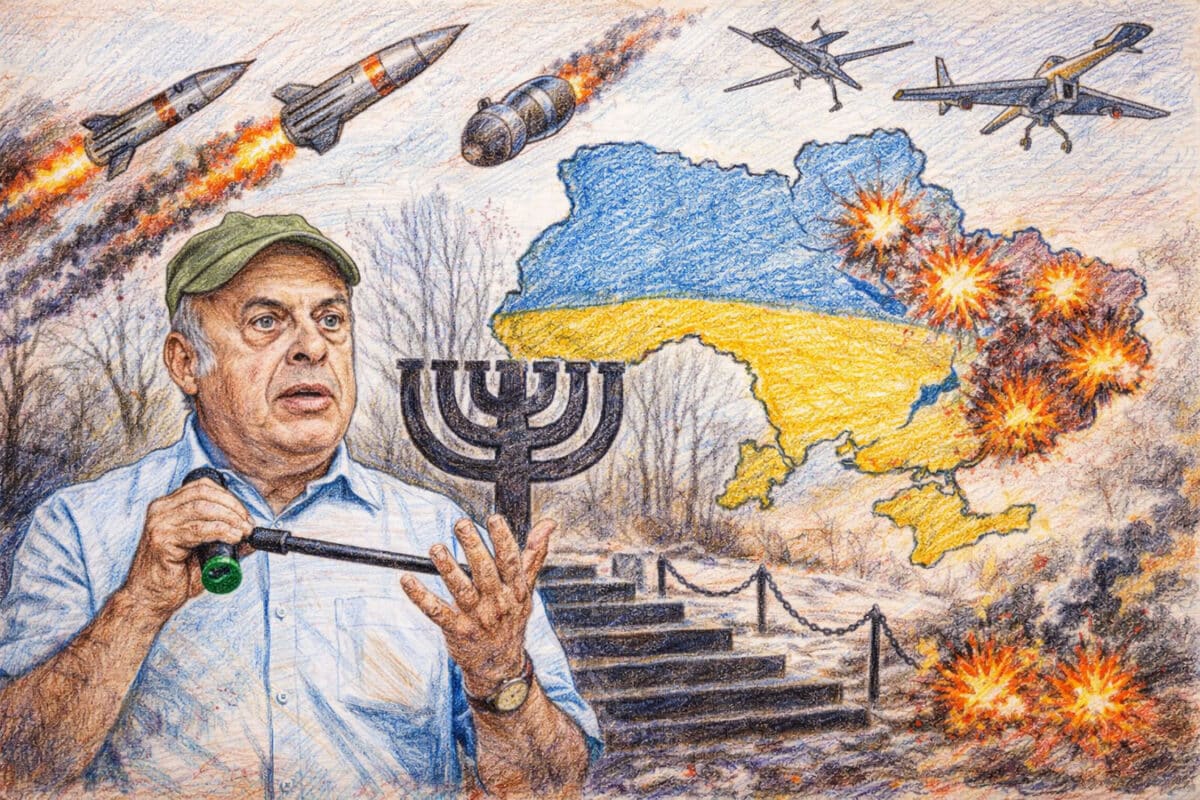
Sharansky places special emphasis on the fact that the archives of Ukraine are not a local story.
“Most Ashkenazi Jews have roots in Ukraine. This belongs to all of them.”
After the project is completed, the archive will become a global resource, allowing people around the world to restore family lines, sometimes broken due to the Holocaust, repression, and Soviet policies of silence.
“After the archive is completed, it will allow Jews around the world to trace family histories that go back centuries.”
Babi Yar and Soviet erasure of memory
Sharansky consistently returns to the topic of Babi Yar not only as a place of mass murder but also as a symbol of the deliberate destruction of memory after the war.
“After the war, the Soviet Union did not commemorate Babi Yar. It tried to erase it from memory.”
According to him, Soviet policy deliberately removed the Jewish context of the tragedy.
“They wanted to turn it into a dump, then a stadium, then a park. Not a word about Jews. Not a word about the Holocaust.”
Only after gaining independence did Ukraine have the opportunity to truly rethink this place.
“One of the first realizations of independent Ukraine was that the destruction of Babi Yar was a crime of the Soviet Union.”
From memorial to digital rescue
In 2016, Sharansky was invited to lead an international initiative to create a memorial at Babi Yar. At that time, he was the head of the Jewish Agency and later became the chairman of the project’s advisory board.
Before the full-scale Russian invasion on February 24, 2022, significant results were achieved: the first synagogue in history was built on the territory of Babi Yar, and a memorial field with the names of the victims was created. The war halted construction work — but gave impetus to another direction.
From the destruction grew an archival project implemented with the participation of the Babyn Yar Holocaust Memorial Center and with the support of the Ukrainian state.
Work underground and without electricity
The conditions in which digitization is carried out are far from academic.
“In Kharkiv, they sometimes work for two hours a day because there is no electricity. Some archives are already damaged.”
Archivists continue to work in shelters, often underground, literally saving history page by page.
The cost of the project in wartime conditions has risen to three million dollars, half of the amount has already been raised.
“Every $100,000 opens access to a new city.”
“We are racing against time.”
Memory as a form of resistance
While the shelling of Ukrainian cities continues, this work remains quiet, almost invisible. But it is precisely this work that records what cannot be restored after destruction.
The archives of Babi Yar today are not just the past. They are a tool against the distortion of history, against oblivion, against attempts to once again deprive victims of names and faces. In this sense, preserving documents becomes part of a broader struggle — for the right to remember and call things by their names.
This is why this story is important for Israel, Ukraine, and the entire Jewish world. Because memory, unlike concrete, is not protected by armor. It needs to be saved manually.
NAnews — News of Israel | Nikk.Agency
Conclusions
The history of Jewish archives in Ukraine is not an abstract heritage of a “foreign country” and not a matter of academic interest. For a huge number of modern Israelis, these documents are the root of family memory. Regardless of whether they vote for the right or the left, whether they are religious or secular, immigrants or sabras — their ancestors are recorded in these archives.
Political disagreements within Israel do not negate one fact: the state of Israel was created as a response to the destruction of Jewish history and Jewish life. Its mission is not only the protection of borders but also the preservation of the memory of the people, wherever that memory may be.
The archives of Babi Yar and other Ukrainian cities are as much a part of Israeli history as they are of Ukraine’s. Their rescue is not an act of goodwill or a foreign policy gesture, but fulfilling one’s own historical duty.
In a situation where Ukraine is fighting for its existence, neutrality turns into a form of loss — loss of history, loss of moral position, loss of the future. Helping Ukraine is not “taking sides,” but refusing to sit on the fence when the memory of the Jewish people is under threat.
This is why the issue of the Babi Yar archives is not only a Ukrainian and not only a Jewish issue. It is a question of why Israel exists — and whether it is ready to defend its history not in words, but in deeds.
