
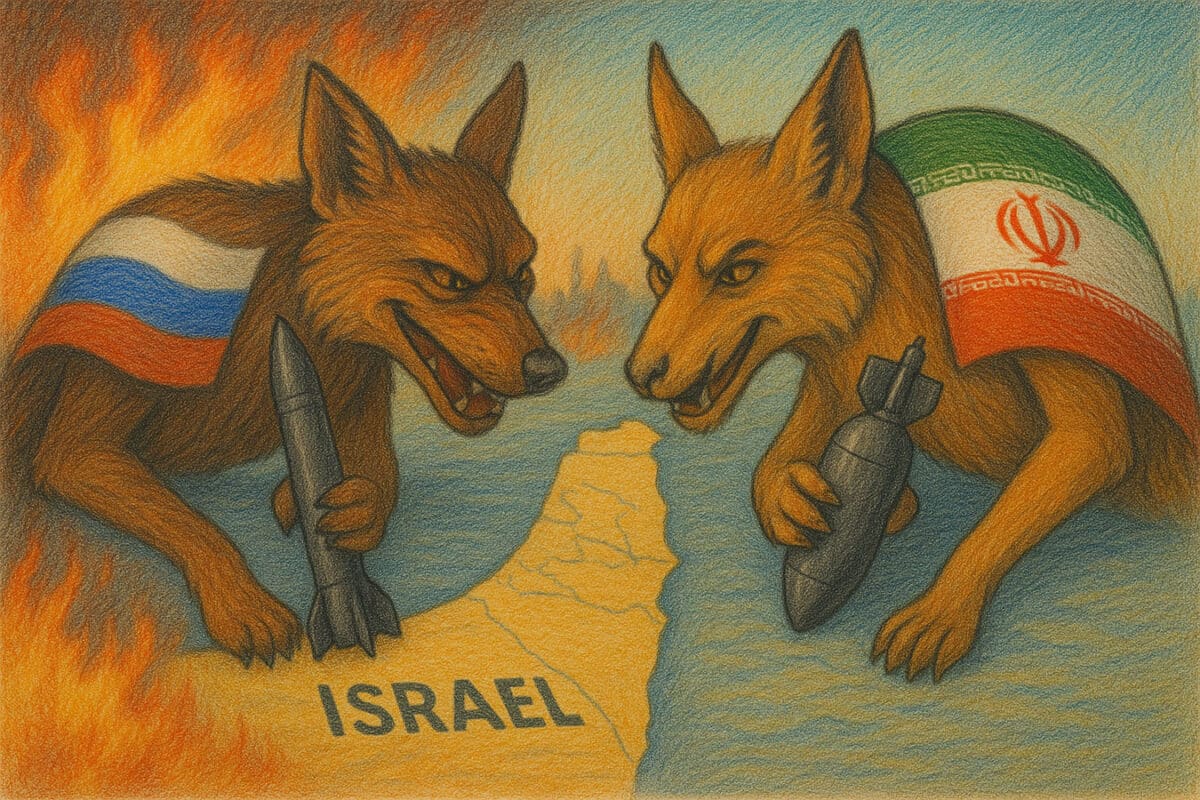
The war between Russia and Ukraine has long ceased to be a regional conflict. It affects not only Europe but also directly impacts the security of the Middle East. For Israel, this conflict has become a factor of real threat — primarily because Iran systematically studies, adopts, and adapts Russian combat experience for a possible future confrontation with the Jewish state.
This is precisely what the Israeli publication Maariv warns about on December 13, 2025, in an analytical column by David Ben Bast. The author’s key message is crystal clear: in a global world, there are no “distant” wars, and the lessons of Ukraine are already in the hands of Israel’s enemies.
“The war in Ukraine is a reminder that in a global world, there are no remote conflicts. Israel must quickly learn the necessary lessons from it because that is exactly what our enemies are already doing.”
The Weakening of Russia as a Factor in Increasing the Iranian Threat
One of the central theses of the Maariv article is the paradox of the current stage of the war. Russia has significantly weakened both economically and militarily, yet this weakening does not reduce the threat to Israel; on the contrary, it indirectly increases it.
Moscow, focused on the Ukrainian front, is becoming increasingly dependent on eastern partners, primarily Iran. This dependence, according to the author, opens dangerous opportunities for Tehran.
“The war in Ukraine has weakened Russia economically and militarily. This dependence provides Iran with a dangerous space for action.”
This is not just about diplomatic support. Iran gains access to real combat experience of modern warfare: tactics of using drones, electronic warfare systems, decentralized troop management, and adaptation to prolonged high-intensity conflicts. This experience is already being considered in the formation of Iranian military doctrines and is being transferred to structures controlled by Tehran, including Hezbollah.
Syria: The Disappearance of the Deterrent Factor
A separate alarming section of the article is devoted to Syria. For many years, the Russian military presence in this country played the role of a kind of stabilizer, limiting the scale of Iranian activity and arms supplies to Hezbollah.
Today, this situation has changed.
“Russia, bogged down in the war, is no longer able to invest resources in its presence in Syria and turns a blind eye to Iranian activity, which poses a direct threat to Israel.”
The weakening of the Russian role means more freedom of action for Iran on Israel’s northern borders and the disappearance of one of the external factors that previously restrained escalation.
The Spread of Weapons: A New Scale of an Old Threat
Maariv emphasizes another dangerous aspect of the war — the large-scale spread of modern weapons. The Ukrainian front has become a zone of concentration of the latest systems, which inevitably begin to leak onto illegal markets.
“One of the most alarming aspects of the war is the scale of modern weapons entering the battlefield.”
This includes anti-tank systems, strike drones, night vision devices, and high-tech combat equipment. Western intelligence services are already warning: some of this weaponry is leaving the Ukrainian theater of military operations and may end up in the Middle East.
The author draws a direct historical parallel with Yugoslavia and Libya, emphasizing that the current scale of weapons leakage is incomparably larger. Combined with the study of Russian tactics, this increases the likelihood that Israel’s future adversaries will not only be better armed but also much better prepared.
Ukraine as a “Living Laboratory of Modern Warfare”
The article emphasizes that Israel is closely monitoring the course of hostilities. Ukraine has become a unique “living laboratory” where the technologies and concepts of war of the world’s leading powers are being tested in real-time.
“The IDF closely monitors the results of the war, the tactics developing in Ukraine, the mass use of drones, and electronic warfare.”
The author’s conclusion is unequivocal: everything that has proven effective in Ukraine will sooner or later be used against Israel. That is why the Israeli army views this conflict not as an external plot but as a model for future wars.
The War for Consciousness and the Complex Diplomatic Balance
Maariv also pays attention to the non-military dimension of the conflict. The war in Ukraine is also a large-scale information campaign. Ukraine is conducting an international struggle for public opinion with unprecedented effectiveness.
Israel, meanwhile, is forced to balance between the need to maintain freedom of action in Syria and maintain relations with the West. Such caution, the author emphasizes, is perceived in some European countries as problematic ambiguity and increases diplomatic pressure on Jerusalem.
Internal Israeli Rift
A separate place in the article is occupied by the social aspect. About 1.2 million Russian-speaking citizens live in Israel — immigrants from Ukraine, Russia, and other former Soviet Union countries. The war has exposed a deep emotional rift within this community.
Many immigrants from Ukraine have lost families, homes, and their past lives. At the same time, Israelis of Russian origin often feel pressure and accusations for policies they are not related to. This conflict manifests in the media, on social networks, and even in family conversations.
However, the author also notes the reverse process — solidarity, volunteering, and active assistance to new immigrants. Since 2022, thousands of specialists in technology, medicine, engineering, and science have arrived in Israel, creating not only a challenge but also a serious opportunity for the country.
Main Conclusion: Israel Cannot Afford Delay
The conclusion of the Maariv article sounds like a strategic warning. Reality requires Israel to quickly invest in cybersecurity, drone defense, electronic warfare, real-time intelligence, and multi-domain warfare.
“This reality requires a rapid update of the concept of warfare because what has proven effective in Ukraine will inevitably come to us.”
The war in Ukraine reminds us of a fundamental truth of the global world: there are no truly distant conflicts anymore. A missile strike on Kyiv echoes in Haifa and Ashdod. Every change in relations between Moscow and Tehran affects the freedom of action of the Israeli Air Force. Every new wave of immigration changes the social and cultural landscape of Israeli society. For immigrants from the former Soviet Union, this war becomes a personal trial, affecting their identity, families, and childhood memories. For Israel, it is a test of national resilience, diplomatic flexibility, and the ability to adapt to the future, not the past.
The Danger of Analytical Neutrality
One fundamental feature of the analysis presented in Maariv deserves special attention. The author deliberately avoids assessing the moral side of the war in Ukraine. The text does not indicate which side is waging a just war, nor does it name the aggressor. This approach can be explained by the desire to maintain analytical distance and focus solely on the consequences of the conflict for Israel.
However, such neutrality carries serious risks. The refusal to clearly define responsibility blurs cause-and-effect relationships and turns the war from a specific act of aggression into an abstract “clash of sides.” As a result, the understanding of why the conflict arose in the first place, who initiated it, and what political goals it pursues is lost.
For Israel, this approach is especially dangerous. In a world where authoritarian regimes increasingly use war as a tool of foreign policy, the absence of clear formulations plays into the hands of those who benefit from chaos. When aggression is not called aggression, its methods are more easily adopted, and its consequences are justified or normalized. This creates a favorable environment for the spread of precisely those military practices that then appear at Israel’s borders — through Iran, its allies, and structures under its control.
That is why the lessons of the war in Ukraine are important not only in the military and technological dimensions but also in the political one. Understanding who and why initiates such conflicts is directly related to the ability to resist them in the future. For Israel, this means that strategic thinking cannot be limited to analyzing tactics and armaments — it must include a clear understanding of the nature of threats and sources of aggression.
This is precisely what NANews — News of Israel | Nikk.Agency is talking about today: events in Ukraine are already shaping Israeli security, diplomacy, and society, and ignoring this fact means consciously losing strategic initiative.
