
Turkey did not “declare” Al-Aqsa its property, but Hakan Fidan included it among the “shrines affecting the values of the Turkish people.” A joint statement by 14 states went much further, declaring all 144 dunams of the Temple Mount “a place of worship exclusively for Muslims.”
On August 5, 2026, a special ministerial meeting on Jerusalem and its Islamic and Christian holy sites was held in Amman at the invitation of Jordan. It was organized by the Jordanian Ministry of Foreign Affairs, and the meeting was opened by the head of the department, Ayman Safadi. Representatives from ten countries of the Arab Ministerial Committee — Jordan, Tunisia, Algeria, Iraq, Qatar, Saudi Arabia, Somalia, the State of “Palestine,” Egypt, and Morocco — the Secretary-General of the Arab League, as well as representatives from Turkey, Indonesia, Pakistan, and Malaysia gathered in Amman. In total, 14 states were represented in the final document. The purpose of the meeting was declared to develop a common position and coordinate actions in response to events in Jerusalem and on the Temple Mount.
Not “Turkish Al-Aqsa,” but a new front for the Temple Mount: what Amman decided and why Israel responded
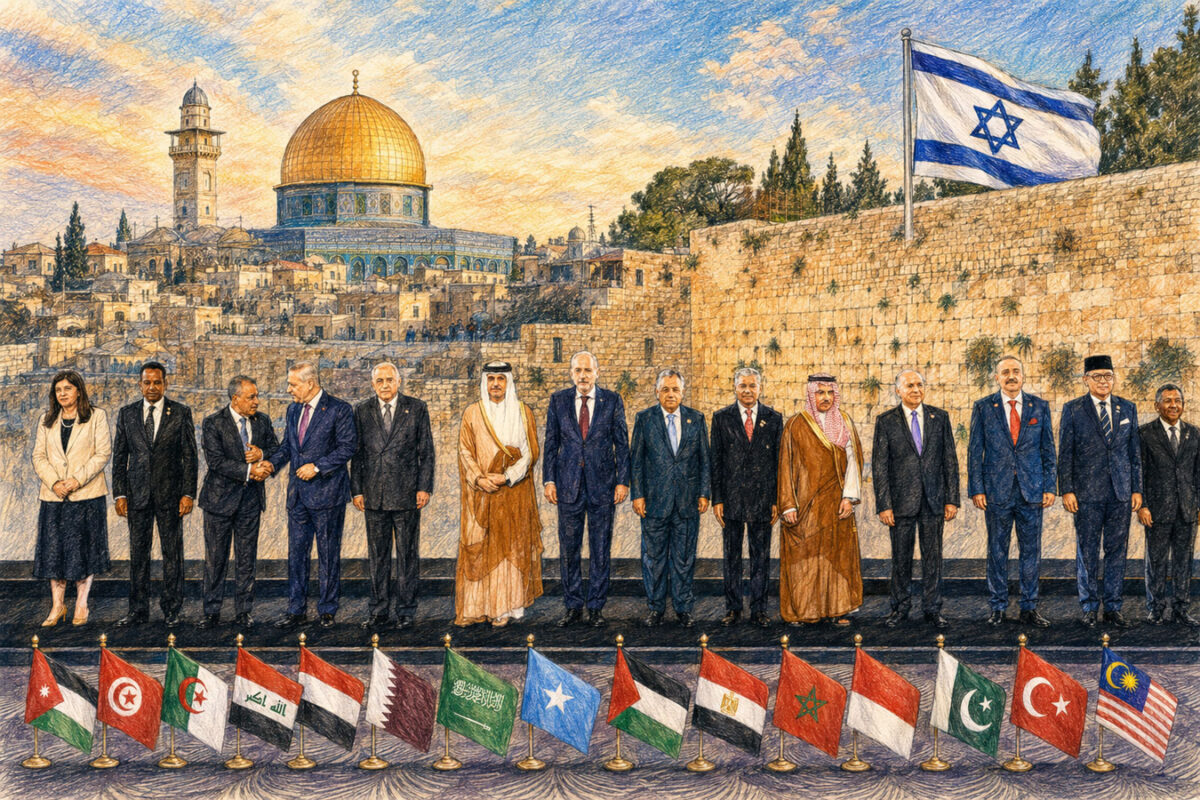
Turkish Foreign Minister Hakan Fidan did not declare the Al-Aqsa Mosque Turkish property, did not claim territorial rights to the Temple Mount, and did not announce replacing Jordan as the custodian of Jerusalem’s Muslim holy sites.
However, his words after the ministerial meeting in Amman cannot be considered a mere diplomatic gesture.
Fidan stated that President Recep Tayyip Erdoğan, the Turkish government, the state, and society perceive Al-Aqsa as “one of our holy places.” Any encroachment on it, according to him, Ankara considers an encroachment on the values of the Turkish people. At the same time, the minister confirmed Jordan’s historical and legal role regarding Jerusalem’s holy sites.
The legal status of the complex did not change after these words. However, the political meaning of the statement is clear: Turkey presents the events on the Temple Mount not only as a foreign policy or pan-Islamic issue but also as a matter directly affecting the Turkish state and society.
What is confirmed and what remains only a statement
At the time of verification, the official website of the Turkish Ministry of Foreign Affairs published a message about Fidan’s participation in the meeting on August 5, 2026, but there is no full transcript of his press conference. The exact wording of “our shrine” is provided by the state Turkish agency Anadolu, whose correspondent asked the minister a question after the meeting. Therefore, Fidan’s words are confirmed by video material and the agency’s publication, but not by a separate official transcript of the Turkish ministry.
Fidan reported that “almost 20 Islamic countries” discussed practical, diplomatic, and other collective measures. The official final statement, published by the Jordanian state agency Petra, lists 14 states and the Secretary-General of the Arab League. How the Turkish minister arrived at the figure “almost 20” is not explained in the available message.
The official list names Jordan, Tunisia, Algeria, Iraq, Qatar, Saudi Arabia, Somalia, the State of “Palestine,” Egypt, Morocco, Indonesia, Pakistan, Turkey, and Malaysia. This was not a session of all the countries of the Organization of Islamic Cooperation but an Arab-Islamic ministerial meeting convened by Jordan.
This distinction is important. The formula “almost 20 countries” creates the impression of a broader coalition, whereas the signatories of the published document were representatives of 14 states.
Which phrase became the main reason for Israel’s response
The harshest statement did not come personally from Fidan. It is contained in the fourth point of the joint document.
The participants of the meeting declared Al-Aqsa — by this name, they mean the entire upper platform of the complex covering 144 dunams, or 14.4 hectares — a place of worship exclusively for Muslims. The Jordanian Waqf is named as the only legitimate body with exclusive competence to manage all affairs of the complex and regulate entry.
It was against this formula that the Israeli Ministry of Foreign Affairs spoke out.
The Israeli side stated that the document is based on false accusations and a distortion of history. In Jerusalem, the situation where Israel is accused of violating freedom of religion while simultaneously declaring the entire Temple Mount a place of worship only for Muslims and completely ignoring the Jewish people’s connection to Jerusalem and its holy places was called a particular manifestation of cynicism. The Ministry confirmed its official commitment to freedom of religion, public safety, and maintaining the status quo.
Here the dispute goes far beyond the question of who can pray where.
The Temple Mount is the holiest site in Judaism and the location of the First and Second Temples. To call its entire territory exclusively a Muslim place of worship can be seen as a description of the current order of prayer. But in combination with statements about the exclusively Arab-Islamic identity of Jerusalem, this formula is perceived by Israel as a denial of Jewish history.
What was the immediate reason for the meeting
The meeting in Amman followed the events of July 23, 2026, when Jews observed Tisha B’Av — a day of mourning for the destroyed temples.
Thousands of Jewish visitors, including National Security Minister Itamar Ben-Gvir, ascended the Temple Mount. He appeared with a prayer book, welcomed Jewish prayer on the mount, and declared significant progress, as Jews pray there and feel like masters of the place.
Jordan regarded what happened as a violation of the historical status quo. It is not only about Ben-Gvir’s visit: non-Muslim visits are allowed and occur regularly. The main subject of dispute was open prayer, prostrations, the use of religious texts, and the Israeli minister’s statements about a de facto change in the situation on the mount.
According to the traditional official interpretation of the status quo, Muslims can pray on the upper complex’s territory, while non-Muslims can visit it during designated hours but not conduct religious rites there. The complex is under the religious administration of the Jordan-linked Waqf, while Israel controls security and access.
The Israel-Jordan peace treaty of 1994 provides for freedom of access to places of religious and historical significance and affirms Israel’s respect for Jordan’s special role regarding Jerusalem’s Muslim holy sites. The treaty does not transfer sovereignty over East Jerusalem to Jordan and does not define the entire Temple Mount as an object historically belonging to only one religion.
Contradiction within the Israeli position
Israel’s historical argument is strong: it is impossible to seriously discuss the Temple Mount while ignoring the two Jewish temples and the central significance of this place for Judaism.
But the political position of the Israeli government seems less convincing.
On the one hand, the Ministry of Foreign Affairs declares the status quo unchanged. On the other hand, the minister responsible for the police openly prays on the mount, welcomes the prayer of other Jews, and presents what is happening as a historical achievement. The police, meanwhile, allow actions that could have been stopped in previous years.
It is this contradiction that allows Jordan and other meeting participants to claim that the status quo is changing without a formal government decision: not through a new law or international agreement, but through a gradual change in police and visitor behavior.
According to NANews — News of Israel, it is necessary to simultaneously recognize two realities here.
Arab and Islamic states indeed use the protection of the prayer order to promote a political formula that excludes the Jewish historical identity of the Temple Mount. But Ben-Gvir’s actions provide them with factual material to claim that Israel itself is moving away from the previous order.
Denying one of these sides makes the analysis incomplete.
What measures were approved by the 14 states
The joint document consists of 15 points. It does not provide for a military operation, severance of diplomatic relations with Israel, or immediate collective sanctions.
The participants decided to:
- create a permanent institutional mechanism and a separate media platform to document and disseminate reports on Israel’s actions;
- bring the collected materials to the platforms of international organizations;
- seek a reaction from the UN Security Council and other international structures;
- support Jordanian custodianship and the work of the Waqf;
- oppose the opening or relocation of diplomatic missions to Jerusalem;
- hold a joint meeting of the Arab League and the Organization of Islamic Cooperation during the high-level week of the UN General Assembly in September 2026.
Thus, the main practical result of the meeting so far is the preparation of a permanent international information-diplomatic campaign.
This is more important than a one-time harsh speech. The states intend not just to issue statements after another visit by Ben-Gvir but to create a mechanism that will systematically collect materials, form a common terminology, and disseminate it through the UN, international organizations, and the media.
What “steps in the coming days” did Fidan promise
After the meeting on Jerusalem, Fidan also participated in a separate session of the group of Turkey, Egypt, Saudi Arabia, and Pakistan.
This quartet discussed Gaza, the implementation of the peace plan, Israel’s behavior within this process, and the broader regional security system. It is in connection with the decisions of this group that Fidan said that proposals would be submitted to the heads of states, after which specific steps could follow in the coming days.
There is no basis in the available source to assert that the promised steps relate exclusively to Al-Aqsa or represent a separate Turkish threat to Israel over the Temple Mount.
These are two related but different lines of negotiation:
- collective measures of 14 states on Jerusalem and the holy sites are already described in the published statement;
- additional decisions of the quartet primarily concern Gaza, the peace plan, and the overall regional situation.
Mixing these two meetings creates a sensation but distorts the content of the negotiations.
Did Turkey declare Al-Aqsa part of its heritage
In the available quote, Fidan did not use the formula “historical heritage of Turkey.” He also did not say “from now on” and did not announce a change in the international status of the shrine.
The exact formula is different:
“Turkey perceives Al-Aqsa as ‘one of our holy places,’ and any encroachment on it is seen as an attack on the values of the Turkish people.”
The difference is significant.
“Turkish historical heritage” could sound like a claim to a special right based on the Ottoman past. “One of our holy places” is a political and religious declaration of solidarity that does not create a legal title.
But the formula itself still expands Ankara’s claims to the role of one of the main defenders of Jerusalem.
Turkey recognizes Jordanian custodianship and simultaneously declares that the protection of Al-Aqsa relates to Turkey’s national values. This allows Erdoğan to enter the Jerusalem agenda without starting an open dispute with the King of Jordan over the formal role of custodian.
This is an editorial conclusion of NANews, based on the simultaneous confirmation by Fidan of Jordan’s role and the inclusion of Al-Aqsa in the system of Turkish national values.
What UNESCO really says about Jerusalem
The claim that UNESCO recognized the Temple Mount, Al-Aqsa, and the Western Wall exclusively as “Palestinian heritage” is incorrect.
The “Old City of Jerusalem and its Walls” is listed as a World Heritage site. The application was submitted by Jordan, the site was included in the main list in 1981, and in 1982 it was added to the list of heritage in danger. During the discussion of inclusion, it was specifically emphasized that it should not be considered as registering political or sovereign claims of any state.
UNESCO’s official description calls Jerusalem a holy city of Judaism, Christianity, and Islam. It separately mentions the Dome of the Rock, the Western Wall, and the Church of the Holy Sepulchre.
In 2016, the Director-General of UNESCO explicitly stated that Al-Aqsa and Al-Haram ash-Sharif are simultaneously the Temple Mount — Har Ha-Bayit, and the Western Wall represents a Jewish shrine.
This does not mean that Israel has no claims against UNESCO. The organization’s decisions use terminology about occupied East Jerusalem, and Israel has repeatedly accused it of politicizing heritage and preferring Arab-Islamic names.
But UNESCO’s formal position is more complex than the thesis of “Palestinian ownership” of the entire complex. The organization recognizes the significance of the Old City and its shrines for three religions while using an international legal position on East Jerusalem, which Israel rejects.
Not only Al-Aqsa: the struggle is for the description of all Jewish heritage
The statement of the meeting in Amman cannot be considered an isolated diplomatic episode. It is part of a broader struggle for the right to determine who owns the history of Jerusalem, Judea, and Samaria and what words this history will be described with in international documents, digital archives, museums, and UNESCO materials.
In July 2026, NANews conducted a detailed study of a memorandum between the Russian state archaeological center and the Ministry of Tourism and Antiquities of the Palestinian Authority. As part of this project, Russia helps create digital models of monuments that Moscow and Ramallah present as “Palestinian cultural heritage” and simultaneously include in the program for documenting objects of Africa and the Islamic world.
Among the first named objects were Solomon’s Pools near Bethlehem and the associated ancient water supply system of Jerusalem. The lower aqueduct was built during the Second Temple period, most likely in the Hasmonean era, and delivered water directly to the Temple Mount. Later, the system was used and rebuilt by the Romans, Byzantines, Muslim rulers, and Ottomans, but its ancient Jewish layer and connection to the temple Jerusalem do not disappear.
The problem with the Russian project is not in the digital recording of monuments itself. Three-dimensional shooting can indeed help preserve them. But along with the digital model, an official name of the object, its historical description, periodization, bibliography, information about cultural affiliation, and indication of the territory to which it is assigned are created.
Whoever forms such a database gets the opportunity to determine whether the ancient aqueduct will be presented as part of the infrastructure of Jewish Jerusalem of the Second Temple period or only as a “Palestinian monument” from the archive of the Islamic world. A detailed analysis of this project was published separately by NANews:
https://nikk.agency/evrejskoe-nasledie/
The mechanism used at the meeting in Amman has a similar nature, although it involves different participants and different tools.
Fourteen states did not gain physical control over the Temple Mount. But they fixed a certain description of the complex in a joint document: all 144 dunams were declared a place of worship exclusively for Muslims, and its identity was presented primarily as Arab-Islamic. At the same time, the participants agreed to create a permanent media platform that will disseminate this terminology through international organizations and global media.
In the Russian-Palestinian archaeological project, the struggle is conducted through digital models, catalogs, and metadata. In Amman — through a diplomatic statement, the UN, the Arab League, the Organization of Islamic Cooperation, and a future media platform.
There is no evidence that these projects are parts of a single coordinated plan. But they demonstrate the same political pattern: modern administrative control or diplomatic majority is used to form a historical description of monuments that arose long before the emergence of modern “Palestinian” statehood and the Islamic world.
This does not mean that it is necessary to deny the Islamic, Christian, Roman, Byzantine, or Ottoman pages of the region’s history. Jerusalem and its surrounding territories have a multi-layered heritage.
But recognizing later historical periods does not require erasing earlier ones.
If the water system was built in the Second Temple period for Jewish Jerusalem, it cannot be honestly presented solely as the heritage of the Islamic world. If the Temple Mount is the main holy site of Judaism, the current ban on Jewish prayer cannot be turned into proof of the absence of a Jewish historical connection to this place.
According to NANews — News of Israel, this is where one of the main lines of the current confrontation lies. The dispute is not only about access to ancient stones and not only about the right to pray. It is about the official language with which these places will be described for future generations.
If Israel does not create its own quality archives, does not publish historical documents in different languages, and does not participate in the formation of international terminology, the vacated space is occupied by other states and organizations.
And then the politically chosen description begins to be perceived as an established historical fact.
The meeting in Amman demonstrates the same mechanism at a higher diplomatic level.
First, a formula is fixed in a joint document about the entire territory of 144 dunams as an exclusively Muslim place of worship. Then a permanent media platform is created, which should disseminate precisely this system of definitions through international organizations and global media.
This is not proof of the existence of a single secret plan. This is an openly published strategy of political communication.
For the Israeli reader, it is important to understand: the dispute is not only about whether the police will allow an individual to pray on the mount. It is about what terminology will become standard in documents, media, educational materials, and international organizations.
For the Ukrainian audience, the mechanism is also recognizable. The political struggle for territory and heritage often begins with a struggle for words: who is named the indigenous people, who is credited with creating the monument, which state is indicated in the catalog, and whose historical connection is brought to the forefront.
This does not mean that the Israeli and Ukrainian situations are identical. But in both cases, the terminology of international documents can influence the public perception of history over time.
What now needs to be checked
After the meeting, five specific questions remain.
First — will the promised permanent mechanism really be created and who will finance its media platform.
Second — what documents will be prepared for the joint meeting of the Arab League and the Organization of Islamic Cooperation in September 2026.
Third — what exactly will be the decisions of the separate quartet of Turkey, Egypt, Saudi Arabia, and Pakistan presented to the heads of countries and will they relate to Al-Aqsa or only to Gaza and the peace plan.
Fourth — will the Israeli government confirm the status quo not only with a statement from the Ministry of Foreign Affairs but also with practical instructions to the police on the Temple Mount.
Fifth — will future international documents include direct recognition of the Jewish connection to the Temple Mount or will the formula remain mentioning only its Arab-Islamic identity.
It is the answers to these questions that will show whether the meeting in Amman was a one-time demonstration of unity or the beginning of a long-term coordinated campaign.
Output NANews
Turkey did not declare Al-Aqsa its property and did not receive new legal powers in Jerusalem.
Fidan did something else: he included the protection of Al-Aqsa in Turkey’s system of national values, thereby increasing the political cost of any new escalation on the Temple Mount.
But the main event was not his speech.
Fourteen states signed a document in which all 144 dunams of the complex are named as a place of worship exclusively for Muslims, and then agreed to create a permanent mechanism of international and media pressure on Israel.
Israel reasonably objects to the erasure of Jewish history on the Temple Mount. At the same time, Ben-Gvir’s demonstrative prayer and the gradual change in police practice complicate Israel’s own claims of the complete invariability of the status quo.
Therefore, the real conflict does not look like a dispute between Turkey and Israel over ownership of Al-Aqsa.
It is a struggle for three things at once: the order of prayer, political control, and the historical description of one of the world’s most sensitive places.
How the material was prepared
NANews compared:
- the official 15-point statement of the meeting published by Jordan’s state agency Petra;
- the message from Turkey’s Ministry of Foreign Affairs about Hakan Fidan’s participation;
- the Anadolu publication with Fidan’s responses after the meeting;
- the statement from Israel’s Ministry of Foreign Affairs on official Russian and English platforms;
- the Reuters report on the events of July 23;
- the text of the 1994 Israel-Jordan peace treaty;
- official documents and the description of the UNESCO World Heritage site;
- previous NANews materials on the politicization of archaeological and religious heritage.
The editorial team does not have its own interview with the meeting participants or its own photos or videos from Amman. The material is an author’s documentary analysis of open primary sources, not a report from the scene.