
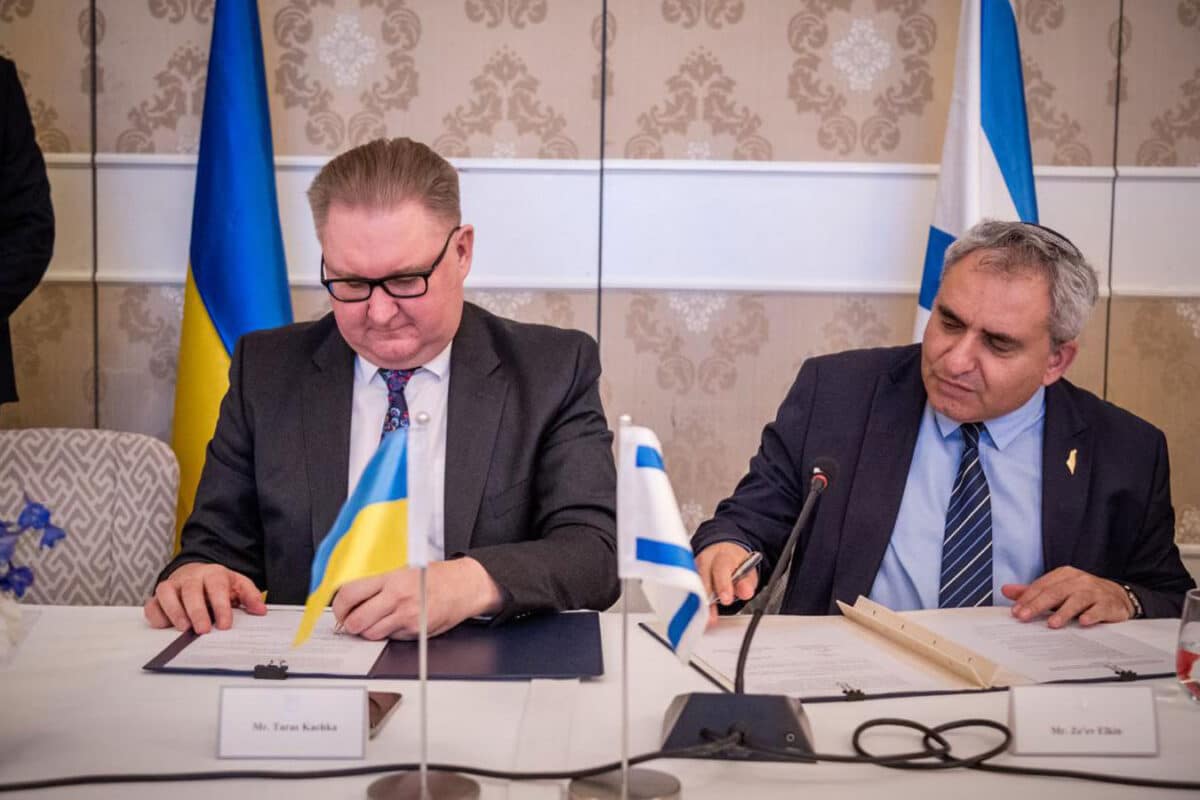
In Jerusalem, for the first time since February 2022, a meeting of the Intergovernmental Commission on Trade and Economic Cooperation between Ukraine and Israel took place. Date — December 4, 2025, the meeting itself — the 13th session of the commission, format — in-person, composition — high-level. The Ukrainian delegation was headed by Deputy Prime Minister for European and Euro-Atlantic Integration Taras Kachka. The Israeli side was represented by Minister in the Ministry of Finance Ze’ev Elkin. The event is simultaneously political, economic, and symbolic: the negotiation track, which was effectively frozen by the war, is working again.
As a result of the meeting, the parties signed a Protocol outlining the priorities for further bilateral cooperation.
Context: what happened before
The last session of the commission before the full-scale invasion took place back in 2021. After February 24, 2022, any economic formats involving Israel and Ukraine existed only fragmentarily — humanitarian programs, targeted projects, trade coordination. A full-scale platform where systemic issues are discussed — markets, standards, supplies, digitalization, energy — was absent for almost three years.
And that is why today’s meeting in Jerusalem marks a turning point: both sides demonstrate readiness to expand cooperation, even if the war continues.
How the meeting went
According to the Cabinet of Ministers of Ukraine, the Office of the Deputy Prime Minister, and the Embassy of Israel in Ukraine, the meeting in Jerusalem focused on practical topics: trade, investments, the agricultural sector, energy, healthcare, digital services, emergency medicine, cybersecurity, veteran rehabilitation.
For Israel, this is also a platform for discussing the country’s future role in post-war reconstruction of Ukraine, as confirmed by the official embassy statement: Israel’s participation in reconstruction was discussed as one of the key tracks.
Main quotes
Taras Kachka framed it as follows:
“The development of bilateral relations in wartime conditions is a demonstration of our resilience. Trade is recovering. It is now important to increase dynamics and invest in cooperation in the agricultural sector and high technologies. Ukraine and Israel continue to build trust. This meeting is an important stage in strengthening mutually beneficial partnership.”
The tone of the statement is pragmatic: the war does not cancel economic ties; on the contrary, it makes them more necessary.
What was specifically agreed upon
As a result of the commission, the parties agreed on five directions:
Resumption of dialogue on veterinary and phytosanitary standards.
This is critical for Ukrainian exports — from grains to dairy products. Without agreed standards, trade always depends on individual permits.Strengthening cooperation in energy resilience and cybersecurity.
Against the backdrop of attacks on Ukrainian energy and growing threats in the Middle East, the exchange of technologies and response methods is reaching a new level.Continuation of partnership in emergency medicine, psychological support, and rehabilitation.
Israeli specialists have one of the strongest global experiences in dealing with trauma and rapid response systems. Ukraine gains access to expert programs and exchange of doctors.New track: digital government services in extreme conditions.
This refers to scenarios where services must operate even with complete communication disruption. Israel has its developments, Ukraine has the experience of “Diia”. Joint protocols and pilots are possible here.Development of rehabilitation and social integration formats for veterans.
This is a systemic topic — from prosthetics to employment. Israel has gone through a similar path for decades and is ready to share models.
Who exactly was present
The participation was extensive. In addition to ministers:
Yevhen Korniychuk, Ambassador of Ukraine to Israel;
Iryna Mudra, Deputy Head of the Office of the President;
Member of Parliament Olha Vasylevska-Smahliuk, co-chair of the friendship group with Israel;
representatives of relevant ministries of both countries;
experts in trade, energy, digital services, medicine, and agricultural policy.
So it was not a formal meeting “for show”, but a working session with the participation of those who make practical decisions.
What Israeli media are writing
The Israeli publication Vesty separately emphasized that within the framework of the commission, post-war reconstruction of Ukraine and Israel’s role in infrastructure and technological projects were discussed. The information coincides with the theses of the Ukrainian side and complements the picture: it is not only about current interaction but also about a strategic horizon after victory.
Why this meeting is important now
Market recovery.
Trade between the countries fell after the start of the war, but in 2024–2025 it began to grow again. Without official coordination mechanisms, recovery is always fragmented.Israel’s turn to a more active role.
The embassy’s statement is a diplomatic signal: Israel sees itself as part of Ukraine’s future reconstruction.Strengthening technological cooperation.
Digital services, cybersecurity, medical technologies, agricultural innovations — points of intersection of interests of both states.Rehabilitation and medicine.
For Ukraine, this is one of the most painful issues during the war. For Israel — a field of expertise.Regional context.
Israel operates under complex security conditions, Ukraine — under full-scale war conditions. The exchange of experience here is not a diplomatic formality, but a real need.
What’s next
The parties agreed to hold the 14th session of the commission in Kyiv. The date will be announced separately, but the very fact of moving the platform to Ukraine means that the format will continue regularly.
Conclusion
After almost a three-year break, the economic dialogue between Ukraine and Israel has returned to working mode. The meeting in Jerusalem provided not just a political signal, but specific technical agreements — from agricultural standards to digital resilience. The next step is Kyiv, where cooperation should move into the project phase. For the Ukrainian economy, agricultural sector, medicine, and digitalization, this is a window of opportunity that no longer looks postponed “until the end of the war”. It has opened now.
In this context, materials published by NANews — News of Israel | Nikk.Agency become part of a broader conversation about the geopolitics and economy of the region.
