
Ukrainian diplomat and expert of the Ilko Kucheriv Democratic Initiatives Foundation Volodymyr Lakomov in a column for “Literary Ukraine” proposes a controversial but understandable thesis: the colonial experience of Eastern Europe cannot be described only in the language of “classical” modern empires.
At the center of his argument is the idea of “reverse colonialism”: a model in which the colonizer historically appeared less developed in institutional and cultural terms than the colonized territories.
“Reverse colonialism”: Ukraine as a mirror of the colonizer
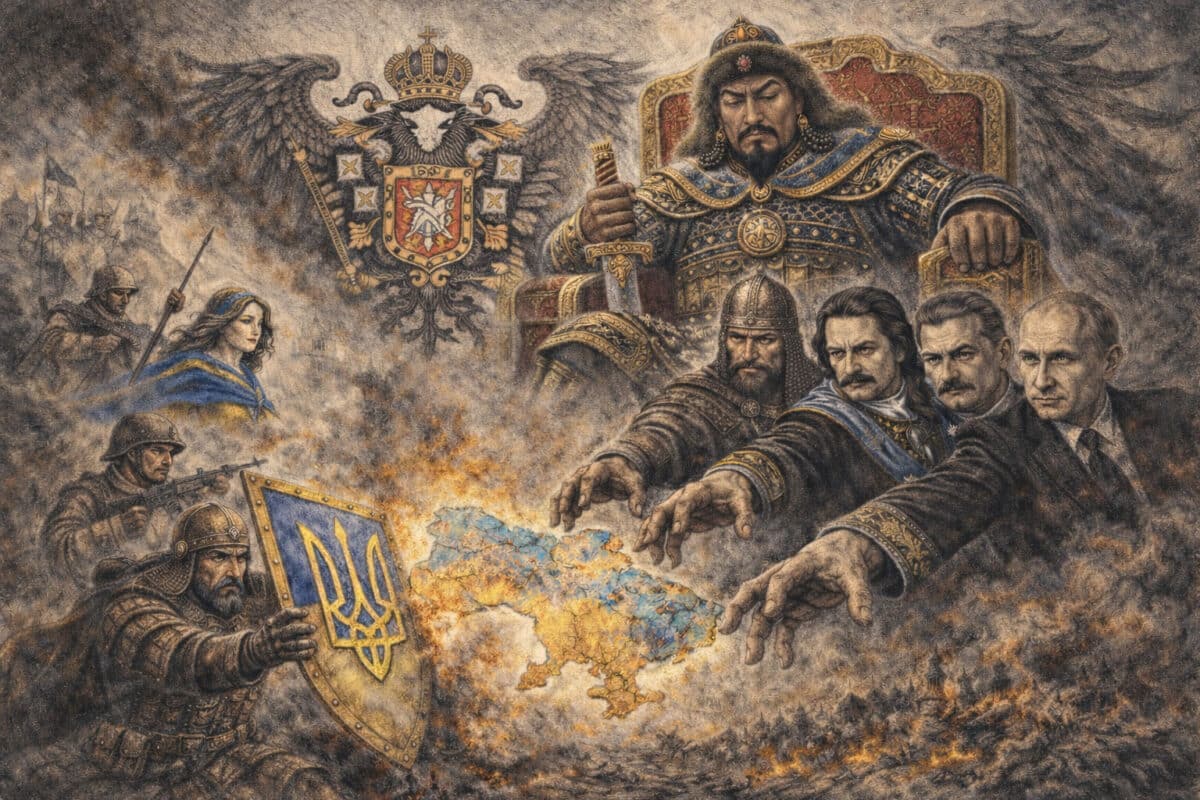
Not a periphery, but a source of modernity
In Lakomov’s text, Ukraine (like the Baltic countries, Poland, Finland) is described not as a cultural periphery of the empire, but as a space with higher practices of self-governance, economy, and education compared to “deep” Russia.
This asymmetry, according to the author, makes Eastern European colonialism “inverted”: the center gains control but does not bring modernization — it borrows it, displacing and appropriating.
The formula sounds harsh.
But it is precisely on such formulations that the author builds the explanation of why the conflict around Ukraine is not only a struggle for territory but a dispute over the right to be an alternative to the imperial center.
Horde as the original “statehood of control”
Lakomov traces the genealogy of this model to the Golden Horde, describing it not just as a military force, but as a system of governance that relied on three things:
tribute and resource extraction,
subjugation of local elites through dependence and internal conflicts,
sacralization of the ruler’s power “beyond the law”.
In such logic, the state functions as an army and tax mechanism, not as a development project.
This perspective is needed by the author to further discuss Russia as an heir not of “European” imperial practices, but of the Horde matrix.
Horde matrix in the Russian political model
Centralization as a cult, verticality as a habit
The column draws a line from the Horde to Muscovy, then to the Russian Empire and the USSR — and further to modern Russia. Not as a direct historical “copy,” but as a reproducible scheme: the ruler is declared the source of law and morality, and the state exists as a vertical of subordination.
For Lakomov, this is not just journalism about “authoritarianism.”
It is an attempt to explain the resilience of the system through historical habit: power is not limited by institutions, it stands above them.
Army and “tribute” as tools of governance
The second link is exploitation and militarization.
The author describes a model where the army is needed not only for external expansion but also for internal control. And regions and dependent territories are perceived as a source of resources: people, money, raw materials, loyalty.
This motif in the text is deliberately brought from the past to the present — as an explanation of why imperial policy is repeated “geography by geography,” regardless of the era.
At this point, the editorial NAnews — News of Israel | Nikk.Agency notes an important nuance for the reader in Israel: such historical frameworks in the Ukrainian discussion are often used not for academic purposes, but as a language of mobilization — to explain why compromise with the imperial project is perceived in Kyiv as a dangerous pause, not as peace.
Isolation and ideology of the “special path”
Another element that Lakomov associates with the Horde legacy is civilizational isolation: opposition to the West, distrust of law and freedoms, prioritization of “force” over rules.
In his description, the ideology of the “Russian world” acts as a hybrid — sacralization of power plus centralism plus rejection of modern individualism. Not by chance, but as a repeatable construction.
The column does not argue with opponents and does not try to be “soft.”
It states: empires do not disappear — they change language and packaging.
Ukraine, Israel, and the Global South: where a common plot arises
Why this is read more broadly than a “European war”
One of the strong lines of the text is the attempt to “translate” the Ukrainian experience into a language understandable to the countries of Africa and Asia: Ukraine is formally European, but its historical experience, according to the author, is colonial.
Not Britain and not France, but an empire that grew out of the Horde type of control.
In this framework, the idea of solidarity appears: between those who experienced colonialism as modernization and those who experienced it as degradation — destruction of institutions, resource extraction, suppression of subjectivity.
For Israel, there is a separate interest here: the country lives in a region where “imperial” models of behavior constantly return in a new form — through proxies, ideologies, military chains of influence. And therefore, any understandable explanatory schemes quickly become part of the public conversation, even if they are controversial.
Memory as an element of political resistance
Lakomov’s final thought revolves around memory.
Not as a museum theme, but as a practical tool: if an empire knows how to transform, then resistance begins with recognizing familiar mechanisms — verticality, sacralization, “right of force,” colonial language.
In this construction, Ukraine is shown not only as an object of pressure but as a “mirror” in which the colonizer sees its own model — and therefore tries to destroy the alternative.
The text leaves an open question, which is probably the main one: if the Horde matrix is indeed reproduced for centuries, then where is the boundary between reforming the imperial project and its next disguise — and who in the world is ready to name this boundary aloud.
