In 2025, Israel will continue to support the translation of Ukrainian literary works. Among them is the “Anthology of Ukrainian Poetry” (Volume I), which includes the works of classics from Hryhorii Skovoroda to Ivan Franko.
This project won a tender for translation and publication and was selected for inclusion in the Translate Ukraine 2025 program. The Israeli publishing house Persimmon Books Ltd will handle the translation, printing, and distribution, funded by Ukraine.
The translation in Israel is being carried out by the creative project and publisher “Nemala נְמָלָה”.
The project was initiated by Asaf Bartov and Nataliia Tymkiv, an Israeli-Ukrainian family dedicated to preserving and sharing the richness of both cultures. They want their daughter and her peers to live in a world where the best works of Ukrainian and Israeli literature are available in their native languages.
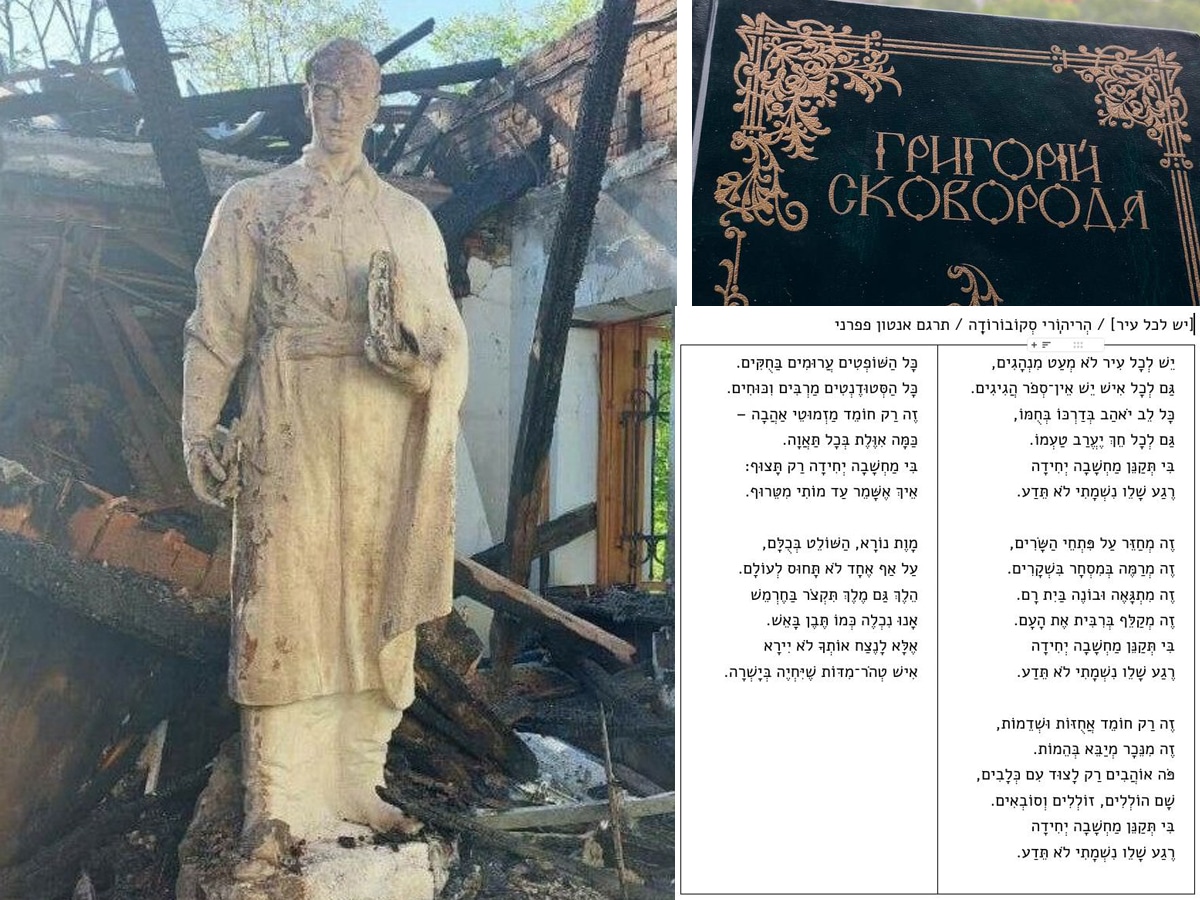
On May 16, 2025, Asaf Bartov announced that the Hebrew translation of Hryhorii Skovoroda’s poem “To Every City Its Custom and Law” has been completed.
“The war waged by Russia against Ukraine is essentially a war against Ukrainian identity and culture.
When Russians occupy a village, they, for example, burn Ukrainian books in local schools. This is hardly a strategic military priority — unless the true goal is to erase Ukrainian identity and forcefully dissolve it into a Russian one, treating Ukrainians as second-class citizens.On May 6, 2022, a Russian missile struck the Skovoroda Museum in the village where he was buried.
The museum was destroyed, although the statue of Skovoroda remained intact, and his portrait among the ruins became symbolic,” said Asaf Bartov.
We have already written about this project — The Israeli project “Nemala נְמָלָה”: enthusiasts bridge Ukrainian and Hebrew literature through translation, creating a cultural link between Israel and Ukraine
Asaf Bartov and Nataliia Tymkiv are also contributors to Hebrew Wikipedia, where they actively publish articles about Ukrainian culture and literature.
Hryhorii Skovoroda — Ukrainian Philosopher, Poet, and Educator
Hryhorii Savych Skovoroda (December 3, 1722 – November 9, 1794) was a Ukrainian philosopher, poet, teacher, thinker, and theologian, and one of the most important figures in the Eastern European intellectual tradition. He is often called the “Ukrainian Socrates” for his life as a wandering sage.
Biography
Skovoroda was born in the village of Chornukhy (now Poltava region, Ukraine) in a Cossack family. He received a classical education at the Kyiv-Mohyla Academy, where he studied theology, philosophy, and ancient languages. He traveled to Hungary, Austria, and possibly Germany as a member of a court choir. He taught at the Kharkiv Collegium but resigned due to disagreement with dogmatic approaches and pressure from church authorities.
Afterward, he led a life as a wandering philosopher, rejecting material wealth and positions, preaching ideas of inner freedom and spiritual integrity.
Philosophy and Language
Skovoroda opposed scholasticism and the spiritual oppression of Russian Orthodoxy. Inspired by the Bible and classical philosophy, he preached that true happiness comes from living in harmony with one’s inner nature and finding one’s “calling of the heart.”
The language of his works remains a subject of scholarly debate. His philosophical treatises were written in Slavic-Ukrainian (Slavenoruthenian), a variant of Early Modern Ukrainian with Church Slavonic influences. His poetry and fables were written in literary Ukrainian, and some correspondence was in Latin.
“To Every City Its Custom and Law”
One of Skovoroda’s most famous works is the tenth song from the collection “The Garden of Divine Songs” — a satirical and philosophical poem denouncing greed, hypocrisy, and moral decay in society.
גם לכל איש יש אין־ספור הגיגים.
כל לב יאהב בדרכו בחומו,
גם לכל חך יערב טעמו.
בי תקנן מחשבה יחידה
רגע שלֵו נשמתי לא תדע.זה מחזר על פתחי השרים,
זה מרמה במסחר בשקרים.
זה מתגאה ובונה בית רם.
זה מקלף בריבית את העם.
בי תקנן מחשבה יחידה
רגע שלֵו נשמתי לא תדע.זה רק חומד אחוזות ושׂדמות,
זה מנכר מייבא בהמות.
פה אוהבים רק לצוד עם כלבים,
שם הוללים, זוללים וסובאים.
בי תקנן מחשבה יחידה
רגע שלֵו נשמתי לא תדע.כל השופטים ערומים בחוקים.
כל הסטודנטים מרבים ויכוחים.
זה רק חומד מזמוטי אהבה –
כמה איוולת בכל תאווה.
בי מחשבה יחידה רק תצוף:
איך אשמר עד מותי מטֵרוף.מוות נורא, השולט בכולם,
על אף אחד לא תחוס לעולם.
הלך גם מלך תקצֹר בחרמש
אנו נכלה כמו תבן באש.
אלא לנצח אותך לא יירא
איש טהור־מדות שיחיה ביָשְרה.
Legacy for Ukraine
Hryhorii Skovoroda is one of the central figures in Ukrainian spiritual history. His philosophy — based on freedom, self-knowledge, and following one’s inner voice — has inspired generations of thinkers, poets, and defenders of Ukrainian identity.
He became a symbol of Ukrainian cultural independence, a philosopher who expressed universal truths in the language of his time, while remaining deeply rooted in Ukrainian tradition. In modern Ukraine, he is revered as a national genius, and his writings serve as a source of wisdom and moral guidance.
Works
During his lifetime, none of Skovoroda’s works were published — church censors found them “contrary to Holy Scripture” and “offensive to monasticism.” Only in 1861 was the first posthumous volume published in Saint Petersburg:
“Writings in Verse and Prose by Hryhorii Savych Skovoroda. With His Portrait and Handwriting.”
Key works include:
- “The Garden of Divine Songs” — a collection of metaphysical poetry
- “Kharkiv Fables” — philosophical allegories and parables
- “Narcissus,” “A Conversation Called Alphabet,” “Symphony” — philosophical dialogues and treatises
Legacy
Skovoroda became a symbol of spiritual freedom and inner independence. His impact on Ukrainian culture, philosophy, and literature is profound and enduring.
On his tombstone is engraved a phrase that became the motto of his life:
“The world tried to catch me, but didn’t succeed.”
This phrase symbolizes his path: to remain true to oneself, to resist vanity, and to preserve spiritual freedom until the end.
Translate Ukraine 2025
The “Translate Ukraine” government program, led by the Ukrainian Book Institute, continues to actively promote Ukrainian culture worldwide.
In 2025, the program will carry on. The list of works selected for translation into foreign languages includes 81 titles, featuring some of Ukraine’s most prominent authors.
One of the most notable projects is the translation into Hebrew, which will help strengthen cultural ties between Israel and Ukraine and promote Ukrainian literature in Israel.
As part of Translate Ukraine 2025, Ukrainian works will be translated into 25 languages across 28 countries. The largest number of translations will be into Polish (7), Spanish (6), Latvian (6), and Slovak (6).
Other translations include English (5), Arabic (2), Bengali (1), Bulgarian (3), Greek (2), Georgian (3), Hebrew (1), Italian (4), Chinese (1), Lithuanian (3), Macedonian (5), German (3), Portuguese (3), Romanian (2), Serbian (1), Hungarian (4), Finnish (2), French (4), Croatian (2), Czech (3), and Swedish (2).
NAnews: Ukraine continues to open doors to its literature for the world. In Israel, this plays a particularly important role in deepening cultural connection. Follow updates on NAnews — Israel News.