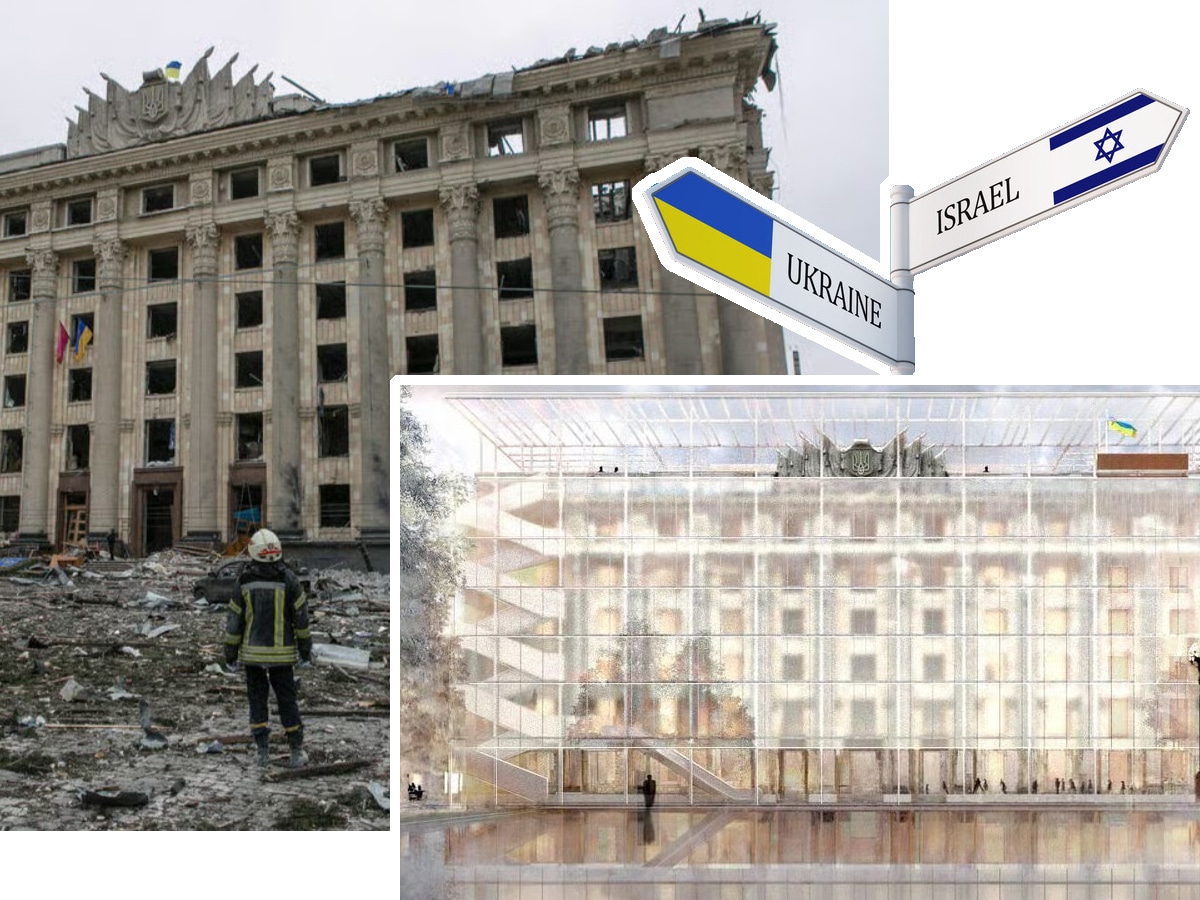
Freedom Square (Ukr. Maidan Svobody) is the central square of Kharkiv, ranking sixth in size in Europe and twelfth in the world. The square covers 11.9 hectares. During the Russian invasion of Ukraine, on March 1, 2022, the square was hit by Russian Kalibr missiles. The explosion caused significant damage to the Kharkiv Regional State Administration building (which was officially declared beyond repair in June 2022) as well as to nearby structures. On August 28, 2022, Russian forces shelled the same area again with S-300 missiles. One missile struck the square in front of the administration building, while another destroyed a three-story building nearby.
Israeli architects were among the top three winners out of 150 participants, presenting the In‑Time project to restore the Freedom Square in Kharkiv, devastated by Russian shelling. This project is a gesture of support to the Ukrainian people and an example of solidarity between Israel and Ukraine. This was reported by the Israeli portal Ynet on June 29, 2025.
You can view the competition brief here.
You can view the winners’ visualization here.

An architectural answer to war: how Israel is helping Ukraine in the heart of devastated Kharkiv
The international architecture award produced an unexpected and inspiring result: the Israeli architectural team JL+M Architects was named among the three winners of the prestigious Kharkov Freedom Square Revival competition, organized at the initiative of renowned British architect Norman Foster.
Their restoration design for Freedom Square and the Kharkiv regional administration building, destroyed during the Russian invasion, is not just a professional achievement but also an act of international solidarity with the Ukrainian people.
The Israel project: architecture as an expression of support
The winning Israeli entry, titled In‑Time, was created by architects Daniel Mintz, Yossi Hayu, and Daphne Dagan, with consultants Marina Epstein and Batia Malul. Their concept serves as a symbolic bridge between past and future, between pain and healing.
They explain that their decision to enter the competition was motivated not only by professional interests but, above all, by a sense of moral duty in light of Ukraine’s suffering.
“When the war began, I watched the news nonstop and saw the horrors unfolding there. It was unbearable,” says architect Daniel Mintz.
He noted that taking part in the competition was a kind of silent protest and, perhaps, an act of healing.
“Participating in the competition was our way of responding, processing, not standing aside. We couldn’t afford to sit this one out.”
Main design principles:
- Preserving the historic facade of the administration building
- Adding a new double-glass façade as a “shield” and symbol of transparency
- Redesigning interior spaces to create places for urban life
- Introducing a grand public fountain surrounded by trees as the square’s focal point
“We wanted to return the lost forests of Ukraine and let nature into this traumatized urban space,” says Daniel Mintz.
A personal story of the architects: from the USSR to solidarity
The project’s lead, Daniel Mintz, told Ynet that joining the competition was a deeply personal act:
“I was born in the USSR and understand Ukrainian language. Russia’s attack on Ukraine was intensely personal to me,” he said.
He emphasized that their participation was a quiet form of protest and a way to express their position.
Their partner Yossi Hayu added: “Our proposal is a sort of letter of solidarity from the people of Israel to the Ukrainian nation.”
Jury reaction and international recognition
The competition jury—featuring Moshe Safdie, Kharkiv’s mayor Igor Terekhov, and Ukrainian-Jewish historian Maxim Rozenfeld—praised the Israeli design. They highlighted the transparent façade as a powerful symbol of openness and a new beginning.
“The proposal demonstrates spiritual depth and a contemporary reinterpretation of historical heritage,” the jury concluded.
Key project takeaways
- The Israel entry was one of the three winning designs out of 150 architectural firms worldwide
- The competition was organized by the Foster Foundation, Kharkiv city government, and UNECE
- Participant identities were kept confidential throughout to ensure fairness
- The project is a humanitarian and cultural gesture of support from Israel to Ukraine
Who are JL+M Architects: an Israeli voice of solidarity through architecture
JL+M Architects is an Israeli architecture collective that won the international “Kharkiv Freedom Square Revival” competition for the renewal of Freedom Square and the regional administration building in Kharkiv.
Team composition:
- Daniel Mintz — founder and lead architect
- Yossi Hayu and Daphne Dagan — project partners
- Consultants: Marina Epstein and Batia Malul
The collective evolved from Mintz Melamed Architects, established in 2007, and was rebranded as JL+M for the competition, combining experience with fresh design perspectives.
Main facts about JL+M Architects:
- Founded: 2007 (as Mintz Melamed Architects)
- Based in: Tel Aviv, Israel
- Notable projects:
- The International Holocaust Education Center at Yad Vashem, Jerusalem (2010, 10,000 m²)
- The Israel Geological Survey, Givat Ram, Jerusalem (2020, 20,000 m²)
- The Museum of the Jewish People at Tel Aviv University (2021, 7,000 m²)
In the Kharkiv Freedom Square Revival competition, organized by the Norman Foster Foundation with UNECE and Kharkiv city hall, the architects submitted the “In‑Time” design. It features restored historic facades, a modern protective glass skin, new public spaces, and a return of natural elements to the city center.
The project was praised as a “message of solidarity from the people of Israel to the people of Ukraine” and recognized by the jury for its spiritual richness and modern acknowledgment of history.
Therefore, JL+M Architects is a Tel Aviv–based firm of international renown whose work in Kharkiv stands as an act of solidarity, humanitarianism, and architectural excellence.
This event is covered by NAnovosti — Israel News, which sees the project as a powerful symbol of unity between Jewish and Ukrainian peoples.