
NAnews presents a review of the podcast “BalachkI” with Michael Goldstein. The Ukrainian community in Israel and key topics — language, politics, volunteering, barriers for Russians, and relations between Ukraine and Israel.
The Ukrainian community in Israel: language, politics and breaking away from Russian narratives
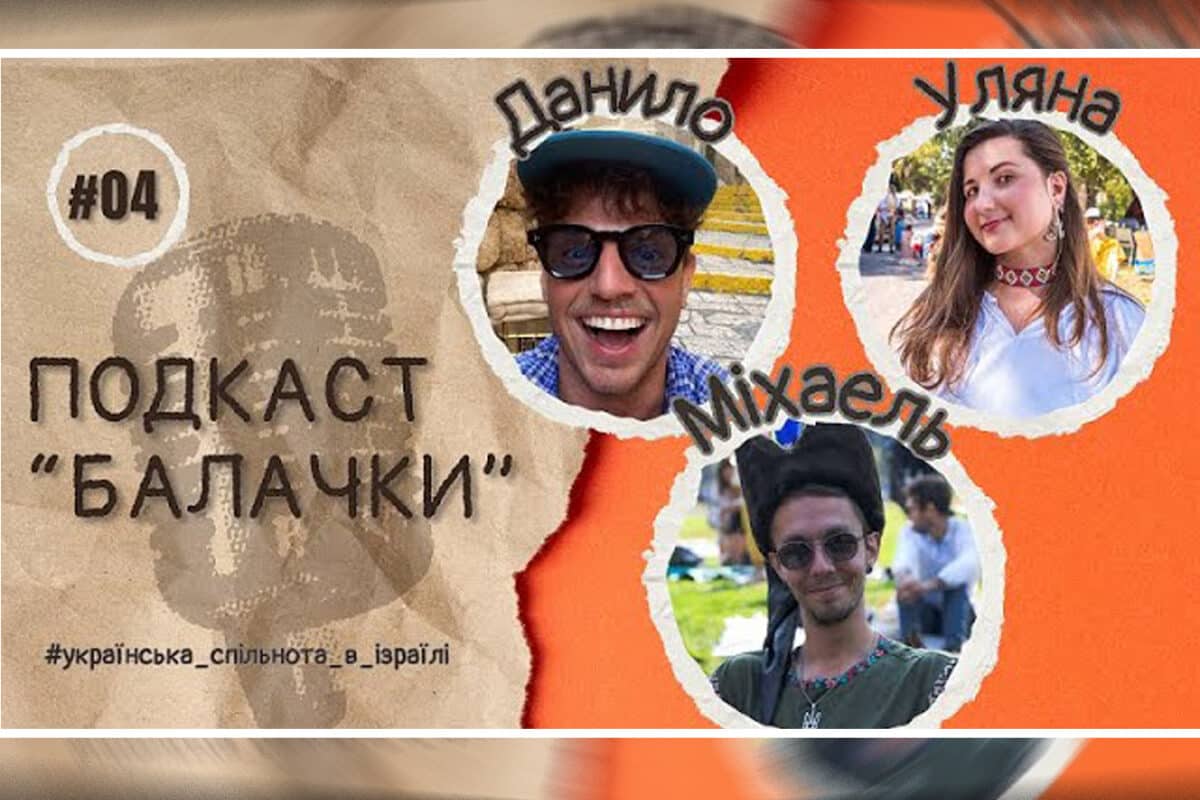
NAnews presents a new review: premiere of the 4th episode of the podcast “BalachkI” (premiere August 15, 2025), dedicated to the Ukrainian community in Israel.
The main guest is Michael Goldstein, political scientist, volunteer, and activist. The focus of the conversation is the issue of language, independence from Russian cultural and political influence, and an emphasis on Ukraine and Israel as the foundation for self-identification.
Who participates
The podcast “BalachkI” is hosted by:
Danilo Tsyporukha — founder of the creative space and café “The Picnic Player” in Jaffa;
Ulyana Dryuchkova — co-founder of “Українські Здибанки в Ізраїлі” and author of the channel UDM Israel.
The language issue as a principle
One of the key ideas of the episode is the rejection of “Russian-speaking” identity and strengthening the Ukrainian language in Israel. According to Goldstein, language helps separate from the “Russian world” and forms the basis for cultural and political self-awareness. For the Ukrainian diaspora in Israel, this is an important step: speaking Ukrainian means remaining part of the nation, even thousands of kilometers away from home.
“Українські Здибанки в Ізраїлі”
Special attention is given to the project “Українські Здибанки в Ізраїлі”, which unites people through conversations, lectures, meetings, and cultural initiatives. The channel UDM Israel became a platform for sharing experiences and supporting the army through donations. Meetings turned into a hub for Israelis, the new wave of repatriates from Ukraine, and Ukrainian refugees.
Cooperation with Russians: a dilemma
A sharp part of the conversation touched on whether the Ukrainian diaspora should cooperate with Russian “opposition forces.” Goldstein emphasized that true independence is possible only with complete rejection of such alliances. Otherwise, the Ukrainian agenda risks dissolving in “liberal” rhetoric, where Ukrainian interests are pushed “to the background.”
Politics, refugees and the Israeli context
Another block of the discussion was devoted to Ukrainian refugees in Israel. According to participants, the situation was paradoxical: in 2022, for every one Russian denied entry, up to five Ukrainians were refused. This was a real shock for the community. Israel, as the speakers stressed, “cares first of all about its own security and domestic policy.”
At the same time, the question was raised: can the Ukrainian community really influence Israeli politics? The answer was cautious: yes, if they unite, support pro-Ukrainian politicians, and form an agenda that Israel can understand.
Russian narratives and the “two chairs” policy
Goldstein focused separately on how Russian propaganda has taken root in Israeli media and politics. He noted that even after October 7, 2023, elements of “Russian explanatory schemes” remain in Israel. This is dangerous, as public opinion is vulnerable to manipulation.
Hence comes the phenomenon of the “two chairs policy” — attempts to balance simultaneously between Ukraine and Russia. For Israel, this may seem pragmatic, but for Ukraine, it is a painful blow.
Other important topics of the episode
Besides language and politics, the episode raised other issues:
- memories of the first years in Israel and the start of volunteering;
- the role of “Israeli Friends of Ukraine” in supporting Kyiv;
- the visit of Gideon Saar to Ukraine and the importance of pro-Ukrainian politicians;
- the “wall” in Israeli-Ukrainian relations;
- the Russian “occupation” of the Sergius Compound in Jerusalem;
- China’s influence on Israel’s foreign policy;
- the Russian trace in the attack on Israel on October 7, 2023;
- the activities of the “Israeli Anti-Nazi Front” (in the sense of “anti-Ukrainian”);
- what victory means for Ukraine and how to achieve it.
Conclusion and recommendation from NAnews
We at NAnews – Israel News present this episode as we understood it ourselves, relying on the highlights made by Michael Goldstein and the hosts. But the discussion turned out to be much broader: from personal stories to global geopolitics.
Recommendation: be sure to watch this and other episodes of the podcast on the channel UDM Israel. It is a living testimony of how the Ukrainian community in Israel seeks its place, defends its language and culture, supports Ukraine and Israel, and builds bridges with Israeli society.
Link to the video – https://www.youtube.com/watch?v=59lu7DHv2gI
By the way, everyone is invited — Ukrainian “Meeting under the Flags” in Tel Aviv-Jaffa on August 23, 2025, on Ukraine’s State Flag Day
