
The same question asked to ChatGPT multiple times can lead to different sources, different sites, and even different recommendations. New research has shown: it’s not just about the wording of the query. ChatGPT is capable of changing its internal search channel, classifying the question differently, and sometimes not even consulting the internet at all. For small and medium businesses in Israel, this means that one good website is no longer enough.
Not long ago, promoting a business on the internet seemed relatively straightforward.
A company would create a website, set up Google Maps, publish service pages, work on Google rankings, and launch ads.
Today, a potential client increasingly does not browse through ten websites.
They ask:
“Which lawyer to choose in Haifa?”
“Where to get a cosmetic procedure in Kiryat?”
“Who repairs air conditioners in Netanya?”
“Which company handles transportation across Israel?”
“Which specialist speaks Hebrew and Russian?”
And they receive a ready answer with several names from ChatGPT, Gemini, Copilot, Perplexity, or another AI assistant.
The main problem is that this list is not constant.
Today, artificial intelligence might name your company, tomorrow a competitor, and the day after might respond without searching the internet, using information the model received earlier.
NANews — Israel News explored what exactly researchers discovered, why ChatGPT results change, and how small and medium businesses in Israel can prepare for the new reality.
This is exactly what Nikk.Agency https://nikk.co.il/ helps small and medium businesses in Israel understand: from websites, Google Maps, and classic search to a new environment where the decision to choose a company is increasingly made not by a list of ten links, but by an AI assistant.
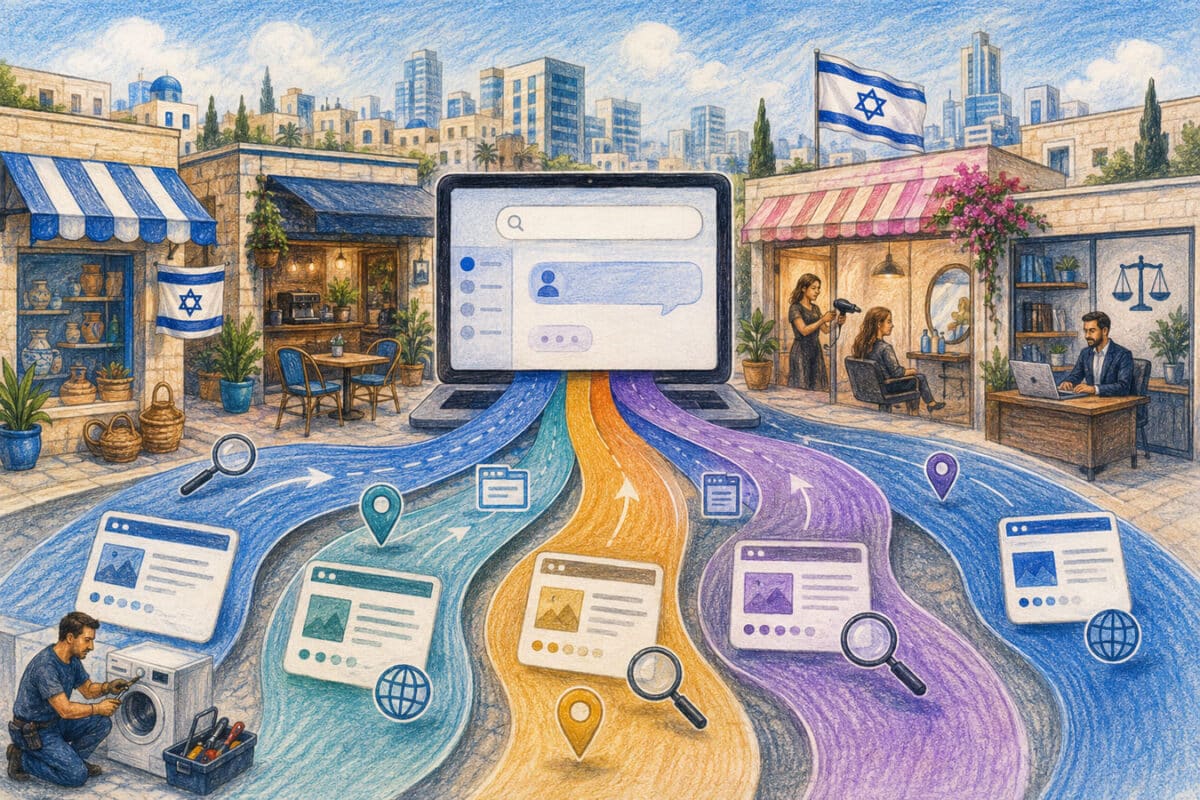
ChatGPT searches for information in more than one way
On July 8, 2026, Search Engine Land editor Danny Goodwin published an article based on research by search engine specialists Chris Green and Sugantan Mohanadasan.
Researchers discovered an internal field result_source in ChatGPT’s technical data.
It shows through which channel a specific web result was obtained.
In June 2026, four values were observed in this field:
- Labrador;
- Bright;
- Oxylabs;
- SERP.
Users do not see these names.
They do not appear next to quotes, in the source panel, or in the ready answer from ChatGPT. A person only sees the page the assistant referred to but does not know how it was found.
It’s important to understand: Labrador, Bright, Oxylabs, and SERP are not four ordinary search engines like Google or Bing.
These are technical labels for result acquisition channels.
Researchers linked Bright to the company Bright Data, and Oxylabs to the eponymous provider of web data collection infrastructure.
The exact role of Labrador and SERP has not been officially disclosed.
The initial assumption that Labrador represents an exclusively closed list of major licensed publishers was later corrected by Mohanadasan himself. During a recheck, small regional sites were also discovered through Labrador.
Meanwhile, OpenAI’s official documentation directly confirms that ChatGPT uses third-party search providers. Among the partners named by the company are Bing and Shopify. However, Bright Data, Oxylabs, Labrador, and SERP are not explained in OpenAI’s public documentation.
Four channels quickly turned into at least five
The research revealed another important thing: the system itself changes very quickly.
Sugantan Mohanadasan initially recorded four labels on June 23–24, 2026.
Already during a recheck on July 4, he discovered a different picture:
- a
bingchannel appeared; - Oxylabs disappeared from his account’s set;
- SERP started appearing again;
- the set of channels differed among users of different tariffs and experimental groups.
The researcher made a cautious conclusion: by early July 2026, at least five channels were observed, but they are not necessarily available to every user simultaneously.
For businesses, this means that it is impossible to check your company in ChatGPT once and consider the result final.
Even if today the assistant found a page and referred to it, tomorrow the query might go through a different information acquisition mechanism.
1000 queries showed how much sources can change
Chris Green conducted a more extensive check.
He prepared 1000 queries, each of which was run up to ten times.
A total of 9946 completed search sessions were obtained.
In his sample, the main channel most often became Labrador — 88.1% of launches. Next were Bright — 9.9%, Oxylabs — 1.7%, and SERP — 0.3%.
However, in 11.6% of queries, the main channel changed between repeated launches of the same question.
When this happened, the set of found pages changed especially strongly:
- the overlap of specific URLs decreased by about 45%;
- the overlap of domains decreased by about 42%.
In other words, after switching the search channel, ChatGPT saw a largely different internet.
This does not mean that every tenth user will necessarily see a completely opposite answer.
The study was conducted under certain technical conditions, and the data was collected through sessions associated with Bright Data. Chris Green himself warns that the results cannot be automatically transferred to all users, countries, tariffs, and ChatGPT models.
But the main conclusion remains important: ChatGPT does not have a single static output, analogous to the classic first page of Google.
There are different information acquisition environments here, and each of them can see a slightly different set of sites.
This is exactly what Nikk.Agency https://nikk.co.il/ helps small and medium businesses in Israel understand: from websites, Google Maps, and classic search to a new environment where the decision to choose a company is increasingly made not by a list of ten links, but by an AI assistant.
Sometimes ChatGPT does not search the internet at all
Switching channels is only one part of the problem.
Sugantan Mohanadasan discovered an internal field turn_use_case.
It is used for preliminary classification of the query.
Before starting the search, ChatGPT determines what type the question belongs to. Among the categories discovered by the researcher were search, local query, shopping, complex reasoning, image generation, and text.
The most important category for website owners is text.
When a query belonged to it, ChatGPT responded based on the model’s internal knowledge and did not conduct a web search.
In such a case, the company’s site does not lose to a competitor.
It does not participate in the selection at all.
OpenAI officially confirms the general principle: ChatGPT can independently decide that a question will benefit from internet information and automatically initiate a search. Additionally, the user can enable the search manually.
The problem is that the decision depends not only on the topic but also on the wording.
Two similar questions can be processed differently.
For example:
- “What is laser hair removal?” might receive an answer from the model’s internal knowledge;
- “Where to get laser hair removal in Haifa in July 2026?” is more likely to require a local and current search;
- “Which laser hair removal clinics in Haifa have current reviews and prices?” might trigger several separate checks.
Therefore, creating a page for a popular phrase does not guarantee that the AI assistant will even consult the internet for such a question.
One question can turn into dozens of hidden searches
During complex queries, ChatGPT does not always limit itself to one search phrase.
The model can reformulate the user’s question and break it down into a series of additional queries.
OpenAI’s official documentation provides a similar example: the initial question can be rewritten into a more specific search formulation, after which ChatGPT sends additional queries to other search providers.
Mohanadasan’s research showed that in deep reasoning mode, one comparative question can generate 15 to 40 additional queries.
The model separately searches for:
- the company’s official page;
- prices;
- service area;
- service characteristics;
- reviews;
- alternative providers;
- competitors the user did not even mention;
- confirmation of found figures;
- pages with terms, working hours, and contacts.
It can use queries like:
site:domain.co.il/pricing
company name reviews Israel
service Haifa price 2026
specialist Hebrew Russian Kiryat
official site working hours
Thus, the business competes not only on the client’s original question.
It simultaneously participates in dozens of small hidden checks.
Additional research by Semrush and Kevin Indig showed that the reasoning mode can indeed create a fundamentally different search environment. When comparing regular and deep responses, only 25.6% of cited domains matched. In complex mode, ChatGPT conducted almost five times more searches and more often referred to official documentation, government, and academic sources.
This is exactly what Nikk.Agency https://nikk.co.il/ helps small and medium businesses in Israel understand: from the website, Google Maps, and classic search to a new environment where the decision to choose a company is increasingly made not by a list of ten links, but by an AI assistant.
A found page does not yet mean it will be shown to a person.
Researchers have identified three different outcomes of a business’s presence in ChatGPT:
Page found.
ChatGPT received it and used it in the analysis, but the user did not know about it.
Page cited.
The link appeared next to a specific statement in the final answer.
Company mentioned.
The business name was included in the recommendation, but the source of information could have been a completely different page.
These are three different levels of visibility.
A company can be found but not cited.
It can be mentioned thanks to an article on an external site.
Or its own page can confirm the price, address, and hours of operation, while the final recommendation by ChatGPT is supported by reviews, a catalog, or an independent review.
That is why a simple check of “whether ChatGPT mentioned my company” provides too little information.
It is necessary to understand:
- by what formulations the business appears;
- in which city or area;
- in what language;
- which pages are used;
- which sites confirm the information;
- whether the company is the source or just a mention;
- whether the result is retained after repeated launches.
Why a clear page can beat a beautiful site
Research has shown that ChatGPT often tries to get facts from the official site.
This is especially true for:
- prices;
- list of services;
- product characteristics;
- geography of work;
- schedule;
- conditions;
- professional specialization;
- contact information.
But if the data is loaded with complex JavaScript, hidden in an image, published only in PDF, or located inside an inconvenient interactive block, the system may not read them.
In such cases, ChatGPT sometimes abandons the official site and uses an external catalog, review, or competitor’s page.
Mohanadasan recorded situations where the model tried to find the price on the official page, could not extract it, and switched to an external service.
It turns out to be a paradox.
The company itself determines prices and conditions, but artificial intelligence talks about it based on another site’s words — just because the other page is technically clearer.
OpenAI recommends not blocking the OAI-SearchBot search robot. The company reports that any public site can appear in ChatGPT Search, but guaranteeing the first place is impossible. To be included in the search, the site must be accessible to the search robot, and the server and protection system must not block the published IP addresses of OpenAI.
This is a basic condition, but not a guarantee of citation.
What all this means for small businesses in Israel
A large network can afford hundreds of mentions, a well-known brand, and large advertising budgets.
The situation is different for local Israeli businesses.
A lawyer, cosmetologist, repair company, private practice doctor, carrier, realtor, teacher, builder, air conditioning specialist, or small store often depend on a few key queries in a specific city.
If ChatGPT recommends only two or three companies, absence in the response can mean losing a ready client.
The Israeli market is especially complex, where the same person can search for a service:
- in Hebrew;
- in Russian;
- in English;
- in Ukrainian;
- with the city name;
- with the district name;
- with the phrase “near me”;
- via voice request;
- via ChatGPT, Google, Gemini, or maps.
Mechanical translation of one page into four languages does not solve this task.
People ask questions differently in each language.
This is exactly what Nikk.Agency https://nikk.co.il/ helps small and medium businesses in Israel understand: from the website, Google Maps, and classic search to a new environment where the decision to choose a company is increasingly made not by a list of ten links, but by an AI assistant.
Even city names can be written in several variations: Haifa, חיפה, Хайфа; Rishon LeZion, ראשון לציון, Ришон-ле-Цион.
The AI assistant needs to clearly understand:
- what the business is called;
- where it is located;
- which areas it serves;
- in which languages it operates;
- what specific problem it solves;
- how to contact it;
- how it differs from similar companies;
- which independent sources confirm its existence and reputation.
What Nikk.Agency can do
Amid such changes, it is impossible to honestly promise a business “eternal first existence and reputation.”
What Nikk.Agency can do
Amid such changes, it is impossible to honestly promise a business “eternal first place in ChatGPT.”
Even OpenAI directly states that guaranteeing the top position is impossible.
Therefore, Nikk.Agency’s task is not to sell a magic button, but to build the digital presence of a business so that search engines and AI assistants have more grounds to correctly find, understand, verify, and recommend the company.
Nikk.Agency is physically located in northern Israel and primarily works with small and medium businesses across the country.
The agency is engaged in SEO promotion, lead generation, Google Ads, Google Maps, website repair and development, as well as separate projects for business presence in responses from ChatGPT, Gemini, Googleaude, and other systems. Work is conducted in Hebrew, Russian, Ukrainian, English, and other languages.
Practical work can include several stages.
Checking what artificial intelligence sees now
It is not enough to ask ChatGPT the company name once.
Requests need to be checked:
- in different formulations;
- in different languages;
- with and without city indication;
- in normal and deep mode;
- on different days;
- with repeated launches;
- on informational and commercial issues;
- separately in ChatGPT, Gemini, Copilot, and other systems.
This way, you can see not a single beautiful answer, but a real picture of visibility.
Analysis of the site and access of search robots
Checked:
- robots.txt;
- access of OAI-SearchBot and other necessary robots;
- page indexing;
- operation of protection and CDN;
- mobile version;
- speed;
- HTML structure;
- presence of important data in readable text;
- correctness of titles, contacts, addresses, and language versions.
If the price, work area, or specialization exists only inside a picture, AI may not see them.
Creating clear service pages
Each important service should be described not with advertising slogans, but with specific facts.
For example:
- what exactly the company does;
- in which cities;
- for whom;
- how much it costs or what the price depends on;
- how the work is carried out;
- how long it takes;
- in which languages service is available;
- where to call or write;
- what documents, restrictions, or conditions exist.
Such a structure helps both people, Google, and AI assistants.
Preparation for hidden additional requests
If a user asks “which lawyer to choose in Haifa”, ChatGPT can separately check specialization, language, area, reviews, working hours, and the official website.
Therefore, a business needs not just one general “About Us” page, but a connected system of materials, each answering a specific question.
Working with Google Maps and a unified digital contour
For a local business, the site should not exist separately from Google Maps, directories, social networks, and independent publications.
The name, address, phone number, working hours, and specialization must match.
When one site lists one company name, Google Maps another, and Facebook a third phone number, the system finds it harder to understand if it’s the same business.
Independent mentions
A personal site well confirms official facts.
But recommendations are often also based on external sources.
Therefore, important are:
- publications in the media;
- professional directories;
- thematic reviews;
- genuine reviews;
- partner mentions;
- expert comments;
- local Israeli platforms;
- materials in the target audience’s languages.
It’s not about buying hundreds of meaningless links.
One informative page with a clear business description can be more valuable than dozens of automatic directories.
Measurable requests and understandable KPIs
On the Nikk.Agency service page for promotion in AI assistants, it is stated that the work is built around an agreed list of requests, geography, and verification protocol, not around the subjective impression “it seems we are being shown more often”.
The digital contour and public digital contour, repeated checks, and iterative work until the evaluation of agreed indicators.
For one business, an important result will be appearing for a request in Hebrew in Haifa.
For another, a correct service description in Russian in Ashdod.
For a third, mention in a comparative ChatGPT response throughout Israel.
There is no universal list of requests for everyone.
New search requires not one-time optimization, but constant monitoring
The main conclusion of the July studies is not that promoting in ChatGPT is impossible.
It is different: AI visibility cannot be measured by one request, one screenshot, and one successful response.
The system is capable of:
- not launching a search;
- changing the wording;
- choosing another channel for obtaining results;
- finding another set of pages;
- switching to deep reasoning mode;
- using an external publication instead of the official site;
- finding a company but not quoting it;
- mentioning a brand without using its site as a source;
- changing behavior after another update.
Therefore, a business needs not an attempt to “trick ChatGPT”, but a solid digital foundation.
- A clear site.
- Accessible pages.
- Unambiguous facts.
- Current contacts.
- Local attachment.
- Several languages adapted for the Israeli audience.
- Independent confirmations.
- Regular checks.
Connecting visibility with real inquiries, calls, and WhatsApp messages.
This is exactly what Nikk.Agency https://nikk.co.il/ helps small and medium businesses in Israel understand: from the site, Google Maps, and classic search to the new environment where the decision to choose a company is increasingly made not by a list of ten links, but by an AI assistant.